New year, new beginnings... I hope!Happy 2018 to everyone! |
|
Nouvel an, nouveaux départs.... on espère!Bonne et Heureuse 2018 à tout le monde! |
First Recording with Cecilia!It's really rewarding when people say "Robin, I loved your playing before, but this new oboe takes it to even greater heights!", especially when some of them are also musicians with a well discerning ear. That's what I've been hearing since I started playing Cecilia in public! |
Premier enregistrement avec Cécile!C'est vraiment chouette d'entendre : "Robin, j'aimais déjà t'entendre jouer, mais avec ton nouvel hautbois, c'est un passage à un niveau bien supérieur!", surtout quand quelques-un qui le disent sont aussi musiciens avec une oreille bien au courant. C'est ce que j'entends depuis que je joues Cécile en public! |
|
| I don't know why, but the culture from the 1st Nations of South America really fills me with a sense of prophecy and a timelessness. So at the risk of appropriating a culture that is not mine, for my first recording with Cecilia (my new Musa oboe by Bulgheroni) I like the idea of playing this Peruvian lament for unaccompanied oboe. The Lamento Andino by Teofilo Alvarez Alvarez (Peru, 2015) is just plain haunting and a real joy to play. Nothing really difficult and very few expression markings: the performer is free to play it as you feel it. |
|
Je ne sais pas pourquoi, mais la culture des 1ères Nations de l'Amérique du Sud me remplissent d'un sens prophétique. Alors au risque de m'approprier d'une culture qui n'est pas la mienne, pour mon premier enregistrement avec Cécile (mon nouvel hautbois Musa par Bulgheroni) j'aime l'idée de jouer cette lamentation péruvienne pour hautbois seul. Le Lamento Andino par Téofilo Alvarez Alvarez (Pérou, 2015) est simplement mystifiant et un vrai régal à jouer. Rien de vraiment difficile et peu écrit outre les notes: on peut le jouer comme on le ressent. |
| This is definitely the video I spent the least time recording and post-processing ever. The first take was good, and then I just did the very minimal noise-reduction: there's the video! Of course, I want to show-off how easy Cecilia makes the altissimo register (the main reason I chose Bulgheroni) but the Lamento only goes up to 3rd ocatve E (jumping from a low A, in one case) so this is not a show off tune. But I really wanted to start the New Year with a recording, and I am just not ready to do the Claude Bolling tunes that go up to A and Bb. |
|
Parmi toutes mes vidéos jusqu'à date, j'ai passé le moins de temps sur celle-ci. La première prise était bonne et je n'ai appliqué que le minimum de réduction de bruit. Bien sur, je voudrais vanter le sur-aigü (c'est dailleurs la raison principale pour laquelle j'ai choisi Bulgheroni) mais le Lamento ne monte qu'au mi du 3e octave (sautant d'un la grave, dans un cas) alors ce n'est pas la pièce la mieux choisie. Mais je veux vraiment commencer l'année avec un enregistrement et je ne suis simplement pas prêt à faire le Claude Bolling qui monte jusqu'au la et si bémol. |
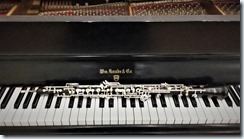
| Here is also a recording of a tune I played with choir, handbells and 9-foot grand piano. It is an excerpt from a flute part, and it sounds more like it should have been scored for piccolo: it really sounds like a fife-and-drum tune that you would have expected in the 1800's. It only goes up to 3rd octave G, but it stays between D and G for possibly 1/3 or more of the notes, making the number (appox. 10 times the length of the excerpt) rather demanding. Even more difficult is going back down to a "normal" register - restoring a good sound when jumping ranges is not an easy thing on many makes of oboe: I find Bulgheroni takes care of the sound, so I don't have to work so hard. |
|
Voici aussi un enregistrement d'une pièce que j'ai jouée avec choeur, cloches à main et un piano à queue de 3 mètres. C'est un extrait de la partie de flûte qui aurait mieux été donnée au piccolo: ça sonne vraiment comme une pièce pour fifre-et-tambour du XIXe siècle. Ça ne monte qu'au sol sur-aigü, mais possiblement le tiers des notes restent entre le ré et le sol du 3e octave, ce qui rend le morceau (environ 10 fois la longueur de l'extrait) assez exigeant. Encore plus difficile est le retour au registre "normal" - reprendre le timbre en sautant les registres n'est pas chose simple sur plusieurs marques de hautbois: je trouve que le Bulgheroni s'occuppe du timbre, m'épargnant un nombre de soucis. |
| The really nice thing about my new oboe is that I can use a reed that would normally be very metallic and buzzy (in my Ol' Faithful Lorée) and still sound relatively nice: the buzz is still there, but it becomes a nice "pastoral" quality which I feel comfortable to present to a discerning audience. This allows me to play with easier reeds, a real bonus owing to the fact I only practice 30 minutes a day: not enough to develop much strength of embouchure. I keep switching between instruments often and the verdict is clear: bad reeds are still bad, but with Ol' Faithful, even really good reeds would require considerable effort to play well. Conversely with Cecilia, when there is a problem with the reed, it is CLEARLY the reed which is at fault: decent reeds make playing easy and good reeds make playing a real pleasure. |
|
Une bien belle chose de mon nouvel hautbois est que je peux utiliser une anche qui sonnerait normalement nasillard (dans ma Vieille Branche de Lorée) mais toujours conserver un timbre relativement plaisant: le "buzz" reste présent, mais devient une qualité "pastorale" qui me laisse à l'aise de jouer devant un auditoire érudit. Ceci me permet de jouer des anches plus faciles; un atout, considérant que je ne répète qu'en moyenne 30 minutes par jour: pas assez pour développer l'endurance. J'alterne souvent entre les instruments et le verdict est clair: une mauvaise anche reste mauvaise, mais avec ma Vieille branche, même une bonne anche exige une effort considérable pour bien jouer. À l'inverse, avec Cécile, si l'anche est le problême, c'est clair et net où se trouve la faute: les anches raisonnables jouent facilement et les bonnes anches rendent le jeu un régal. |
BYE-BYE year of the split reeds!One last thing I did much less of, in 2017, is making reeds! It's enough to make me start believing in curses! Since the summer, I feel like more of my reeds have split from tip to staple than in all my oboe life before! Old reeds, but more frustratingly new reeds too, would split. Often, these cracks are not visible, but definitely there. The tell-tale signs are they would sometimes sound buzzy but always play flat ... Test by inserting a plaque and gently lift: CRACK-SPLIT from tip down to the thread. One reed was playing really nicely and sounding sweet too, but I just could not get it up in tune, always 1/4 tone or more flat: it was so good I decided to trim the 47mm staple to 45mm. That helped, but not completely: then the predictable split happened! |
ADIEU année des anches fendantes!Une dernière chose qui m'a vraiment manqué en 2017 est la fabrication des anches! C'est assez pour me faire croire aux sortilèges et aux malédictions! Depuis l'été, il me semble qu'autant d'anches ont fendues que dans le reste de ma vie hautboïstique (comme on dit au Québec: c'est fendant)! Vieilles anches, mais encore plus frustrant, aussi les nouvelles qui s'annonçaient bien, une après l'autre. Le signe annociateur est que l'anche joue trop grave (parfois un timbre nasillard) et que rien ne semble pouvoir le monter. On vérifie en insérant une plaque puis lever doucement: CRAQUE du bout jusqu'au fil. Une anche ne voulait pas monter, mais elle jouait si bien que j'ai coupé le tube de 47mm à 45mm. Ça a aidé, mais pas complètement: ensuite, la fente prévue! |
|
| As a result, I had to play the Marcello Concerto in October and my Christmas performances on reeds I had scraped in the spring and used at IDRS to evaluate the oboes and choose which one to buy. | Par conséquent, j'ai joué le concerto de Marcello en octobre et mes présentations de Noël avec une anche grattée au printemps; une qui m'a servie à la conférence IDRS pour évaluer les instruments et faire mon choix d'achat. | |
| But one big problem I had with reeds was my own fault: I had been tying lots of reeds over the past couple of years with whatever gouged and pre-shaped cane I had left: I did not test for cane quality at all, not even flatness/straightness (my pet peeve). I think the last time I gouged cane was in 2015. So clearly, most of my reeds were predictably hard to blow because the cane was just too soft and/or curved the wrong way. | Mais une grande part du problême est de ma propre faute: au cours des dernières années, j'ai utilisé beaucoup de roseau "restant": acheté gougé-taillé ou bien que j'avais gougé mais délaissé auparavant. Je ne me suis pas soucié de la qualité du roseau, même pas qu'il soit plat/droit (mon point sensible). Je crois que la dernière fois que j'ai gougé le roseau était en 2015. Alors clairement, la majorité de mes anches était prévisiblement dures à souffler simplement parce que le roseau était trop veineux et/ou courbaturé. | |
| It's little wonder I spent 3 days over the holidays shaping and tying 26 pieces of cane (I hope the grain is better). I hope to be able to take more time this year to gouge cane and select it better ... I like to experiment, but I find time is becoming hard to muster. | Donc pas surprenant que j'ai passé 3 jours, pendant les fêtes, à tailler et monter 26 morceaux de roseau (espérons que le grain soit meilleur). Souhaitons-moi une fin-de-semaine à gouger le roseau puis mieux le sélectionner ... je me plais à expérimenter, mais le temps devient rare. | |
2017 Strange YearI really can't explain why, but this year has been strange. Apart from one extra programming contract I took (work at home in evenings and weekends) I was not overly busy. But yet I have accomplished much less than in the previous 3-4 years. |
2017, année étrangeJe ne saurais expliquer pourquoi, mais cette année était étrange. À part un contrat de programmation (le soir et les fins-de-semaine) je n'était pas particulièrement débordé. Mais il me semble que j'ai accompli moins que dans les 3-4 années précédentes. |
|
| I don't like blogging about my pains, but one of the original purposes of this blog was to encourage other musicians who persevere in the face of real physical obstacles. In fact, during the year, I have learned that some people I've known for awhile already suffer more than I do with much more serious afflictions than mine: severe arthritis, multiple sclerosis and more. In fact, typically women suffer fibromyalgia with much more pain than I can complain about for myself. But I was told that describing my adventure helps lift the spirits of others. | Je n'aime pas décrire mes maux, mais un des buts initiaux de mon blogue est d'encourager d'autres musiciens à persévérer devant leurs obstacles physiques. Au fait, pendant l'année, j'ai appris que certaines connaissances souffrent bien plus que moi: arthrite sévère, sclérose en plaques et d'autres afflictions. Même que les femmes souffrent habituellement plus de la fibromyalgie que ce que je puisse m'en plaindre. Mais on m'a dit que décrire mon aventure aide à garder le vent dans les voiles. | |
Dedication:Fibromyalgia hit me hard in 2017. It is often called an auto-immune syndrome because inflammation is essentially the over-production of white blood cells. But one American Facebook friend has a an auto-immune so bad, her body actually rejects food. So I would like to dedicate this post the this friend: may the determination of the Peruvian tune recording and the good vibes carried by the community carry you to good health! I have resumed physiotherapy because the "big pains" came back with real consequences: since the summer, headaches (occipital neuropathy) caused by muscle strain in back of the head have been relentless. Also, one shoulder is popping and crunching almost all the time. The physiotherapy emphasizes the need for strength training in the shoulder blade area, but there is a problem: when I train for strength, fibromyalgia flares up... Although Tai-Chi still remains the best relief, I have been taking more pain relievers than previous years: and the pills drain me of stamina. I mostly feel exhausted and frustrated because I can't "just live a normal life". |
Dédicace:La fibromyalgie m'a frappé fort, en 2017. C’est souvent inclus en tant que syndrôme auto-immunitaire parce que l’inflammation est essentiellement la sur-production de globule blanches. Mais une amie Facebook américaine en est affligée au point que son corps rejette la nourriture. J’aimerais alors lui dédier cet article: que la détermination dans l’enregistrement de la pièce Péruvienne et la bonne volonté qui suit cette communauté te mène à la bonne santé! J'ai repris la physiotherapie parce que le pire des maux est revenu avec de vraies conséquences: depuis l'été, j'ai souffert de maux de tête (neuropathie occipitale) sans relâche causés par des tensions musculaires derrière la tête. Aussi, une de mes épaules donne l'impression de gravier à tout mouvement. La phisiothérapie met en évidence un besoin de me renfrorcer les omoplates mais l'entraînement entraîne aussi les attaques de fibromialgie... Bien que le Tai-Chi offre le meilleur soulagment, je prends bien plus de médicaments contre la douleur que les années passées: ceux-ci me siphonent l'énergie. Je suis surtout épuisé et frustré de ne pas pouvoir simplement "vivre une vie normale". |
|
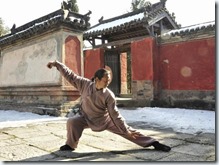
All the more reason to focus on music and the oboe. All these complaints make it difficult to seek out people to play with, but then playing with groups also takes time away from personal goals. For sure, this coming year, I need to practice technique for sound much more than I have in the past several years - back to basics in order to solidify the foundation for the repertoire I am aiming for. So I guess my hopes for 2018 would be: 1. focus more on Taijiquan for fitness |
 |
Raisons de plus à travailler la musique et le hautbois. Toutes ces plaintes ralentissent la quête à trouver d'autres avec qui jouer, mais jouer avec des groupes m'enlèverait le temps de viser mes propres buts. Je dois travailler la technique sonore beaucoup plus que je ne l'ai fait, ces dernières années; un retour aux bases pour solidifier les fondations en vue du répertoire que je vise. Alors je suppose que mes souhaits pour 2018 seraient: 1. me centrer sur le Taijiquan pour la forme physiques |
| May 2018 bring you all fulfillment in your artistic, social and physical lives! | Que 2018 vous apporte tous l'épanouissement artistique, sociale et physique! |
Thursday, January 4
HAPPY / BONNE 2018 !





Sunday, December 10
IDRS 2017: changing impressions–how to choose?
Chers lecteurs francophones: je vise toujours le bilinguisme mais le temps et l'envergure de cet article sont tout simplement trop des facteurs limitatifs, étant donné que la très grande majorité de mes lecteurs sont anglophones. J'en suis désolé et je vous remercie de votre compréhension. Entretemps, copier-coller l’adresse dans le traducteur Google donnera une traduction … enfin, je ne sais pas à quel point ça marche, mais ce sera traduit!
Wow, I've had my Bulgheroni Musa (Cecilia) now for over 5 months ... but I have hardly blogged about her yet, no You-Tubes either. It would be perfectly reasonable for someone to believe that this proves disappointment or buyers remorse .... sorry to disappoint you, but no, this is not the case: I am really happy with Cecilia! I’ll explain when I post my first recording with Cecilia how this year has just been very odd – fatigue and timelines just played against me. First week of December, I played the Marcello concerto with reeds I made last spring … not even time to take a good picture with Cecilia yet!
I am now taking her for granted ("Of course this is how I sound!") and I'm finding it increasingly difficult to play Ol' Faithful (1985 Lorée) much anymore. Oddly, this Bulgheroni has the same effect as Smiley (an old Marigaux SML I had borrowed for 4 months): playing it makes me sound much better on Ol' Faithful, despite the mismatch. But returning to Cecilia immediately reminds me why I bought her. My Lorée does have its charms and SOME reeds actually sound better on Ol' Faithful, but I always find it easier to play my Bulgheroni.
Choosing a new instrument?????
With Christmas time upon us, parents of oboe students will be looking for a potential instrument they could buy for their budding musical artist. This brings the nervous question "What is the best oboe?", because the price of this instrument can be prohibitive, so parents with tighter means (or students preparing for college) will want to be sure they don't make a mistake and need to buy something else in a year or 6 months!
Please note that everything in this post are my own opinions. I encourage people to test-compare instruments for themselves and form their own opinions: if we disagree, all the better! By discussing our differing views, we promote more variety and open doors.
The first thing I can say is that, today's serious market (avoid the cheap copy makers) rarely has outright bad instruments (with real design or construction flaws) and even the used instrument market (if you stick to well-established makers) will yield instruments that will play really well - assuming you purchase from a reputable reseller or have it repaired by a well appreciated oboe specialist.
It doesn't matter if you the parent of a high-schooler, an adult enthusiast or even a professional, there are 3 factors involved in choosing an instrument:
- Which instruments are available?
- What can you afford?
- How does the instrument fulfil your physical needs and artistic goals?
For me, available instruments boil-down to whatever is at IDRS conferences, but for most people, it will be the closest big-city music shop, and in the USA or Europe, that is usually quite good. You really want instruments that you can try yourself, or at least have tried by a respected teacher or performer. Even if one maker's characteristics can be predicted at 85%, the remaining 15% is enough to cause serious annoyance OR to find an absolute treasure! No two instruments from the same maker play the same and selecting used or even new by internet descriptions is risky because there is just no way to know in what state of repair and adjustment the instrument will be.
Concerning affordability, even with professional or passionate amateurs, it would be incredibly naïve to think that instrument characteristics alone will motivate the final purchase. Unless a buyer is wealthy, price will always factor-in to the decision. Don't be fooled by people being doctors or lawyers or engineers or any well paid profession: there is the phenomena of "double-income bankruptcy" that any responsible adult will seek to avoid! Luckily, regardless of the characteristics you favour (sound, phrasing, mechanics) there are always different makers with enough overlap in them to give you some choice, and different vendors will list competitive prices.
And finally, instrument characteristics, this is where experience is everything. For most students, you really should not worry too much about blogs like mine and other reviews that describe what instruments do: there really is very much to develop in terms of controlling tuning and sound and technique that most reputable instruments will serve the purpose quite well. It takes years to build physical technique and find your artistic goals, both of which will end-up determining the instrument you will ultimately want.
Do not fall into the trap of listening to your favourite oboist and thinking "if I get her/his oboe, I can sound like that too" - this is not true! For example, at IDRS 2017, the featured Mönnig player had essentially the opposite sound from Albrecht Mayer, though they both played the same model instrument! It is not necessary to have all the bells and whistles when starting, so give it time and enjoy the journey to get there!
Oboes at IDRS 2017
With that in mind, I want to say more about how my preferences had changed at IDRS last summer. My thoughts on general comparison between instruments remain reasonably the same, but which instruments I prefer have shifted: this surprized me and I think it is significant: it emphasizes that the instrument that is right for a person right now (even as a very skilled and experienced musician) might very well not be the preferred one in a few years, as the body changes with age and as habits (and goals) change with focus repertoire and aesthetic preference.
I really don't think the instruments (of the same model) have changed very much, so this leads me to believe that a musician may favour different qualities in the instrument as personal abilities and conditions evolve over time. For this reason, I will not mention makers where my impressions remain the same (e.g. Laubin, Püchner, Rigoutat, Dupin, Ludwig Frank, Covey, Yamaha, Lorée, Patricola); you can see my previous posts for that (click here). Instead, I want to focus on brands where my tastes have changed.
First example: Fossati.
This one struck me. At IDRS 2013 and 2014, I clearly preferred the A model, even though it is their least expensive from the professional Fossati line. At the time, their representative explained to me that the A model is their "entry-level" professional instrument: the S and MB models are better suited to professionals who naturally "work the sound harder". At the IDRS this year, I clearly preferred the S model: I really preferred the way it handled breathing and the flexibility of its tone.
They had a violetwood S model that completely stole my heart. The one and ONLY reason it did not make the list of my 3 favourites is because the altissimo (above 3rd octave G) was more difficult than the other 3 makers. Otherwise, I completely fell in love with it and nearly bought it on the 1st day! Compared to the black granadilla S, the violetwood allowed me to relax my entire embouchure (the actual jaw) that much more to get the sound that I was aiming for. It is very difficult to explain: it is entirely a matter of how it interacts with the body for sound production.
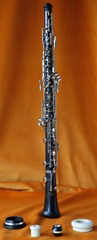
Fossati has innovated an oboe with interchangeable crowns and bell bottoms ("swells"?). Obvious question: does changing the parts really change the sound? Short answer: yes it does. Long answer: the white plastic crown and bell swell does give a more mellow sound, very appropriate for baroque repertoire. The black crown and swell provide a proper modern orchestral tone. I did not notice a difference between the black and black + metal ring, but it was not possible for me to do so: the purpose is to increase projection in concert halls.

Second example: Buffet Crampon.
I have always loved the sound of the Orfeo, but Buffet in general used to leave me uncomfortable in the airways while blowing, especially the "standard" Prestige model. This time, every single Buffet they had on the table pleased me completely. I would have been fully happy to bring home any one of the Buffets on display.
The Orfeo is still my favourite because of its rich, deep and enveloping tone, but the Prestige was also pleasant to play. At the Gala concert, one artist played the Orfeo with the usual American reed and delivered a performance with as much verve, spirit and lively contrast as I would expect from European oboists!

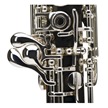
Buffet Crampon's new Virtuose is really the talk of the town, featuring a bell cut below the last holes, so they can be easily changed to different woods. Yes, changing the bell does change the sound. With a variety of woods and composite materials, you really have a rainbow of sounds at your fingertips: without changing reeds! They were showcasing a neon-green bell that was actually 3D printed: this one essentially made it sound like a Lorée AK (when I tried it). The mechanics are really different: same fingerings, but MUCH more work on ergonomics and click prevention. This is something you really can only appreciate over time: more than a few days at a conference. It just feels a little bit too much like a Lorée to my taste: many people will like this, but this is something I am trying to move away from.

The lower joint is cut just below the D key instead of between the hands. Normally, this intends to improve the tuning of Ab down to F. I did not notice any difference in tuning between the Virtuose and the Orfeo, but these are things you normally notice at home or in the concert hall: in other words, it is intended as insurance against Murphy's Law!


Alain Vlamynk did a couple of excellent posts on the Virtuose on his blog. Click here. It’s in French only, but you can always copy-paste the URL to his website in Google Translate!
Fox Sayen & Fox-Laubin
To my personal taste, Fox still shows resistance to my air flow, but that's a personal thing because WOW, what a nice instrument! Talk about perfect tuning and stability combined with a glorious sound: that's the Sayen! Almost all the Foxes with 3rd octave key allowed me to play up to the Bb with just as much ease as the Bulgheroni I finally bought! So for most American players of any skill level that prefer a more reserved air stream, the Fox Sayen is a really interesting candidate!
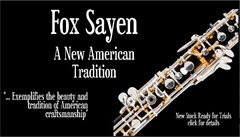

The new Fox-Laubin is essentially the same (to my taste) as the Sayen, but with more free-blowing allure, as we'd expect from a Laubin. It is not a Laubin and it is not a Sayen: this is a case where you really have to try it and decide for yourself.
Differing views on Howarth:
They did not have any XM models with them: too bad because I really did love those the best in New-York. I used to say every XL played the same, but this time I felt the sound (for the XL an LXV) was more vibrant (shaky) than before, thus requiring a more focused and restrained reed. This is excellent for American-scrape reed players or "better behaved" European scrape reeds. I really like my reeds to be wild in order to get the dynamics and articulation contrast I seek. When I tried to play above altissimo G - no luck at all - I was recommended to try their 21st Century model (they had none there on site) which is apparently designed for a better 3rd octave range.
Old heart-throbs: Mönnig & Marigaux
I was really, truly hoping to love the Mönnig Albrecht Mayer model. I was really hoping to find a used one and buy it. Problem is, I confirmed my very first impressions from the very first time I tried it in New York it is a remarkable instrument, but requires a more solid professional player than me. I found the 2nd octave key range sounded crystalline and thin; but I have been told by professionals who play it that this becomes full and rich as one develops the strength to play it properly. Similarly with the altissimo, I could not break the G barrier: this was the deciding factor telling me I could just not buy this instrument. Too bad, because the sound from 1st octave key notes all the way to the bottom is downright mythical!
In particular, one individual Mönnig, straight off the airplane from Berlin, had very special pads. Cork pads were covered with silicone: I found it vibrated and tickled the fingers when playing. Some people do not like this but I loved it! The vibrations/tickling in the fingers makes it feel like I'm that much more a part of the music I'm playing.
Similarly I was really, truly hoping to fall in love with the Marigaux M2. But I can't shake it, the body and bore of the 901/2000 models are just much better suited to my habits and my goals at this time. It is believed (remains to be proven) that many Lorée players (like me) or similar instruments eagerly adopt the 901 whereas the M2 is preferred by people who already play Marigaux, or another instrument with the qualities to the 901. .... This raises an interesting question: if changing preferences is a trend that will continue over the next 5-10 years, now that my Cecilia is very different from Ol' Faithful, could it be possible that I too will migrate to the M2 in the future?
My opinion has not changed: Marigaux has proven it's worth in Ottawa and Montreal in every kind of weather I can think of, even over 4 months comparing. So for me, to buy a Marigaux 901 or 2001 would have been the safest choice.
Playing safe or adventurous risk?

In comparison, for me, choosing a Bulgheroni was taking a risk because I could only try Bulgheroni at IDRS conferences. Even though Bulgheroni was not time-tested at home, its rich warm and large sound qualities answer what I have been aiming for as long as I can remember. Furthermore, every single Bulgheroni I tried, Musa, Opera, even their student models played up to the altissimo Bb without any effort at all, using my favourite reeds!
Bulgheroni has a decent market for student models in the USA, but mostly in Europe. Their professional models (Opera and Musa) are not new, but they are not marketed with as much intensity as Lorée or Marigux or Bufet or Yamaha, and they don’t have any big-name promoter-artists, so they are nowhere near as well known. But since this summer, Christian Schmitt (very well known in Europe and also known as a Rigoutat artist) has taken on the mantle. At IDRS 2017, after I bought Cecilia, I quickly met him and he told me he had tried her and liked it quite a lot. It was a few months later that I learned he too now plays the Bulgheroni Musa (like Cecilia).
Compared to my Ol’ Faithful Lorée or even Marigaux, Bulgheroni is a very different instrument.I’ll discuss that when I record my first You-Tube with Cecilia, but here I want mention that Bulgheroni's student model is also striking. Since the first time I tried Bulgheroni at IDRS 2013 in Redlands, I kept telling the Bulgheroni family their student models "develop good habits". This could sound facetious, but it's honest: I find they develop proper expectations four sound (rich, broad and versatile) as well as a proper feeling of freedom when blowing.
A funny thing happened on the way to the conference.
Josef oboes are always a popular curiosity because of their innovation in wood and sculpture. My opinions on them have remained the same, but the following anecdote is funny enough to mention here.
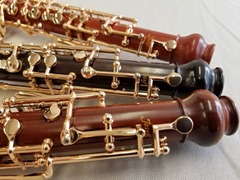
A special note on "Chinese oboes"
It is very unfortunate that such a great country (in size, population, production and history) as China should be equated in the average western mind with cheap (less than 1/10 the normal price), throw-away products that defy repair and sometimes are even missing a few parts. This is VERY unfortunate for at least one Chinese producer of really good instruments: K-Ge. I have tried his instruments at 3 IDRS conferences: seriously, it's hard to see them as anything less than professional calibre instruments. There are new producers of oboes from China that appear to steal the designs and looks from the great makers (like Marigaux, Ludwig Frank, Josef and Dupin), but I have not tried them and I don't know anyone who has. I have read some comments on Facebook of people happy with their internet purchase of "Chinese oboes" and others were really very angry. So my conclusion is: buyer beware. However if you are considering K-Ge: go for it, I really think you'll be happy.
Monday, July 10
Oboes/Hautbois IDRS 2017 : Journey’s end / La quête achevée

| This blog has been tracking my return to musical life, in defiance of fibromyalgia (chronic pain and fatigue) and in parallel with the time constraints earning a living as a computer software developer. An important part of this has been my quest to prove that the wrong instrument (for "you") can inhibit one's musical expression, thereby launching a quest to find "the ideal" instrument for me. This year, the IDRS conference has been particularly revealing and during the 2 weeks after my return, I have suffered flare-ups of pain (I needed to take medication every day - not normal), but this served to prove the choice I made at the IDRS conference: after 4 years of searching, I finally chose an oboe! | Ce blogue chronique mon retour à la vie musicale, défiant la fibromyalgie (douleur et fatigue chroniques) et dans les contraintes de temps en gagnant ma vie en tant que développeur informatique. Une part importante de cette chronique, qui a cherché à démontrer qu'un instrument mal choisi peut nuire à son expression musical, a lancé la quête à trouver l'instrument idéal (pour moi). Cette année, la conférence de l'IDRS s'est montrée particulièrement révélatrice et les 2 semaines après mon retour m'ont affligé de douleurs (à en prendre des médicaments à tous les jours - pas normal). Mais ceci a servi à prouver mon choix à la conférence: après 4 ans à chercher, j'ai enfin choisi un hautbois! |
Quest for the ultimate oboeChoosing "the best oboe" (for "you") is a process based on criteria that the instrument must answer. My criteria will be different than your criteria because we have different experience, different physical qualities (including strength and health) and different musical goals. I hope following will inspire people, not to copy the journey I took, but rather to find their own ways in identifying the instrument that will help them most reach for their musical ideals. |
En quête du hautbois ultimeChoisir "le meilleur hautbois" (pour soi) est un processus basé sur des critères auxquels l'instrument doit répondre. Mes critères seront différents des vôtres parce que notre expérience, nos qualités physiques (y compris la force et la santé) et nos objectifs sont différents. J'espère que ce qui suit inspirera les gens, non pas à copier mon cheminement, mais plutôt à identifier vos propres buts à viser. |
| Last time I tried all the instruments was 3 years ago at IDRS 2014 in New-York. At that time, I decided not to buy anything because of an epiphany brought on by the recitals of Jacques Tys. This inspired me to ignore characteristics of the instrument and concentrate instead on finding the soul-expression of music in my own playing. | Mon dernier essai de tous les instruments date d'il y a 3 ans à IDRS 2014 à New-York. À l'occasion, j'ai décidé de ne rien acheter en raison d'une épiphanie reçue aux récitals de Jacques Tys qui m'a inspirée à ignorer les charactéristiques de l'instrument pour chercher à la place l'âme expressive musicale dans mon jeu. |
| This is nearly impossible to explain in written text: listening to Jacques Tys in person, I seemed to hear and feel the very life of music. In my opinion, when a person witnesses something so wonderful, it should become a life-quest to seek that wonder in her/his own playing ... it might not be possible to achieve it, but at least one should aim for the same ideals, as much as one is capable of hearing/feeling them in someone else's performance ... otherwise, what is the point of practicing and playing? | Presqu'impossible à expliquer textuellement, entendre Jacques Tys en personne, il me semblait entendre et ressentir l'âme-même de la musique. À mon avis, lorsqu'une personne témoigne de quoi de si merveilleux, ça devrait devenir une quête personnelle à trouver cette merveille dans son propre jeu ... je n'y arriverai peut-être jamais, mais il faut au moins toujours viser ces idéaux, autant qu'on est capable de l'entendre/ressentir dans le jeu d'autrui ... autrement, pourquoi travailler et jouer? |


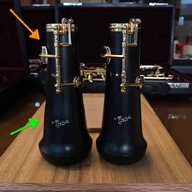
| Marigaux tables had several 901
and 2001 models. Two of the 901s (out of maybe 8) and one 2001 (out of
maybe 3) facilitated the altissimo. Marigaux offers a certain comfort
and is uniquely friendly to reeds: a bad sounding reed still sounds
relatively bad, but the tone is shaped to become very acceptable. I do
prefer the left-hand pinky finger keywork of the M2, but the 901/2001
models "grow the sound" more comfortably for me. All Püchners at the table just opened the altissimo with remarkable ease. It's power is unmatched and yet it still plays as gently as you like without effort. The sound is just plain wonderful, but a bad reed sounds bad. The keywork was next to perfect for my fingers, only Mönnig surpasses it. |
Marigaux
avait plusieurs 901 et 2001sur un nombre de tables. Deux des 901s (parmi
peut-être 8) et un des 2001 (parmi peut-être 3) facilitaient le
sur-aigü. Marigaux offre un certain confort et se montre uniquement
tolérant des anches: une anche gazoue reste gazoue, mais le timbre se
voit enveloppé et présentable. Je préfère franchement la palme des
clefs de gauche du M2, mais le corps du 901/2001 fait "croître le son"
d'une manière plus confortable pour moi. Tous les Püchners à leur table m'ouvraient le sur-aigü avec un aisance remarquable. Sa puissance est sans pareil et pourtant joue aussi doucement qu'on puisse vouloir sans effort. Le timbre est merveilleux, mais une mauvainse anche sonne mal. Le clétage est presque parfait pour mes doigts, seul Mönnig le surpasse. |
Dilemma on day 4
So, between Marigaux 901 and Püchner on day 2, to choose was gruelling because both are just plain
amazing. |
Dilemme du 4e jourAlors le 2e jour m'a arraché entre Marigaux 901 et Püchner, parce que les deux sont simplement formidables. |
| It's on day 4, when I had a chance to try all the makers at least twice that it really struck me: Bulgheroni is the absolute easiest for the altissimo register (it actually rivals Dupin!) AND where others sound thin and crystalline from the 2nd octave key upwards, the Bulgheroni Musa still sounds full-bodied and rich, offering a singing character .... BOING! | C'est le jour 4, lorsque j'ai eu le temps d'essayer toutes les marques au moins deux fois que ça m'a vraiment frappé: Bulgheroni est sans équivoque pour moi le plus facile dans le sur-aïgu (il rivalise même Dupin!) ET, où d'autres rendent un timbre cristallin et mince à partir de la 2e clef d'octave en montant, le Musa de Bulgheroni maintient le timbre riche et velouté avec un caractère qui chante .... BOING! |
| At this point, I favoured the Marigaux over Püchner for one reason only: Püchner seems to "put the sound out there" (its projection in the concert hall is legendary) whereas Marigaux gave me the feeling that my entire person was resonating the music. The Bulgheroni provides this impression half-way between Marigaux and Püchner, it dictates the sound even more than Marigaux and it's mechanics are slightly preferable (to my fingers - not necessarily yours) than the Püchner. Marigaux and (especially) Püchner encourage all dynamics, whereas the Bulgheroni encourages the softer dynamics, it does allow me to play as loudly as the reed will let me. | À ce point, je favorisais le Marigaux (par rapport au Püchner) pour une raison seulement: Püchner semble "envoyer la musique au devant" (sa projection dans la salle est légendaire) alors que Marigaux me fait sentir que mon corps entier résonne la musique. Le Bulgheroni est à mi-chemin entre les 2 autres et il est encore plus "dictateur" du timbre que Marigaux, puis sa mécanique est légèrement préférable (pour mes doigts, pas nécessairement les vôtres) au Püchner.Marigaux et Püchner (surtout) encouragent toutes les nuances alors que Bulgheroni encourage la douceur, tout en me permettant toute la puissance offerte par l'anche. |
| So now, my dilemma was between 3 instruments. The choice was finally made on the basis of the altissimo and the quality of controlling the tone colour (timbre): I went with the Bulgheroni. On top of it all, I got a synthetic top joint (remember Canada's notorious weather for cracks) and a German-styled bell and keywork designed by Christoph Hartmann for the same price as the all wood / regular instruments. | Alors le dilemme se trouve entre 3 instruments. Le choix final s'est fait en fonction du sur-aïgu et le contrôle du timbre: j'ai pris Bulgheroni. Pour cimenter le choix, j'ai eu un corps supérieur synthétique (rappelons-nous du climat canadien, affreux pour les fentes) avec un pavillon de style allemand et un clétage conçus par Christoph Hartmann pour le même prix qu'un instrument tout-bois/régulier. |
Confirming Cecilia was the right choiceAfter the purchase, I had 2 days in Appleton's cool weather (sometimes sunny, often raining) to build my impression of it: I just fell in love! Back in Ottawa (mostly raining, sometimes hot), over 2 weeks of painful neck & shoulder stiffness, thumping arm muscles and severe cramps in the legs and feet meant, Cecilia (the new oboe) needs to prove friendly ... well it did! The weather has been causing my reeds to go simultaneously limp and hard just before they decide to split and yet Cecilia keeps the tuning and sound are just lovely --- not to mention dependable altissimo! Compared to Old Faithful, my wife says Cecilia sounds much more "alive" than any other instrument I ever brought home --- I say the sound "takes more space" whithout necessarily being louder. |
 |
Confirmer que Cécile fut le bon choixAprès l'achat, j'ai eu 2 jours à Appleton, au climat frais (parfois ensoleillé, souvent pluvieux) pour m'y faire une impression: j'en devint tout-à-fait amoureux! De retour à Ottawa (surtout pluvieux, parfois chaud), plus de 2 semaines de douleurs au cou, raideur aux épaules, muscles du bras fébriles et crampes sévères aux jambes et aux pieds ont fait que Cécile (le nouvel hautbois) doit vraiment se montrer facile à jouer ... voilà, c'est fait! La météo a rendu mes anches simultanément molles et résistantes au souffle juste avant de fendre; pourtant Cécile maintient la justesse et sonne d'une beauté --- sans parler du sur-aigü sans faille! À comparer à ma Vieille Branche, mon épouse dit que Cécile sonne plus "vivante" --- moi, je dis que le son"prend plus d'espace" sans être plus fort. |
Why "Cecilia?"Bulgheroni named this model the "Musa": Greek muses were spirits that inspired beautiful artistic creativity, so I wanted the name of a muse ... well, Saint-Cecilia is the patronness-saint of music, instrument makers and poetry! Then, considering the extraordinary voice of Cecilia Bartoly and one family secret, there was no better name for this new oboe who should really help my music soar!I'm preparing for a very special You-Tube recording that will show this. |
Pourquoi Cécile?Bulgheroni a nommé ce modèle la "Musa": les muses grecques étaient des esprits qui inspirent la beauté dans la créativité artistique, alors je voulais le nom d'une muse ... or Sainte-Cécile est la patronne de la musique, des fabricants d'instruments et de la poésie! Tenant compte en plus de la voie phénoménale de Cécilia Bartoly et puis un secret de famille, il n'y avait donc vraiment pas de meilleur nom pour ce nouvel hautbois qui devrait vraiment aider l'envol de ma musique!Je prépare une vidéo You-Tube bien spéciale qui devrait illustrer. |
|
| … the search is now over, let the adventure begin!| | … la quête est achevée, que l’aventure commence! |
Saturday, May 27
Oboe Charming the Nations! / Le hautbois charme les nations!
Spreading the Oboe's Charm! | Partager le charme du hautbois! |
|
| The only thing I don't like about the oboe is its name! "Hautbois", in French, sounds so refined, but in English, "oh-bowe" ... ah well ...
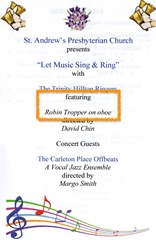
My real job is programming computers. I play oboe only for fun and so I only get to perform in community events. So as an amateur, I get different audiences than professionals would. This is neat, because last night, I performed for a small, but well known community in Ontario: Carleton Place. I got to play solo oboe (accompanied by piano and then by handbells) in front of maybe100-200 new people (and 50-100 people who did hear me before). For many of them, it was the first time they heard an oboe of greater than high-school quality. OK, it's neither professional nor dignified nor classy to gloat .... BUT NOW YOU KNOW ME BETTER! Well, in a concert that included English handbells and a Vocal Jazz group, my Schumann (Romance #1), Bach (BWV 1020, Adagio), Handel and Nelson were received literally thunderous applause and an avalanche of compliments on my phrasing and expressiveness, including from parents of professional musicians and singers or pianists who had worked with local professional oboists ... it looks like my 30 minutes of hobby practicing is paying off! |
|
Mon vrai gagne-pain consiste à programmer les ordinatuers. Je joue le hautbois pour la joie de vivre, alors je joue lors de présentations communautaires. En tant qu'amateur, je joue pour des auditoires bien différents que les professionnels. C'est bien, parce que hier soir, j'ai joué pour une petite communauté bien connue en Ontario: Carleton Place. J'ai joué en solo (accompagné de piano et de clocches anglaises) devant 100-200 nouvelles personnes (et de 50-100 personnes qui m'ont déjà entendus). Pour un bon nombre, ce fut la première fois qu'ils ont entendu un hautbois de niveau supérieur à l'école secondaire!
D'accord, ce n'est ni professionnel, ni élégant, ni raffiné de me vanter ... MAIS VOUS ME CONNAISSEZ MIEUX MAINTENANT! Et bien dans un concert qui inclut des ensembles de cloches anglaises et un groupe de Jazz Vocal, mon Schumann (1ère Romance), Bach (adagio du BWV 1020), Haendel et Nelson ont été reçus avec un tonnerre d'applaudissements suivis d'une avalanche compliments pour mon phrasé et mon expressivité. Ceux-ci incluaient des parents de professionnels et des musiciens qui ont travaillé avec des hautboïstes professionnels de la région ... on dirait que répéter le hautbois 30 minutes par jour en a vallu le coup! |

Haunted Reed |
Anche ensorcellée |
| Reasons for a reed-friendly oboe keep piling-up .... I show-up at the Church to warm-up: find the reed I intend to use (playing very nicely, thank you) and do warm-ups here and there, all over the building. All is fine until the dress rehearsal: the reed decides to go really flat on 2nd octave A etc. I actually thought the reed had split because that's how it was behaving.... no, no cracks at all. | Une raison de plus pour un hautbois tolérant aux anches ..... j'arrive à l'église: je choisis l'anche pour l'occasion (joue très bien, merci) et je me réchauffe ça-et-là, un peu partout dans l'édifice. Tout va bien jusqu'à l'avant-première où le La, 2e clef d'octave et environs, baisse affreusement. L'anche se comportait comme si elle avait fendue ... non, aucune faille du tout. |
| After that, I play the same reed again in many different places - all good, very fine reed. At the performance, I had to work hard on tuning because really flat 2nd octave again! | J'ai donc joué la même anche encore une fois à plusieurs autres places - tout va bien, très belle anche. À la présentation, j'ai dû travailler très fort parce que le 2e octave s'est mis à fausser encore une fois! |
| There must have been an air draft at that specific spot, otherwise, some ghost must have haunted to say I should not play exactly there! | Il dut y avoir un courant d'air entre vitraux à cet endroit précis, autrement il faudra que je soupçonne un fantôme qui ne voulait pas me voir exactement là! |
Music to bridge the nations! |
La musique rapproche les nations. |
|
| On Facebook, I like to share news of all the excellent new oboe CD's that can really inspire appreciation for the different playing aesthetics out there. For my blog, I don't want to be a CD critic/reviewer, but every once in awhile, one CD really makes a mark and I like to share my thoughts on it. This was the case for Levantasy, an exceptionnal collaboration between an Israeli oboist, a Dutch Jazz Trio and an Iranian recording company. And I think the new CD "Melodies of Nations" can also participate in making the world a place where the cultures of different nations are enjoyed in friendship. |  |
Sur Facebook, j'aime à partager tous les excellents nouveaux CD qui inspirent l'appréciation du jeu vraiment différent de partout dans le monde. Pour mon blogue, je ne veux pas faire le critique journaliste. Mais une fois de temps-à-autre, un CD fait impression spéciale et je veux partager mes impressions.C'était le cas, en particulier, pour Levantasy: une collaboration exceptionelle entre un hautboïste israélien, un trio jazz hollandais et une étiquette d'enregsitrement iranienne. Je crois que le nouveau CD "Melodie of Nations" peut aussi aider au monde à mieux apprécier les cultures de différentes nations dans une atmosphère d'amitié. |
| The word "nationalist" and the sense of national identity is sometimes seen as a good thing and sometimes bad. These days, we tend to favour inclusiveness and integration of cultures, and "nationalism" is sometimes abused to turn away people who are different than "us", people who "don't come from here". But I have always loved to celebrate the "national cultures" of different parts of the world: in fact, Canada likes to call itself a "Great Mosaic" where people of different origins keep their distinct cultures and all together, we give a much more colourful picture to our nation. |  |
Le mot "nationaliste" et le sens d'identité nationale est parfois vu comme de quoi de bien et parfois comme dangereux. Ces jours-ci, on a tendence à préférer l'inclusivité et l'intégration des cultures; le nationalisme est souvent abusé de sorte à détourner autrui, se méfiant de ceux qui sont "différents de nous" ou "qui ne viennent pas d'ici". Mais j'ai toujours aimé à célébrer les "cultures nationales" d'ailleurs dans le monde: en fait, le Canada se considère une "mosaïque ethnoculturelle" où les gens d'origine variées conservent leurs cultures distinctes tous ensemble, ce qui donne au tout une image à couleurs bien vivantes. |
| So when oboist Sanja Romic (Serbian) and pianist Fionulla Moynihan (Irish) chose to entitle their new CD "Melodies of Nations", I thought that was a really nice idea. The composers represent Germany, England, Serbia, Ireland Russia+Canada and Slovenia. This is especially fantastic because I remember the wars of the 1980's, causing the breakup of Yugoslavia: they made us forget the absolutely wonderful and highest class musical artistry that used to be the very definition of those areas. |
|
Alors quand la hautboïste Sanja Romic (serbe) et la pianiste Fionulla Moynihan (irlandaise) ont intitulé leur nouveau CD "Melodies of Nations", j'ai trouvé ça vraiment chouette. Les compositeurs représentent l'Allemagne, l'Angleterre, la Serbie, l'Irelande, la Russie+Canada et la Slovénie. C'est vraiment formidable d'autant plus que je me souviens des guerres des années 1980 qui ont fracturé la Yugoslavie: ils nous ont fait oublier l'esprit artistique musical vraiment de la plus haute classe qui caractérisait auparavant ces nations. |
| Traditionally, recordings and recitals consist of "standard" sonatas, specifically composed for oboe. To get some variety, some oboists have started to take more popular violin concertos and string sonatas, thus expanding the repertoire. Otherwise, "new music" compilations will keep repertoire that is appreciated by a smaller segment of listeners. What I really like about this new CD is it brings repertoire for oboe that is less frequently recorded and some very contemporary compositions that are a complete joy for anyone to hear. |
|
Traditionellement, les enregistrements et récitals consistent de répertoire "standard", composé spécifiquement pour le hautbois. Dernièrement, les hautboïstes étendent leur répertoire en empruntant du matériel (sonates et concertos) bien connu pour violon. Autrement, des compilations de "musique nouvelle" rassemble ce qui est apprécié par un segment particulier de l'auditoire. Ce que j'aime beaucoup de ce CD est qu'il présente du répertoire pour hautbois enregistré bien moins souvent et des compositions tout-à-fait contemporaines,pourtant un vrai régal pour n'importe-qui. |
| The CD contains selections for oboe and piano together as well as solo piano and solo oboe. I have to admit, the solo piano pieces can remind me of a cat jumping on a keyboard... but Fionulla plays them so well, with great understanding feeling, that I can listen to them and remain interested all the way through. The new music for oboe, from Serbia, Slovenia, Russia/Canada and England are absolutely contemporary, but tonal, representing their cultural heritage and fully accessible to anyone. |
|
Le CD présente le hautbois et piano ensemble et aussi quelques sélections pour piano seul et pour hautbois seul. Je dois admettre que les compositions pour piano seul me fait penser à un chat qui s'amuse sur le clavier... mais Fionulla les joue tellement bien, avec compréhension et sentiment, que j'arrive à les écouter puis conserver mon intérèt tout au long. Les compositions nouvelles pour hautbois proviennent de la Serbie, la Slovénie, la Russie/Canada et l'Angleterre est tout-à-fait contemporaine, mais tonale et représentent leur héritage culturelle de manière accessible à tous |
| Fionulla and Sanja are truly remarkable musicians, each by themselves, and when they play together: real magic! Of course, I am mostly interested in the oboe: I can only say that we can really feel a joy of living in her playing. Sanja Romic is capable of all the technical athleticism, and yet she impresses with the gentleness in her sound. She can power away with all the vigor you can expect from anyone and then turn around with a soothing delicacy. |  |
Fionulla et Sanja sont de remaquables musiciennes, chacune pour soi. Lorsqu'elles jouent ensemble, véritable magie! Bien sûr je m'intéresse surtout au hautbois: je ressens une vraie joie de vivre dans son jeu. Sanja Romic est capable de tout athlétisme technique, et pourtant elle impressionne avec la tendresse de son timbre. Elle montre toute la puissante vigueur qu'on pourrait s'attendre de quiconque puis elle vire à une délicatesse appaisante. |
| Sanja's partnership with Fionulla is difficult to explain, because you can clearly hear they are solid soloists in their own right, and yet there is a definite partnership: not so much that they sound like one instrument together, but that a playful friendship resonates in their music. | Le partenaria entre Sanja et Fionulla est difficile à expliquer parce qu'on voit clairement leur prouesses individuelles en tant que solistes et pourtant il y a un partenaria indéniable: pas tellement qu'elles sonnent comme un seul instrument, mais il y a une amitié badin qui résonne de leur musique. | |
| Unfortunately, the only You-Tube videos I can find (I like the video format for my blog) did not have very good sound-recording, so they don't do justice to what the CD actually sounds like. I hope this video will be enough to motivate people to get the CD: it really is a pleasure to hear and a wonderful way to explore the world! | Malheureusement, les seules vidéos You-Tube que j'arrive à trouver (j'aime le format vidéo pour mon blogue) ne bénéficient pas d'une excellente prise de son: ça ne rend vraiment pas justice au CD. J'espère que cette sélection sera assez pour motiver le monde à se procurer le CD: un vrai régal et un si belle manière à explorer le monde! |