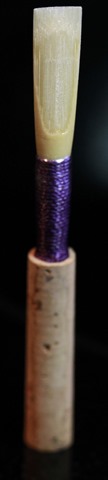
Saturday, July 25

Why make reeds? (part 2.c) / Pourquoi faire ses anches? (#2.c)

CAUTION:
These are my own impressions on very small sample of reeds. Evaluating a reed for any other person is a terribly delicate issue, even when people play together frequently. To evaluate reeds for people we have never even met, possibly inhabiting distant countries with vastly different climates and geographic considerations is almost ridiculous.

Any reed instrument player with any reasonable amount of experience will agree that, from any same reed producer, a dozen reeds can play very differently. I have tried only one reed from each maker, so my opinions cannot be considered representative of their work.
Je m'efforce au bilinguisme, chers lecteurs francophones, parce que vos visites me font franchement honneur! Mais cet article est assez long et la grande majorité des mes visiteurs comprennent l'anglais, pas le français – alors puisque je ne reçois aucune rémunération ni faveur quoi que ce soit pour ce blogue, je réserve le droit de préserver un peu de mon temps libre pour mes autres loisirs… Merci de votre compréhension!

Why then even write this post? Well for one, I promised Vicky I would... which is fine because I actually do like the reeds she sent. Also, it might be interesting for the reedmakers to get a distant opinion. But mostly, I hope this will encourage oboists when reeds don't always meet their needs – and possibly provide and idea of what to expect when making or buying oboe reeds as well as some insight on what mind-frame to adopt when evaluating them.

General Observations

When Vicky offered to send me reeds to try, she asked me what strength I prefer. I really had no clue, so I just answered something and she sent me one reed from each maker. This means that I could have made serious mistakes in my choices with no way of knowing!

Each reedmaker produces reeds of different strengths and styles for different levels of experience and/or physical ability. This is where experience and the ability to order different samples from the same place comes-in handy.  And no matter how careful a person may be in selecting cane, it remains the product of a living plant, not an engineered polymer! Arundo donax (a variety of grass!) is a living organism that will always behave in unexpected ways. So, having just one reed from each maker is really not a good representation of their work. Also for this reason, I prefer not to describe scraping profiles or measurements.

What is a "professional reed"?

I have very happily corresponded with a number of reed makers via the internet. Some makers consider “professional category” reeds simply to be more resistant reeds (harder, but still ready to play right out of the box) whereas other makers understand that many professional level players will want to fine-tune reeds to their own tastes. In the case of American scrape, I think the ability to adjust them is even more important, because individual styles are so much more sensitive and impactful.

All the reeds Vicky sent me are professional grade, except the Tipple which is medium-soft, designed for high-school students. The hard reeds are too much for me to play on for more than a few minutes at a time. BUT despite this, they are among the most responsive reeds I have ever played on! Strangely, it takes lots of air pressure (perhaps because of the climate/geographic change) but responsiveness is so easy it’s almost scary! I have never worked much at developing double-tonguing, but despite the hardness, these reeds help me do double-tonguing more easily and clearly than my own reeds. They also all appear to prefer an embouchure that does not change.

I got the reeds in late April, so I have been playing them once-in-awhile from early spring to mid-summer. The change in the weather has drastically changed the reeds behaviours: some have completely exchanged characteristics to the point where I have to look at the thread color and my notes to remember which is which! This supports my assumptions that:

  • The reeds are made for professionals, whose facial muscles become strong with several hours of playing every day.
  • I believe that if I went to the city where they are made, they would be much easier to play, even for me.
  • I would imagine that just ordering their softer versions of the reed would leave me fully satisfied.

    All reeds are excellently bound/tied: no sideway slipping of the blades at all – I really appreciate that! I find reeds that slip (overlap sideways) have a warmer, more velvety sound with perfect stability, but they also make me feel very choked when playing and I tend to get dizzy spells with them. However, a number of professionals from different countries told me they prefer reeds WITH a slipped overlap, so it's a matter of personal preference.
    One recommendation I would make to all reed makers using wire: don't ship them without some kind of cellophane to cover the wire! Not only does it prevent the lips and/or fingers from bleeding by accidental yank, it also keeps the wire in place. No matter how well you tie the wire, it is in the middle of a curve and will drop really easily, thus messing-up all your fine-adjustments! Back in the 1980's, "gold beater's skin" (the natural membrane used to wrap sausages) was popular and despite its delicateness, it worked rather well. Plumber's tape and food wrap can do well, but they tend to unwrap when wet or strangle the reed. My favourite modern cellophane is "Parafilm M" laboratory tape: it stretches and clings firm and resists friction as well as soaking – revolutionary, in my opinion.

    reedLineup_crop

    From left to right:
    Qing Lin, Kai Rapsch, Laura Arganbright, Koje, Tamo Ramirez, Tipple


    Recordings:

    I did make recordings to compare the reeds. I have a new microphone, and when I combine it with my old one, I get a very good sound, almost true-to-life. But when I play back the recordings of the reeds, the difference in sound is so small they almost sound the same. I used 4 different head-sets and 3 different loud-speaker setups: each setup sounds different overall, but on the same setup the reeds only show minute differences in tone colour. This is unfortunate because when playing them in person, they really do sound different. I think the lessons here are:

  • Do not trust recordings to judge an instrument, a reed or a musician: it really takes excellent recording equipment AND playback equipment AND sound engineering experience to provide anything close to live performances.
  • Try many different reeds (keep them to try them again at different times of the year), try different instruments, ask the reed makers to use different producers of cane and try those.
  • Do NOT choose your reed for very small differences in tone colour – besides, I have reeds that sound fantastic at home and became buzzophones in some concert locations (vice-versa as well)! So you might as well choose reeds for how they allow you to play the most comfortably and with the most expressive articulations and dynamic range (according to your tastes and goals).
  • Different reeds will have big differences in sound in the same location. So choose your favourite sound in terms of big differences: leave the small differences to work on embouchure and breath.
  • All the above should also be true for instrument makers…. don’t bother asking a vendor to make comparative recordings of different instruments, it’s pointless! Try the instruments and go for general comfort while playing. Yes, tone colour is part of that comfort, but only if the difference is clearly evident: subtleties can be caused by so many other things.


    Observations on each maker:

    Qing Lin (China/Germany):

    a new professional, already distinguished in performance. I had the real pleasure of hearing him play one of the Lebrun concerti: the prize for winning the Gillet-Fox competition at IDRS 2013. Harder than the others and also more fluffy on articulations, these reeds provide a very beautifully haunting sound.

    One thing I always wanted to try (but never did) is something he does on all his reeds: where books say to cut the corners (making the tip narrower) he leaves the "ears" on from the shaper! Again, understanding that the change in geography and climate can exaggerate the strength of the reed, this reed testifies to his current stay in Germany with an absolutely stable reed built for solid professionals who want the plushest sound.... I have to wonder if this might be in the lineage of the legendary sound of Lothar Koch...

    Koje (Malaysia):
    Is a reedmaker from Malaysia that is starting to be well known in Facebook land. It is run by oboist Yong How Keen, important oboe teacher in Southeast Asia and innovative quality reed maker, increasingly respected at home and abroad. The few videos I can find of him playing show a really free sounding full-range of expression and articulation: I would expect his reeds to answer my tastes quite well. But the reed I got is a special production model, designed with and for the divine oboist Michaela Hrabankova. Surprise for me, and don't let her delicate charming looks fool you: this Czech girl is a powerhouse on the oboe, and needs a reed up to the challenge! His reed provides the ultimate baroque-esque sound; no exaggeration! Just looking at it, I don’t see anything out of the ordinary, but when playing it I am struck by its sound: very broad, warm, dark and resonant, like I’d expect to hear from Marcel Ponseele on his baroque oboe! Absolutely stable in pitch on the whole range of the instrument, it takes only a small increase in air power to reach its dynamic potential.
    Laura Arganbright (USA): 

    American scrape has never been in my favour, so I don’t want to risk misrepresenting her reeds.  But, I hear many, many American oboists sound very crystalline or metallic despite the reputation of that scrape: Laura’s reeds are among the warmest, darkest, silky sounding reeds I’ve played from any style at all. Her philosophy, concerning professional reeds (and I do agree with it) is that professionals will want personal fine-tuning, so she does leave room for finishing touches.

    Her scraping is clearly very well controlled, clean and I am very impressed with how perfectly the blades are aligned (two aspects not always characteristic of American Scrape). Actually, her scrape is so clearly meticulous it almost looks like a component for the Mars Rover! In line with her philosophy on pro-reeds, I think it is a fantastic starting point for any professional who wants to save time and effort and fine-tailor the reed to their own stylistic preferences: the scrape leaves room for any variant of American scrape I have ever seen.

    Cayetano “Tamo” Ramirez (Spain):

    his is probably the closest to how I make reeds. I don't mean what the scrape looks like, but rather how the reed behaves with respect to articulation and air pressure. The sound is also very warm, but more clearly defined in a reed that really does want to play along with my whims. It is also the reed that plays most easily in the altissimo range (especially above F). This is where I really believe the geographic/climate conditions are making all these reeds harder than they are really supposed to be: Ramirez reeds play so much like how I design mine, that I find it hard to believe they are truly this hard. What he told me is that, in Spain, they do like reeds a little bit harder compared to many other parts of the world, but not as hard as the Germans like them.

    Kai Rapsch (Germany):

    Despite being hard, I really like it! It will be a source of study for me. Like the Ramirez reed, it behaves the way I like reeds to behave, but with a heavier sound: possibly designed for an instrument that demands more support from the player, it also tends to play 2nd octave key notes flat (compared to the others) on my Lorée. From my experiments trying instruments, this reed would be great with a Marigaux M2 or a Mönnig 150 where I have found the 2nd octave notes sharp (according to professionals I have chatted with, sharpness/flatness seems to vary with geographic location).

    The tip is the shortest I’ve ever seen in my life! But this takes nothing at all away from its responsiveness: I can articulate notes the way I like to, period! Like my own reeds, his reeds sound very clearly defined, but unlike my reeds, there is not a hint of crystal or buzz: sheer oboe warmth.... it makes my Lorée sound like a Ludwig Frank!

    Tipple (UK):

    mission accomplished! He wants his reeds to play just fine “right out of the box”, and I concur this to be true! Perhaps Suffolk, England has similar climate to Ottawa? Whereas the reeds I have from other makers are professional grade, the one I have from Tipple is a medium-soft (high-school) reed: so I must hold back my power. The scrape is short but the cane shape is narrow (like American reeds): this helps maintain precision and quality of tone-colour for people with less air power, likely very suitable to many adult amateurs. This reed is very well designed to promote good embouchure and breathing habits in students: biting on this reed will kill the tone whereas a relaxed embouchure will allow any articulation you want. Being narrower, it would likely be a great starting point for habituates of American reeds who want to explore European scrape.

    Conclusion:

    I personally, will not start buying reeds.  I have been making them for 30 years: as a hobbyist, making reeds is part of the excitement of this oboe journey. With my engineer's attitude, even if I played saxophone I would probably make my reeds and even mouthpieces! However, this experience has been very enlightening about the possibilities for reeds and the usefulness of buying some (from time to time and from very different makers) as a source of study.

    headerBannerI think for professionals who want to save time (devote more time to practice and family in a busy performance schedule) buying reeds from Vicky (her website here) and/or other well reputed venues is an excellent idea: the professional can then spend only a few minutes fine-tuning them as needed without worry. I am very curious to try the reeds Koje plays on himself: apparently much easier to blow. For someone like myself, who likes to explore and experiment, these reeds are a fantastic source of investigation using the Ramirez and Rapsch reeds: I will be doing lots of comparisons and experiments on my own reeds.

    I think students and amateurs, who have teachers who really answer the student's goals, getting these specific reeds would be an excellent start as the teacher can fix the reeds to suit the student perfectly. Also, these reeds are excellent to show students what to aim for, and acquire the skills to fine-tune a reed that is already quite good.

    For students and amateurs who need a reed to be ready for concert right out of the box, Tipple should be quite good, and I really suspect that getting a softer Koje or Ramirez would be advisable.  Qing Lin and Kai Rapsch (also the "Michaela" by Koje) should be considered for more advanced students who want to develop specific sound qualities.

    Do Contact Vicky (and your local reed maker) with questions – I know she is continually trying other makers and sources to provide the best possible product for her clients.

  • Friday, July 10

    Why make reeds? (part 2.b) / Pourquoi faire ses anches? (#2.b)

    Recall:

    These are MY opinions: I encourage everyone to try for yourself and come to your own. I think this blog is most useful if it starts conversations and helps people ask more intelligent questions (maybe help people realize they are not crazy if they have difficulties with reeds). Not everybody will share my opinions and that is good: the more contrasting conversations we can have, the better!

    I wanted to discuss this topic in 2 parts:

    1. the definition of a good reed
    2. comments on the makers.

    But some conversations I had on Facebook lead me to insert one more discussion in the middle.

    Rappel:

    Ceux-ci sont MES opinions: j'encourage chacun à essayer pour soi et se former ses propres opinions. Je crois que ce blogue est utile à démarrer la discussion et aider aux gens de poser des questions intelligentes (peut-être à confirmer que la difficulté avec les anches n'indique pas la folie). Plusieurs ne partageront pas mes opinions et c'est bien ainsi: toujours bien d'avoir des discussions contrastées!

    Je voulais discuter le sujet en 2 parties:

    1. la définition d'une bonne anche
    2. commentaires sur les fabricants.

    Mais quelques discussions sur Facebook m'incitent à insérer une autre discussion au milieu.

    Also, this experiment on reeds made by other people coincides with more elaborate experiments on my own reeds with new and old cane from different producers. I have found that different sources of cane favour very different tone colours AND feelings while playing: two sources can sound the same, but require very different embouchure habits – this is not an easy thing to modify while experimenting! Aussi, cette expérience avec les anches fabriquées par d'autres coïncide avec des expériences plus élaborées avec des roseaux par différents producteurs. J'ai trouvé que différentes sources de roseau favorisent des timbres ET des sensations bien différents de l'une à l'autre: ceux de deux producteurs peuvent sonner presque pareils tout en exigeant des habitudes d'embouchure différentes – pas une chose facile à modifier en expérimentant!
    Finally, I just acquired a new microphone. It is quite good, but almost the opposite from my old one, so I'm debating the possibility of recording sound clips from the different reeds.... with just my old microphone, it is very difficult to capture the small differences that are a big deal to us oboists, and that we hope the audience actually hears! Enfin, je viens d'acquérir un nouveau microphone. Il est excellent, mais presque l'opposé de mon vieux, alors je jongle avec l'idée de faire de courts enregistrements avec chaque anche… avec mon vieux micro tout seul, il n'est pas facile de capter les détails sonores, si importants aux hautboïstes, mais qu'on ne peut qu'espérer que l'auditoire perçoit!

    Remember one of the slogans from last post (here): "A reed can play easily OR sound great, but not both". This leads to the question: what is a good tone colour on the oboe?


    Harsh tone or harsh playing?

    Back in the 1980'-90's, when I was a music student, MANY people were criticizing Heinz Holliger for sounding like a swarm of flies in recordings he made in the early 1980's. I don't know if the recordings were faithfully reproducing his sound or if sound equipment and expertise at the time were inadequate, but it's clear that his tone colour is completely unimportant when you start grasping his unique expressiveness, vitality and the artistry in his ornamentations of baroque repertoire.

    Still, I think most people prefer a more velvety sound. For sure, I am trying to move away from the Indian snake-charmer sound oboes give in old black-and-white movies. But if sounding like a plush toy means getting headaches from blowing like an air compressor or being unable to extend a range past p-mf, then I'll leave that sound to other people.

    olFaithful

    Many years old and still one of my best playing/sounding reeds ever!

    Plusieurs années à me servir et sonner le vrai délice – reste une de mes meilleurs anches jamais faites!

    Rappel d'un des slogans du dernier article (ici): "Une anche peut bien jouer OU bien sonner, mais pas les deux". Ceci mène à la question : c'est quoi, au juste, un bon timbre de hautbois?


    Timbres durs ou dureté du jeu?

    Dans les années 1980-90, pendant mes études musicales, PLUSIEURS personnes critiquaient le timbre nasillard de Heinz Holliger (ses enregistrements au début des années 1980). Je ne sais pas si les enregistrements véhiculaient fidèlement son timbre ou si l'équipement et l'expertise de prise de son à l'époque manquaient d'expérience, mais il est claire que son timbre n'a aucune importance quand on commence à saisir l'expressivité unique, la vitalité et la musicalité de ses ornementations dans le répertoire baroque.

    Toujours est-il que la majorité du monde semble préférer un timbre plus velouté.

    Sans aucun doute, je vise à délaisser le timbre des envoûteurs de serpents de l'Inde dans le vieux cinéma. Mais si sonner comme un ourson en peluche équivaut à des migraines parce qu'il faut souffler comme un compresseur ou me limiter à p-mf, alors je laisserai ce timbre à d'autres.

    When I started being active in Internet groups, I felt only very dark, baroque-like sounds (e.g. Louise Pellerin or Cynthia Steljes were good and everything else was bad musicianship. Over the years (thanks to You-Tube, Vimeo, Arte-Web, etc.!!!) I have come to appreciate edgy sounds, or clear sounds with a hint of a buzz in it, which I consider more "living" or "pastoral" (country-side) sounds. In high-school, beginner oboists honk their way through band class, so we want to stay away from any kind of hollow, strong sound. But as a performer reaches the control of the professional, a sustained goosey tinge to the sound, I find, is actually very nice in many respects. My own personal taste still prefers the tone of the Baroque Oboe (Marcel Ponnsele or John Abberger) over all others, but I now find quite a lot of modern oboe sounds to have pleasant qualities that simply don't occur in the period instruments.

    I'm not trying to be politically correct or sensitive to the preferences of others: there are still big names whose sounds bother me to the point of not being able to appreciate their artistry. And now I consider many professionals with heavenly tone-colours play without feeling or soul – in my opinion, of course. I have just come to appreciate variety: this makes my quest for the "one single ideal oboe" even more difficult!


    Cynthia Steljes
    Louise Pellerin
     
    Heinz Holliger
     
    Marcel Ponsele

    Au début de mon activité dans les groupes Internet, je croyais que seuls des timbres très sombres, riches et baroquescants (tels Louise Pellerin ou Cynthia Steljes) se respectaient et que tout le reste trahissait un manque de goût artistique. Au fil des ans (merci You-Tube, Vimeo, Arte-Web, etc.!!!), j'apprécie maintenant les timbres plus carrés, clairs ou même avec un soupçon de buzz, que je qualifie plus vivant ou pastoral. À l'école secondaire (le lycée), les débutants vont plutôt klaxonner leur hautbois. Par conséquent, nous cherchons à délaisser un timbre creux ou rude. Mais lorsque l'artiste acquiert le control professionnel, un soupçon de cacanement (cri de l'oie) soutenu à son charme. Mes goûts personnels favorisent toujours le hautbois baroque (Marcel Ponseele ou John Abberger) mais j'apprécie beaucoup plus les timbres modernes pour avoir des qualités plaisantes qui sont simplement absents des instruments d'époque.

    Je ne vise pas la rectitude politique, ni la sensibilité aux préférences d'autrui: il reste des grands noms dont le timbre m'achale au point de ne pas pouvoir apprécier leur musicalité. Je trouve aussi que certains professionnels avec des timbres célestes peuvent manquer d'âme dans le jeu – mon opinion, bien sûr. Mais j'apprécie maintenant la variété: ce qui rend plus difficile ma quête pour "l'unique hautbois idéal" encore plus difficile!

    Best reeds: machine made or all handmade?

    Vicky's website is called "Handmade Oboe Reeds" and I know there is generally a general bias in favour of making reeds by hand rather than machine. But I think most large-scale makers of short-scrape reeds now start their reeds with profiling machines and produce first rate reeds; there are even profiling machines to make American reeds. Most makers will test and finish their reeds by hand; in the end, the only thing the machine did was speed up the process and prevent accidental chopped-off corners or holes where you don't want them.

    Which is better, American (long) scrape or European (short) scrape?

    This is probably the most emotion-packed and verbally violent debate among oboists in international discussion groups. Well, let me begin by pointing out that "long scrape" does NOT imply "American scrape". Actually, the very notion of "American" reeds actually becomes fuzzy because there are important variances and I have seen sketches of similar scraping styles characterizing Dutch reeds.

    red2

    Looks can be deceiving:
    NOT American scrape!

    Gare aux apparences: n’est
    PAS le grattage américain!

    Meilleures anches: fabriquées à la main?

    Le site web de Vicky s'intitule "Handmade Oboe Reeds" (anches faites à la main) et je sais qu'il y a un parti-pris général contre la fabrication à la machine. Mais je crois qu'en gros, les fabricants de style européen commencent les anches à la machine et produisent ainsi d'excellentes anches; il existe aussi des profileurs pour anches américaines. La majorité des fabricants vérifieront personnellement les anches ainsi produites et les termineront à la main; en fin de compte, la machine sert à accélérer le travail de gros et prévient les trous et coins rongés par accident.

    Quel est mieux, le grattage américain (long) ou européen (court)?

    Voici sans doute la question la plus remplie d'émotion, provoquant des "débats animés" dans les groupes de discussion internationaux. Commençons par préciser que grattage long n'implique PAS le style américain, notion qui devient floue parce qu'il y a nombreuses variantes et j'ai vu des esquisses semblables décrivant le style hollandais.

    In my own personal definition, "American" scrape is always nearly full-cane-length and requires one very special characteristic: the back "windows" must be thinner than the heart, with the heart typically rather thick. A reed can be scraped very long, but if it the thinning is continual from back to front without an important hump, then by my definition it is not American scrape. Many of my own reeds look American because of a long W behind the heart, but the back "gullies" (as I call them) are thicker than the heart: these reeds are popularly called "hybrid" (i.e. half-way between American and European scrape). The length and gullies serve to control opening on obstinately open reeds.

    The words "European" or "short" scrape can be used almost interchangeably. Short scrape is a straight-forward technique and very likely the oldest: just always get thinner towards the tip (and the sides). People still talk about German or French or English scrape, but there are really numerous variances that cause impressive differences in sound and behaviour. People now adapt them to their own tastes and country-label is really only useful for discussion. Dozens of profiles and scraping length can vary from 1/4 to almost all of the cane length. In general, the idea is "not American".


    americanMass

    Machine-made American scrape.

    Grattage à l’américaine faite à la machine.

    Selon ma propre définition, le grattage "américain" couvre toujours presque toute la longueur du roseau et exige une caractéristique particulière: l'arrière (les fenêtres, "windows") doit être plus mince que le coeur, avec le coeur typiquement assez épais. Une anche peut être grattée longuement, mais si la minceur procède continuellement jusqu'au bout, sans bosse importante, par ma définition ce n'est pas une anche américaine. Mes propres anches peuvent parfois paraitre américaines en raison d'un W allongé derrière le cœur, mais ces cannelures restent plus épais que le cœur: on appelle souvent ce style "hybride" (mi-chemin entre européen et américain). La longueur et les cannelures servent à contrôler l'ouverture d'anches qui s'obstinent à trop ouvrir.

    Les expressions "grattage européen" et "grattage court" sont presqu'interchangeables. Le grattage court suit un profile intuitif et fort probablement très vieux: on amincit tout simplement vers le bout (et les côtés). Le monde parle toujours d'anches allemandes ou françaises, mais il y a de nombreuses variances qui produisent des différences importantes dans le son et le comportement de l'anche. On adapte le profile pour ses goûts personnels et le libel national n'est utile que pour la discussion. On retrouve des douzaines de profiles avec des longueurs de grattage d'un quart à presque toutes la longueur de l'anche. En gros, l'idée est "pas américain".

    So which is the better scraping style?

    The common "safe" answer is "it depends on your goals for sound". I'm never convinced of the sincerity of this answer because I would expect an explanation on which scrape is better for which sound.... and that rarely follows. Besides, I have found that any sound characteristic that can be found on American scrape can also be produced on short scrape. The preference for long or short scraped reeds is interesting because I find more and more Europeans trying (and selling) American scrape reeds. Conversely, a number of Americans and Canadians I know personally (and others via Facebook) are abandoning American Scrape and returning to short scrape.

    In my personal view, the ideal reed style should a function of your PHYSIOLOGICAL characteristics; how your own body responds to blowing and the resistance from the reed. Many people will say that short scrape requires more strength and biting: but I assure you my some of own reeds put an end to that idea! Many people will say that American scrape produces a softer, mellower, darker tone: but old and new recordings of oboes with very metallic and harsh tones are easily found with long scrape reeds.

    americanMakeramericanPro

    Very different hand-made (by pros.) Amercian scrape reeds.

    Anches professionnelles américaines très différentes faites à la main.

    Alors quel est le meilleur grattage?

    La réponse commune est "cela dépend de tes objectifs sonores". Cette réponse ne m'a jamais convaincue parce que je m'attends à une explication de quel style fait quoi…. ce qui suit rarement. De toute façon, j'ai trouvé que tout ce qui peut décrire le grattage américain est aussi disponible avec le grattage court. La préférence pour un style particulier et curieuse parce que je vois de plus en plus d'européens essayer (et vendre) des anches américaines. À l'inverse, un nombre d'américains et de Canadiens que je connais personnellement (et autres via Facebook) abandonnent le profil américain pour reprendre le grattage court.

    À mon avis personnel, le style idéal doit concorder à vos caractéristiques PHYSIOLOGIQUES; comment votre corps répond au souffle et à la résistance de l'anche. Plusieurs prétendent que le grattage court exige une embouchure plus forte et un peu de morsure: je peux vous assurer qu'un nombre de mes anches mettent fin à ça! Plusieurs diront que le grattage américain produit un son plus rond, sombre et velouté: mais des enregistrements de tout âge présentent des anches américaines au timbre métallique, nasillard et rude.

    Several players of European-scrape reeds told me they found American scrape reeds are much easier to blow and more responsive: I used to make American reeds for myself – I also have some made by other people in my collection – and I really disagree with that point of view: American scrape can be very restrictive and stop responding after a few minutes of blowing.

      Plusieurs jouers d'anches européennes m'ont qu'ils trouvent le grattage répond mieux et sont plus facile à souffler: je fabriquais jadis mes anches à l'américaine, et ma collection comprend quelques-unes faites par d'autres – et je ne suis vraiment pas d'accord sur ce point de vue: le grattage américain peut grandement restreindre la nuance et arrêter de répondre après quelques minutes de jeu.

    Conclusion:

    The more I discuss with people, the more I am of the opinion that preferring long/short scrape and specific details is a function of climatic conditions: a matter of fitting the effects of climate on the cane and the requirements of your specific comfort at playing. Different sources for cane REALLY produce different kinds of cane (hard, spongy, waxy, grassy...) resulting in reeds that behave differently. So factors like gouge and scraping profile, I think, might suit one type of cane more than another. For me, personally, the sprightly nature of short-scrape, with its ability to cope with very weak and very strong blowing suits me better – but I also have preferences in cane to go along with it.

    Therefore, there is no correct answer to this question apart from: "try and decide for yourself". Furthermore, my own experience, a person's stamina and tolerance will change a lot in different climates... just as the reed will change its behaviour too. The important thing is this: if you're getting dizzy spells or turning red when playing, try a reed with a different cane, staple and/or scraping style!!!
    beigeYellow

    Hybrid Scrape (on the short side).
    Grattage hybride (plutôt court).

    Conclusion:

    Le plus je discute avec le monde, le plus j'ai l'opinion que la préférence entre grattage long/court et les détails techniques est une fonction du climat: question d'apparier les effets du climat sur le roseau et les exigences particulières de votre confort à jouer. Différents producteurs produisent du roseau à caractéristiques VRAIMENT différentes (dur, mou, spongieux, cireux…) ce qui donne un comportement vraiment différent à l'anche. Alors des facteurs comme la gouge et le profile, je crois, peuvent mieux s'appliquer à un type de roseau qu'un autre. Pour moi, personnellement, la nature dynamique du grattage court et son adaptation au souffle très faible et très fort me convient mieux – mais j'ai mes préférences de roseau pour aller avec.

    Il n'y a donc aucune réponse correcte à la question sauf: "essaie-les et décide pour toi-même". De plus, selon mon expérience, la vigueur et l'endurance d'une personne changera aussi avec le climat… tout comme l'anche changera son comportement. La chose à retenir est ceci: si vous éprouvez des étourdissements en jouant, essayez un anche avec un autre roseau, tube et/ou profile de grattage!!!

    Sunday, July 5

    Nerves and Oboe (,) bells / Poil-au-pavillons (de cloches et de hautbois)

    OK,
    So I’m late with my next article on buying ready-made reeds…. this post might help explain why…
    Bon d’accord,
    Je suis en retard avec mon prochain article sur les anches vendues toutes-faites… cet article devrait expliquer…
    musicAndBeyond2015

    http://musicandbeyond.ca/festival2015/family/

    Yes, I made that poster with parts of the real brochure and my own stuff…

    Oui, j’ai construit cette affiche avec des parties de la vraie brochure et mes propres bidules…

    One more public performance!


    Today, I played oboe and handbells with the Trinity Hilltop Ringers at University of Ottawa! That means, since last Christmas concert (included), I have played more oboe in public than in the previous 15+ years combined!

    For my part with the handbells, I had 3 rehearsals and 2 tutorials to play a rather athletic and rhythmically complex tune the rest of the choir had been practicing for 3 years! I played half-decently in that one; no embarrassing CRASH-BLOING’s, so I’m actually happy!

    Une présentation publique de plus!


    Aujourd’hui, j’ai joué le hautbois et les cloches anglaises à l’Université d’Ottawa avec les Sonneurs Trinity Hilltop! Ceci signifie que, depuis le dernier concert de Noël inclusivement, j’ai joué le hautbois sur scène plus que les 15+ dernières années ensemble!

    Pour ma part à sonner les cloches, j’avais 3 répétitions et 2 tutoriels à jouer une pièce assez athlétique et de rythme complexe que le reste de l’ensemble travaille depuis 3 ans! J’ai joué raisonnablement pas-mal; pas d’énorme BLOOIINNNGG, alors je suis satisfait!

    Family discovery day:


    The festival Music And Beyond hosted an event at University of Ottawa where many musicians and ensembles played in various locations on campus. People could bring their children to hear and even try to play all kinds of instruments, from Chinese xylophones to Indian drums, to Jazz trombones and, yes even English handbells and chimes! The performers were top notch, some of them professors at the university or professional orchestra musicians.

    Journée de découverte en famille:


    Le festival Music et Autres Mondes a tenu une journée portes-ouvertes à l’Université d’Ottawa où plusieurs musiciens et ensembles ont joué à divers endroits sur le campus. Les gens pouvaient apporter leurs enfants à entendre et même essayer toutes sortes d’isntruments incluant xylophones chinois, tambours indiens, trombones jazz et, oui même des cloches anglaises! Les musiciens comptaient des professionnels accomplis, incluant profs à la faculté et musiciens à l’orchestre symphonique.
    Rush-in, set-up quick, play and get out fast!
    This festival was actually full of excellent performers and ensembles. What this means for performers, is that while playing music, doors are opening and closing, people are talking, chairs are being dragged, helium balloons are exploding. This might sound barbaric, but it is actually excellent to build relations with the audience and help make live-human-music more a normal part of life in the community.
    Entrez-vous rapidement, vite avec le montage, jouez et quite sans perdre une minute!
    Le festival était plein d’exellents interprètes et ensembles. Ceci signifie que lorsqu’on joue, les portes ouvrent et ferment, l’auditoire parle, les chaises glissent et les ballons à l’hélium explosent! Ça sonne barbare, mais c’est excellent pour les relations avec l’auditoire et pour construire une culture qui compte la musique-humaine-en-personne comme partie intégrale de la vie normale.


    oboeBells     playing_IN_public    

    Hold on… what is this?… nervous?


    The time allotted to the handbell ringers was rather short…. we had 3 tunes played by the full choir (15 people: I played oboe in one tune and handbells in another tune), a quartet played 2 remarkable tunes and two duets each played 2 really impressive tunes too. So there was really no time left for me to show off the oboe at all.
    ….. well, while they were setting-up the bell stage, I “warmed up my instrument” by playing some rather advanced unaccompanied repertoire! Yes, I played this while my fellow handbell ringers were moving tables and positioning bells, music stands and so on…

    Attention… pardon?… nerveux?


    Le temps alloué aux sonneurs de cloche était plutôt court… le choeur avait 3 pièces (15 sonneurs: j’ai joué le hautbois dans une pièce et les cloches dans une autre), un quatuor a joué 2 pièces remarquables et deux duos ont chacun joué 2 pièces impressionnantes. Il ne restait donc vraiment aucun temps pour moi de mettre en valeur le hautbois.
    … Eh bien, lorsque l’ensemble a monté la scène pour les cloches, j’en ai profité pour “réchauffer mon instrument” avec du répertoire sans accompagnement assez avancé! Oui, j’ai joué ceci pendant que mes collègues traînaient des tables, positionnaient bruyamment les cloches, lutrins etc…

    fearlessPerformance
    Fearless Performance:
    The Newsletter is REALLY worthwhile!

    I played my repertoire well enough: no major mess-ups and decent control of my tone. But I’m kind of happy there was so much noise and bustle, because I as I was playing, I noticed that I was actually quite nervous at playing in public. It is not the difficulty of the repertoire that made me nervous: I would have felt the same way playing Mary had a Little Lamb!

    This really surprized me. I remember in my days as a “real” musician, I would be terrified of exams and very tense at auditions, but always very comfortable at public performances, even just in duet with piano. Actually, even last Christmas, alone with guitar, or a few months ago, alone with piano, I was very comfortable on stage…. so I really don’t know what happened. Perhaps this was due to the hustle-and-bustle and people not paying attention?

    I think I’ll have to go play in parks on the weekend to see where this all comes from…..
    J’ai joué le répertoire assez bien: pas de grandes gaffes et un contrôle raisonnable de ma sonorité. Mais je suis heureux du bruit et achalandage pendant mon jeu parce que je me suis trouvé assez nerveux. Ce n’est pas la difficulté du répertoire, je me serais senti aussi nerveux à jouer la Soirée du Hockey!

    Ceci m’a vraiment pris par surprise. Je me souviens de mes jours de “vrai” musicien, effroyé par les récitals-examens, plutôt tendu lors des auditions, mais très confortable lors des performances publiques, même si en duo avec piano. À bien y penser, l’an dernier à Noël, seul avec guitarre, ou il y quelques mois, seul avec piano, j’étais très confortable sur scène… alors je ne sais vraiment pas ce qui s’est passé. Peut-être dû à l’achallandage et que le monde ne me portait pas attention?

    Je crois que je devrai expérimenter à jouer la fin-de-semaine dans des parcs pour voir d’où vient tout ça…

    Saturday, June 6

    Why make reeds? (part 2.a) / Pourquoi faire ses anches? (#2.a)

    After IDRS 2013, I wrote at the potential of being able to enjoy playing the oboe without needing to make reeds (click here). I am happy that meeting professionals and amateurs over the internet only strengthens that position. This blog post (part 1 of 2) is taking a very long time to prepare because I never really expected to do anything like this.

    Every once in a while, someone sends an e-mail or a Facebook message asking where they should buy reeds from. I don’t promote specific reed makers because:

    1. I never purchased reeds, so I don’t know the makers;
    2. A reed one person loves, another person will hate!


    François Leleux:
    Reed philosophie d’une anche!

    Après la conférence IDRS 2013, j’ai traité du potentiel de s’amuser à jouer le hautbois sans devoir fabriquer ses anches (voyez ici). Je suis heureux du fait qu’avoir rencontré des professionnels et des amateurs sur Internet appuie cette position. Cet article (première moitié) a pris longtemps à préparer parce que je ne me suis vraiment jamais attendu à une expérience comme celle-ci.

    Une fois de temps en temps, quelqu’un me demande par courriel ou par messagerie Facebook chez-qui il/elle devrait acheter ses anches. Je n’aime pas faire la promotion de fabricants particuliers parce que :

    1. Je n’achète pas mes anches, alors je ne connais pas les fabricants;
    2. Une excellente anche pour une personne sera détestée par quelqu’un d’autre!

    But one person contacted me with a cool idea: Vicky Kwok (HandMadeOboeReeds.com) sent me a bunch of reeds so I could write what I think! Hey, why not? But while trying the reeds, and considering my own experience of making them for myself, the question became just a teeeeeny bit complicated!

    What makes a good, stable reed?

    In the USA and Canada, oboists spend LOTS of time making reeds and complaining about them. The single most common complaint I ever heard or read is "my tuning is all over the place because my reed is unstable". The word "unstable" has been used to criticize my reeds, but now I throw back that my reeds play absolutely fine on other oboe makers (or in New-York!). Besides I’m not sure the word is even always describing the same thing!

    Mais quelqu’un m’a contacté avec une idée curieuse : Vicky Kwok (HandMadeOboeReeds.com) m’a envoyé un nombre d’anches pour que j'en fasse l'évaluation… pourquoi pas? Mais en les essayant, et compte-tenu de mon expérience à fabriquer les miennes, la question est devenue … euuuuh une petite affaire compliquée!

    Que rend une anche bonne et stable?

    Aux É.U. et au Canada, les hautboïstes passent BEAUCOUP de temps à faire des anches et à s’en plaindre. La critique la plus commune que j’entend est "ma justesse est n'importe-quoi parce que mes anches sont instables". Le mot 'instable' a été utilisé pour critiquer mes anches, mais je rétorque que mes anches jouent parfaitement bien dans d'autres marques de hautbois (ou à New-York!). De plus, je ne suis même pas certain si le mot sert toujours à décrire la même chose!

    An interesting experiment:

    So for an amateur to decide where to buy reeds, the difficult task of describing them makes it almost impossible to choose. This is why Vicky started her business: instead of dealing with a bunch of different stores and multiplying shipping charges for one or two reeds in each place, she offers a platform from which a person can try and compare many different makers in one purchase.

    I see more and more professionals buying their reeds, and this as it should be. Professional or amateur, it SHOULD be possible to just buy reeds and start playing without worry. The only problem remaining is to find the reed maker that makes them to suit each player’s specific preferences.

    webSite

    Une curieuse expérience:

    Pour qu'un amateur puisse décider chez qui acheter ses anches, la tâche difficile de les décrire rend le choix presqu'impossible. C'est pourquoi Vicky a lancé son entreprise : au lieu de multiplier les efforts et les frais d'envoi en achetant de plusieurs places, elle offre une plateforme où quelqu'un peut essayer et comparer plusieurs fabricants en même temps.

    Je vois de plus en plus de hautboïstes professionnels acheter leurs anches, et c'est bien ainsi. Professionnel ou amateur, on DEVRAIT pouvoir juste acheter une anche et se mettre à jouer sans peine ni misère. Reste à trouver le fabricant qui répondra aux caprices de chacun.

    Great Idea, difficult task!

    So Vicky sent me reeds from different countries (Germany, Malaysia, Spain, UK and USA) so I could discuss them in my blog. This is proving to be a REALLY difficult thing to do!

    Firstly, how do I make sure the words I am using mean the same thing to me and all the readers from 90 countries? And apart from that, many people have confirmed that reeds will behave really differently when you travel from one geographic location to another. So how the reed plays here in Ottawa might mean nothing for the USA Midwest or Estonia or Spain or Brazil or Kuala Lumpur or Istanbul.

    Actually, all the reeds I got from Vicky are quite good. I’ll discuss them next time, while I try to find the right vocabulary!

    Belle idée, tâche ardue!

    Alors Vicky m'a envoyé des anches de diverses provenances (Angleterre, Allemagne, É.U., Espagne et Malaisie) pour que j'en discute sur mon blogue. Ceci s'avère assez difficile!

    Premièrement, comment savoir que mon vocabulaire véhicule le même sens pour mes lecteurs dans 90 pays? À part ça, maintes personnes m'ont confirmé qu'en voyageant, les anches se comportent vraiment différemment d'une région à une autre. Alors la manière que joue une anche à Ottawa ne garantit rien concernant son jeu dans les plaines des É.U., en Estonie, en Espagne, au Brésil, à Kuala Lumpur ou Istanbul.

    À vrai dire, toutes les anches venues de Vicky sont plutôt bonnes. Je les discuterai au prochain article, me donnant un peu de temps à saisir mon vocabulaire!

    So, what IS a good reed?

    Whatever “stability” may be, the word is really used a lot to build the mystery of the correct reed. Over many years, I have repeatedly heard slogans like the following:

    1. [Face turning red from blowing hard:] It hurts to play the oboe!
    2. If you can breathe, you can play the oboe.
    3. When making reeds: function first[good tone colour is a bonus]!
    4. If it sounds good, it IS good!
    5. A reed can play easily OR sound great, but not both.
    6. An oboe is not a trumpet, it’s not capable of loud dynamics.
    7. The oboe is the closest instrument to the human voice.

    People who have been following my blog or remember my comments on discussion groups know how I believe such doctrines to be preachy and unnecessary.

    I also believe that many people – and this applies to much more than just playing the oboe – find security in being able to complain about how difficult things are: this way they can relax in mediocrity without feeling pressured to risk failure by aiming for excellence.

    Mais c'est QUOI une bonne anche?

    Sans définir précisément ‘stabilité’, le mot est beaucoup utilisé dans le mystère des anches. Au fil des années, j'ai entendu des slogans comme suit:

    1. [Le visage virant au pourpre à force de souffler fort:] Bien jouer le hautbois, ça fait mal!
    2. Si quelqu'un peut respirer, il/elle peut jouer le hautbois.
    3. En fabricant une anche: la fonction d'abord [le beau timbre est un bonus]!
    4. Si ça sonne bien, C'EST bien!
    5. Une anche peut bien jouer OU bien sonner, mais pas les deux.
    6. Un hautbois n'est pas une trompette, ça ne joue pas de nuances fortes.
    7. Le hautbois est l'instrument le plus proche de la voix humaine.

    Ceux qui suivent mon blogue ou se rappellent mes commentaires dans des groupes de discussion savent combien ces doctrines me paraissent ridicules.

    Aussi, je crois que bien des gens – et pas seulement en ce qui concerne le jeu du hautbois – trouvent une sécurité à pouvoir se plaindre de leurs difficultés : ainsi, ils/elles peuvent se reposer dans la médiocrité sans ressentir la pression de faire face aux risques d’échec qui viennent avec la poursuite de l’excellence.

    Well, the oboe IS more difficult to play than the recorder, but in my opinion, NOBODY needs to feel bad while playing the oboe: a full range of expressiveness is completely possible while felling comfortable and exhilarated while playing.

    If the reed (because of the instrument?) inhibits any of the expressiveness, gentleness or power than a singer can produce, there is something wrong with the instrument, the reed or the performer’s outlook. This is what I set out to prove in this blog and my You-Tubes, with only an average of 30 minutes daily practice and making reeds only a few times a year.

    Eh bien, le hautbois EST plus dûr à jouer que la flûte à bec, mais à mon avis, PERSONNE n'a besoin de se sentir mal à jouer le hautbois: un pleine gamme expressive est complètement possible tout en étant bien à l'aise et ressentir l'euphorie en jouant.

    Si l'anche (à cause de l'instrument?) ne permet pas toute l'expressivité, la douceur ou la puissance que peut produire un/e chanteur/euse, il y a de quoi de mal avec l'anche, l'instrument out le point de vue de l'interprète. C'est ce que j'ai entrepris à démontrer avec ce blogue et mes You-Tubes, avec juste une moyenne de 30 minutes par jour à travailler le hautbois et ne faisant des anches que quelques fois par année.

    For me, a good reed is one that will let me play for hours without "busting my face", will sound good warm and enough to make an audience fall in love with the sound of the oboe, while making a true pp and a true ff easy in all ranges of the instrument. This kind of reed, I have made often, it’s not just a fluke. If, in spite of this, tuning or quality of particular notes becomes problematic, then the instrument should be questioned – and I have found some brands of oboe to be helpful and others to be troublesome for me (while being fine for other people). Pour moi, une bonne anche doit me permettre de jouer pendant des heures sans me casser la gueule, de sonner avec un timbre à faire soupirer d'amour l'auditoire tout en rendant un vrai pp et un vrai ff faciles sur toute la tessiture de l'instrument. De telles anches, j'en fabrique souvent, ce n'est pas par accident. Si malgré tout, la justesse ou la qualité de quelques notes précises devient problématique, c'est l'instrument qui doit être mis en question – et j'ai trouvé que certaines marques de hautbois me facilitent la tâche tandis que d'autres me font suer (tout en étant excellents pour d'autres musiciens).

    I am not a pro:

    OK, my professional life was extremely short (6 months to 2 years, depending on your definition) so what do I know? My You-Tube videos also show there remains a lot of room for improvement... and yet I get much more encouragement than criticism: perhaps people are just very polite... But who here has a Ph.D. in acoustics and fluid dynamics with differential equations in hand to prove me wrong? Listen to many dozens of inspiring soloists and ensemble performers from all over the world (including North-America) and notice the feeling of freedom (or versus strain) in the sound and you’ll know who chooses their reeds and instruments for ease of playing – and still sound heavenly!

    Je ne suis pas professionnel:

    D'ACCORD, ma vie professionnelle fut bien courte (de 6 mois à deux ans, dépendant de la définition) alors qu'est-ce que je sais, au juste? Mes vidéos You-Tube montrent aussi qu'il me reste bien du chemin à faire… pourtant, je reçois beaucoup plus d'encouragement que de critique: peut-être que le monde est simplement très poli… Mais qui, ici, détient un Ph. D. en sciences acoustiques et en dynamique fluide avec équations différentielles en main pour me démentir? Écoutez des douzaines de solistes et hautboïstes d'ensemble de partout dans le monde (y compris les É.U.) et remarquez ceux qui sonnent un air de liberté (versus sentiment d'effort et de limitation) et vous saurez qui choisit des anches et instruments qui facilitent le jeu – tout en sonnant céleste!

    What is a "stable" reed anyway?

    I have reeds made by maybe 10 different professional makers (some from Vicky, some I gathered in other places) and it seems other people have a different definition. Reeds made by others can play very well, with a full spectrum of articulation and dynamics, but still feel very restricted when I blow harder or softer.

    For me, a stable reed means that I can make a note as soft as I want, crescendo for as hard as I can possibly blow, and the note will always be in tune without ever feeling choked and without requiring compensation fingerings! Also, the articulation and the dynamics of the previous note must never limit the articulation and dynamics of the next note.

    Qu'est-ce qu'un anche "stable", au juste?

    J'ai en main des anches faites par environ 10 professionnels divers (quelques-unes viennent de Vicky et j'en ai ramassé d'autres au fil du temps) et il me semble que la définition change. Les anches faites par d'autres peuvent jouer vraiment bien, avec un pleine gamme d'articulations et de nuances, mais me faisant sentir restreint quand je souffle plus ou moins fort.

    Pour moi, une anche stable veut dire que je peux rendre une note aussi douce que je veux, faire un crescendo pour souffler aussi fort que je veux sans jamais me sentir étouffé et la note sera toujours juste sans avoir besoin de doigtés compensatoires! Aussi, la nuance et l’articulation de la note précédente ne doit jamais limiter la nuance et l’articulation de la prochaine.

    The flip-side: this kind of extreme flexibility means that I am happy to change my embouchure in a split second to accommodate sudden bursts of power or the opposite..... this is usually anathema in the academics of oboe playing, but I see the greatest oboists of the world do it all the time! => I'm nowhere near their quality, but this makes my oboe playing experience a delight when it was once a headache. De l'autre côté de la médaille: cette flexibilité extrême veut dire que j'accepte volontiers de changer ma technique d'embouchure à chaque fraction de seconde pour accommoder les éclats de puissance ou l'inverse… ceci est habituellement anathème dans l'académie du hautbois, mais on peut voir les meilleurs hautboïstes au monde en faire autant! => je ne suis nullement à leur hauteur, mais ça fait de mon expérience à jouer le hautbois un délice alors que ça a déjà été un mal de tête!

    Sunday, April 26

    Ring the (oboe) bells / Sonnez les cloches!

    I’ve not been blogging much for a few rather pleasant reasons. Here’s the first one.

    Spinoff from Christmas Concert:

    In a previous post, I was thrilled to mention how I finally got back on stage in a “chamber music” capacity, playing Telemann and Bach sonatas with the Pianist and director of music of a local church, David Chin. This was thanks to the Christmas concert (click here) where I met Stuart Belson, director of small ensembles of English Handbell Ringers and then David, who is also director of the Handbell Chorus.

    The contacts have opened possibilites for playing together (oboe, piano and/or handbells). These possibilities are very motivating, up to the point where I finally got my computer and digital piano working together and I have started doing arrangements for the ensembles!

    (English) Hand Bell Ringers

    We use the name “English” because of the specific construction of the bells and the mostly British origin of the tradition.

      20150417_111656_HDR


    bellTable

    Je ne suis pas très actif au blogue ces temps pour quelques raisons plaisantes. Voici la première.

    Conséquence du concert de Noël :

    Dans un article précédent, j’ai eu le plaisir d’annoncer mon retour sur la scène publique en tant que “chambriste”, jouant des sonates de Telemann et Bach avec le pianiste et directeur musical d’une église locale, David Chin. C’est grâce au concert de Noël (cliquez ici) où j’ai renctontré Stuart Belson, directeur des petits ensembles de Sonneurs de Cloches Anglaisses et ensuite David, qui dirige aussi le Choeur de Cloches.

    Ces contacts ont ouvert la possibilité de jouer ensemble (hautbois avec piano et/ou cloches). Ceci est motivant au point où j’ai enfin connecté correctement mon piano digital à l’ordinateur pour entammer des arrangements pour ces ensembles!

    Sonneurs de Cloches (Anglaises)

    Nous utilisons le mot “Anglais” en raison des caractéristiques de ces cloches particulières et que l’origine de la tradition est grandement britannique.
    I went to a few rehearsals of the Trinity Handbell Chorus (12-15 players!) and one rehearsal of the quartet. These things and the people who play them are amazing!

    There are about 30 different ways to ring those bells. In the choir, each ringer is responsible for a few notes each, then count and hope you hit it right! This is really different than playing an oboe or a piano, you play 2 notes in really weird parts of the melodic lines.

    They made me play a little bit…. I can tell you this is NOT easy as the bells either don’t always do what you want them to! For example, here I had to play E and F, not Eb, not F# (on other pages) and the left hand is not always the off-beat!!!
    …. now try adding melodic phrasing with notes we don’t play!!!

    Amazing Teamwork:

    The point is, you can learn all the theory you like, when it’s time to play the oboe with handbells, or even more write for them, you can only really understand how amazing the players are when you’ve done it yourself!
    Trinity Handbell Quartet


    Handbell-Side-and-Bottom-Views

    bellQuartet
    J’ai participé à quelques répétitions du Choeur de Cloches Trinity (12 à 15 sonneurs!) et une répétition du quatuor. Les cloches et les musiciens sont simplement épatants!

    Il y a environ 30 manières de sonner ces cloches. Chaque musicien est responsable de quelques notes et doit compter comme un fou pour sonner à l’endroit exact! C’est vraiment différent que de jouer une mélodie au hautbois ou au piano: on joue nos 2 notes à des places vraiment pas évidents dans la ligne mélodique.

    Ils m’ont fait jouer un peu…. je peux vous assurer que c’est vraiment mêlant, en plus que la cloche semble vouloir sonner quand elle veut et non pas quand moi je le veux! Par exemple, je jouais le fa et le mi, pas le mi-b ni le fa-# (sur d’autres pages) et la main droite ne fait pas toujours le temps fort!
    … maintenant, il faut y ajouter le phrasé avec notes qu’on ne joue pas!

    Vrai jeu d’équipe:

    En fin de compte, quand vient le temps de jouer le hautbois avec les cloches, ou pire encore faire des orchestrations, toute la théorie qu’on peut lire n’aide en rien: il faut en faire l’expérience pour comprendre!
    What is really amazing is that we know how practicing the oboe 30-45 minutes a day is not enough to really advance…. playing orchestral parts once a week certainly does not make one a virtuoso…. but with handbells that are stored in a church (only 3 people have the key) it is not possible at all for anyone to practice at any other time than the once-a-week rehearsals… and yet you can hear the results!

    I hope I get to make videos of the amazing bell-passing techniques and confusion they surmount to end-up playing with near professional artistry!

    handbellExcerpt

    20150426_114127
    Ce qui est vraiment impressionnant est que, nous savons combien travailler 30 minutes par jour ne fait pas un virtuose et que la répétition d’orchestre hebdomadaire ne suffit vraiment pas à la tâche, mais avec des cloches sous clef au sous-sol d’église, il n’est même pas possible de répéter sur son temps libre. Pourtant, vous pouvez voir les résultats avec ces amateurs!

    J’espère, plus tard, faire des vidéos de techniques de passage de cloche et la confusion qu’ils doivent surmonter pour enfin jouer avec un sens artistique vraiment développé!

    Saturday, March 28

    Spring back to life? / Printemps et revitalité?

    Here in Eastern Canada, Spring is very shy to show its face: the last Friday of March actually gave us a snow-storm in Ottawa. This is completely normal here: we have been lucky, in the past few years, to have grass and flowers by now. But seriously, Eastern Canada alternates between early and late springs! But I don’t care, I really need to start doing Tai-Chi outside again: my body aches are crying for it!

    Long Time no write!

    Since after Christmas holidays, the product my team has been preparing for a major release with massive redesigns. This means cleaning-up old software bugs and fixing the new-ones. Seeing as my team is for the User Interface, we get many times more bugs and improvement activities than anyone else. We “volunteered” two weekends, but most of us work long hours and time on weekends anyway: it’s not slave labour, we want to make things work and solid, so long hours are just part of our chosen field of work.

    I’ve also been blogging less because I’ve been practicing more: I’m up to an average of more than 45 minutes almost every day. I’m practicing lots of advanced repertoire and I think I may actually be sounding better now (tone quality and musical-expression/artistic-wise) than I ever have before in my life.

    20150326_122748

    My lunch-time Tai-Chi spot
    Où je fais mon Tai-Chi du midi


    ncitRobin_sm

    (old picture from my M.A.Sc. days)
    (mes jours à la maîtrise)

    Dans l’est Canadien, cette année, le printemps se gêne à se pointer le nez: le dernier vendredi en mars nous apporte une petite tempête de neige à Ottawa. Chose bien naturelle ici: nous avons eu de la chance, les quelques années passées, de voir le gazon et les fleurs à ce point. Mais la vérité est que, par ici, on a l’habitude d’alterner entre les printemps hâtifs et tardifs. Mais pas grave, je ressens vraiment le besoin de reprendre le Tai-Chi à l’extérieur: mon corps en crie!

    Longtemps qu’on s’est vu!

    Depuis le temps des fêtes, mon équipe au boulot prépare une révision majeure avec des changements massifs. Ceci veut dire nettoyage des vieux bogues et dépistage des neufs. Mon équipe est responsable de l’interface usager, ce qui produit nécessairement maintes fois plus de bogues que les autres équipes, alors nous avons dû passer quelques fins-de-semaines à l’ouvrage, bien qu’il est normal pour nous de passer des heures le soir et la fin de semaine: ce n’est pas de l’esclavage mais plutôt notre propre entêtement à faire fonctionner les choses correctement, construit sur des bases solides. Les longues heures font partie de notre boulot choisi.

    J’ai aussi délaissé mon blogue parce que je travaille plus le hautbois: je fais maintenant 45 minutes par jour, en moyenne. Je travaille beaucoup de répertoire avancé et je crois peut-être mieux sonner maintenant (timbre et expression artistique/musicale) que jamais auparavant.


    Back on stage!

    The notion of my improved artistry was put to test when I played 2 baroque sonatas (solo with a piano) in a Church Service a few weeks ago. Compared to the Christmas concert (click here) this was actually a much more sophisticated performance, because it was just me and very intricate duet playing with a very competent pianist (professional piano teacher and choir conductor), performing serious repertoire in a fantastic hall with only 3 rehearsals! We played Bach BWV 1020 and Telemann Sonata in a-. The way I see it, this was the final bit of conclusive proof that I am still a proficient performer.
    postPerformance


    Ob./Htb.: Robin Tropper
    Piano: David Chin
    Trinity Presbyterian Church


    De retour sur scène!

    L’idée que ma musicalité soit à son meilleur a été mise à l’épreuve lorsque j’ai joué 2 sonates baroques (solo avec piano) lors d’une messe, il y a quelques semaines. À comparer au concert de Noël (clickez ici) c’était une présentation plus sophistiquée parce que c’était juste moi avec un pianiste très compétent (enseignant de piano et chef de choeur proffessionnel) qui jouions un répertoire sérieux dans une salle formidable avec que 3 répétitions! Nous avons joué Bach BWV 1020 et la sonate de Télémann en la mineur. Ceci me semble la preuve finale que je sois toujours interprète digne de ce nom.


    Living with Fibromyalgia

    A little recall on what fibromyalgia is: essentially, when a person is always in pain all over the body and medical science can simply not find any “normal” reason for it, they call it fibromyalgia. What this means for me is the last 12+ years of my life, my world feels more like I’m walking and moving in molasses instead of air: every movement becomes difficult and tiring, even something as simple as brushing my teeth!

    In this blog, I have posted several times about IMS therapy (intra-muscular stimulation, click here). It has worked, and continues to work very well. But it must be understood that physiotherapy is all about getting over the big problems, it is not a magic-pill that suddenly turns a person into a superhero. I am down to treatments every 2 months, and when I am diligent in my physio-homework and Tai-Chi, I could almost quit IMS completely.

    That’s the problem: the combination of long hours AND more oboe practicing means I am doing much less physiotherapy and Tai-Chi….. The result is that hard days are harder and more frequent: delicate time management! Although I am playing much better, when the muscle stiffness kicks in the back, legs and arms, my concentration goes out the window: it’s not just many more mistakes, but I find it simply impossible to follow any musical motif to the end. The focus is literally destroyed by the pain and stiffness.

    This also has an impact on my computer profession. I have all the education, experience, drive and ability to be a very competent software designer and senior developer, but the fatigue just makes it impossible for me to invest the time and efforts that go with the extra responsibilities. Any amount of personal stress flares-up my pain factors and late nights are just not an option because disrupted schedules and reduced sleeping hours (less than 7) really affect my ability to just walk and breathe!

    For the time being, I will just thank the Lord that my current position is very satisfactory and do my absolute best to keep it: this includes not only competence at work, but also efforts at getting along with people amidst conflicting ambitions. Ironically, the more I practice oboe, the better my morale and the more efficiently I can focus at computer work too!


    walkingDivingSuit


    lateRomEngRing_200


    Vivre avec la fibromyalgie

    Petit rappel: lorsque la science médicale ne trouve aucune explication “normale” pour que le corps entier d’une personne soit toujours en douleur, le mot “fibromyalgie” est utilisé. Ce que ça signifie pour moi est que les derniers 12+ années de ma vie, ma vie normale donne l’impression que je me déplace entièrement immergé dans une piscine de mélasse au lieu de l’air: chaque mouvement devient difficile et épuisant, même de quoi d’aussi simple que me brosser les dents!

    Dans ce blogue, j’ai souvent mentionné la thérapie IMS (stimulation intra-musculaire, clickez ici). Ça a très bien fonctionné et contiue à le faire. Mais il faut comprendre que la physiothérapie consite à surmonter les gros obstacles, ce n’est pas une pillule magique qui soudain fait d’une personne un super-héros. Je subis maintenant un traitement aux 2 mois et lorsque je suis diligent avec mes excercies à la maison et le Tai-Chi, je pourrais presque cesser l’IMS complètement.

    Voilà le problème: la combinaison de longues heures au boulot ET plus de pratique du hautbois réduit le nombre d’heures que je peux consacrer à la physiothérapie et au Tai-Chi….. Par conséquent, mes jours difficiles font plus mal et sont plus fréquents: gestion du temps délicat! Bien que semble jouer beaucoup mieux, lorsque les muscles raidissent dans le dos, les jambes et les bras, ma concentration fiche le camp: ce n’es pas seulement une question de faire plus d’erreurs, mais il devient impossible de même suivre un motif musical du début à la fin. La raideur et la douleur qui s’ensuit détruit simplement l’attention.

    L’impact est aussi ressenti dans ma profession informatique. J’ai toute l’éducation, l’expérience, les habiletés et la motivation nécessaires à faire un développeur sénior ou un concepteur logiciel. Mais la fatigue rend impossible l’investissement en temps et en enffort qui vont avec les responsabilités supplémentaires. Un rien de stress personnel éveille la douleur et les nuits blanches ne sont simplement plus admissibles: toute atteinte à une nuit complète de sommeil affecteront mon énergie au point de rendre la respiration pénible!

    Pour l’instant, je rend grâce au Seigneur que ma position actuelle soit très satisfaisante et je fais mon possible pour le garder: ceci inclus non seulement le rendement professionnel, mais aussi l’entente avec autrui qui peut avoir des ambitions conflictuelles à mes intérêts. Ironiquement, plus je pratique le hautbois, plus mon moral s’allège et plus je suis capable de me concentrer au boulot informatique aussi!


    Potential for future playing

    I have a few more potentials for playing in public that I will follow. The fibromyalgia is actually an impetus to pursue exactly the repertoire I want to perform: I don’t have the time or energy to play in any group that does not completely share my goals, even if it looks like a great opportunity to play on stage.

    Because I do want to play on stage more and more, I am practicing more and more “interesting” (read difficult and sophisticated) repertoire, which requires more self-confidence and mental solidity. So I don’t really want to record anything until I can really capture what I think is my current proficiency.


    Potientiel de présentations à venir

    Il reste quelques possibilités à jouer devant le public, je vais bien sûr les suivre. La fibromialgie sert de ligne directrice qui me limite à travailler exactement le répertoire que je souhaite interpréter: je n’ai ni le temps, ni le courage de participer dans un ensemble qui ne partage pas complètement mes buts, même si ça offre des chances de me présenter sur scène.

    Étant donné que je veux jouer davantage sur scène, je travaille donc de plus en plus de répertoire “intéressant” (à comprendre difficile et sophistiqué), ce exige plus de confiance et de solidité mentale. Alors je ne veux pas vraiment enregistrer de quoi avant de pouvoir vraiment capter ce que je crois être mon niveau véritable actuel.


    Better reeds for better sound

    The more I play, and the more I practice when fatigued, I find I just have much less tolerance for less than good reeds. My next blog post should feature a new reed setup I have tremendous success with. When I played the sonatas with piano, I actually used the first try of this reed. It really makes dynamics and responsiveness much easier. My oboe is still a Lorée, with its limitations,
    so I am still acheiving no more than 80% of my goals (especially in terms of tuning), but it helps me reach that 80% much more easily than before.
    noReeds


    Meilleures anches pour mieux sonner

    Le plus je joue, et le plus je travaille lorsque fatigué, le moins j’ai de patience pour les anches médiocres ou pires. Mon prochain article devrait montrer un nouveau montage d’achnes qui me donne d’excellents résultats. Lorsque j’ai joué les sonates avec piano, j’ai utilisé la première de ces anches qui m’ont rendu la vie plus facile pour les nuances faibles et fortes ainsi que la réponse des articulations. Mon hautbois reste un Lorée avec ses limitations, donc je ne parviens à atteindre au plus 80% de mes buts (surtout pour la justesse), mais ça m’aide à atteindre ce 80% beaucoup plus facilement qu’auparavant.