Showing posts with label activité physique des musiciens. Show all posts

Saturday, January 14

Nino Rota Duet for 2 oboes (2/3) … but 3rd recorded

3rd duet for 2 oboes by Nino Rota


Here it is, the triptych is now complete!

This one is called “il Mulino”: the mill (wind-mill, grain-mill, saw-mill, river-mill) and it is easy to imagine the squeaky machinery rolling and turning! The cool thing about this one is the 1st oboe part being mostly in the altissimo register, usually between:

oboe1registerI have found that practicing this high actually improved my sound in the middle and lower registers.


Thank you Michele Mancaniello for re-introducing me to this fantastic composer and also for providing me with this very special music. The 3 duets were very enjoyable to play, funny to listen to but also really difficult to record the 2 parts together.

Reeds and Recording:

One thing I learned this year is that the entire process of recording influences the sound as much as (or more than) the reed! I’ll do a blog post about that and my thoughts on this recording next week.

What is “Allegro”?

This is a 12/8 movement marked allegro. The metronomes often indicate Allegro = [120, 160], but what is to be used as the beat? I think it’s important to put things in context, these words do not always denote speed (tempo) but often character:

  • Moderato : moderate speed
  • Allegro : happy
  • Vivace : lively
  • Presto : swift

… of course, these words can be interpreted differently, but in comparison to each other, this makes sense.

I played the 3rd duet at dotQuart88, but I don’t think anyone would say it’s too slow for an Allegro. It could be considered too fast, but slower just didn’t seem right… it was also much more difficult to play the rhythm and togetherness cleanly at slower speeds…. apparently, Franz Liszt once said he didn’t know his own etudes well enough to play them slowly!!!!

Physical Update: ouch

Just before the holidays, my physiotherapist scolded me for not doing my nerve flossing exercises. I told her it was because I never feel anything when I do them……. uuuhhhhh, now I feel a lot (ouch) when I do them!

The point of those exercises is to ensure mobility of the nerves to prevent irritation. Well, a few months of too much social networking (internet stuff) in front of the TV in the morning and evening has left its mark. Especially after having shovelled the snow last night, my shoulders are now rather bothersome, feeling as if I have strings inside my arms, neck and back that pull whenever I move.

…… ah well, back on the floor to do those simple exercises!!!!!!!

Also, if you do muscle strengthening exercises, the trainer I often see at my gym explained that the really easy exercises given by physiotherapists strengthen a set of small muscles. If you do the same exercises with heavier weights or stronger rubber bands, the bigger muscles will take over and the whole point of the workout is lost.

Wednesday, July 20

IMS Update and Performance Endurance

A little note on recent observations because people have been coming to this blog have been Googling “IMS” and such.

Practice Endurance vs. Performance

I’m at the point now, where I can practice (alone) for about 2 hour “straight”. Seeing as I’m just about ready to record a short 4-movement baroque sonata, I figured I should be able to play all movements from beginning to end. Uuuuhhhh, no! No such luck. I can do the 2nd movement, though loosing the musical character, and my face just blows out half way through the 3rd.

More endurance is definitely required for a performance than practice, when we stop and retake and rest in between. I suppose, then, that Cooper Wright’s advice was well given (see comment from here). Also, I’ve noticed that:

  1. when the mouth gets tired, the shoulders and hands tense up;
  2. when the arms gets tired, the face tenses up.

I don’t know if this is just me (because of fibromyalgia) or if it’s a general rule for everyone, but I think young musicians should pay attention to this.

IMS treatment, one month later

I am now seeing my physiotherapist every month instead of every 2 weeks. The last few times (still bi-weekly) the needles did not hurt anymore, hardly felt any twinges at all. But this time, the reaction was similar to approximately the 6th treatments… that is, not too much pain, but still a lot of reaction (sweats, soreness, fatigue). My physiotherapist was pleased to explain that it wasn’t because of more time between treatments, but because I had begun swimming and training: I am challenging my body and it is reacting to it. This is good because pushing the limits and treating the symptoms will help improve.

She did emphasize that blips between the notes when playing is bad news: it means I am not taking enough care of nerve mobility. My nerves are still constricted, so I need to do her exercises more. The exercises I presented in a previous post  are far, far, far too advanced for me. She said, if I can comfortably do those, I don’t need physio anymore! Winking smile However, the roller foam exercises for myofascial release are excellent and important. Now, I do those with a rolling pin where the huge roller can’t easily reach, and I have noticed more relaxation and control of the pedals when driving!

She fully agreed with the trainer at my gym that I should not work on building the body quite yet, rather, I should stretch muscle groups that are almost always problematic in people who sit at a computer (or reed making table). Once I have gained enough flexibility in the legs and nerve mobility in the arms, then my body will be able to build muscle mass without risking anything.

Sunday, July 17

Knife Sharpening, part 2 – Affûtage, 2e partie.

Physical Update
My shoulder, elbow and wrist are doing much better than last week: the flossing and reduction in speed of activity definitely helped. But I want to give one more week before recording the sonata…. IT’S HARRY POTTER’S LAST MOVIE THIS WEEKEND!
I still think the 1st was the best!
État physique en bref.
Mon épaule, coude et poignet vont beaucoup mieux: les exercises physiothérapeutiques et la réduction d’activité ont définitivement aidé. Mais je veux donner une autre semaine avant d’enregistrer la sonate…. C’EST LE DERNIER DE HARRY POTTER CETTE FIN-DE-SEMAINE!
Je pense toujours que le 1er était le meilleur!
The secret to good reeds:
It has become a common saying that: “The 2 secrets for good reeds are: 1. sharp knives, 2. sharp knives.” …. well, I would like to amend that to 4 secrets of good reed-making: 1. good cane, 2. sharp knives, 3. good cane, 4. sharp knives!
MANY oboists have witnessed that you can do almost anything to a good piece of cane and it will play well, no matter how badly you handle it (and there’s nothing to be done with a bad piece of cane). However, the devastation caused by an improperly sharpened knife is undeniable and once you’ve used a well sharpened knife, nothing else will do.
Le secret des bonnes anches:
C’est devenu monnaie courante de dire que le secrèt des bonnes anches est d’abord un couteau bien coupant et ensuite un couteau bien coupant! Je voudrais bien modifier en disant: 1. bon roseau, 2. bon tranchant, 3. bon roseau, 4. bon tranchant!

BEAUCOUP de hautboïstes attesteront qu’on peut faire presque n’importe-quoi avec un bon roseau et il jouera bien (à l’inverse, rien à faire avec un mauvais roseau). Par contre, le dommage causé par un couteau mal affilé est indéniable et lorsqu’on en a utilisé un bien affûté, rien d’autre ne fera l’affaire.
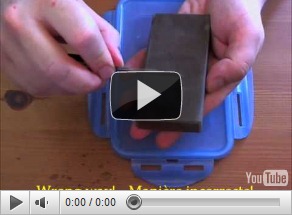
Click on the YouTube icon for full-sized video. Cliquez sur l’icône YouTube pour le vidéo à pleine-grandeur.
Bevelling a blade.
Sharpening a hollow-bevel knife.
Re-edge and fine-honing.
Get my free book here. Trouvez mon livret gratis ici.
The secret to sharp knives:
expensive stones!

Last time I only introduced stones and some knife designs, so here are the real demonstrations of sharpening. This technique is simple, basic, but used almost universally to achieve excellent results.  Depending on how badly the edge got rounded, it’s just a matter of progressing from a coarser stone to a finer one.
High quality (usually expensive) stones are a must. You get these stones from specialized woodworker shops, not your local hardware store. Cheap imitations just don’t do it and whatever miracle gizmo that comes out on the market has yet to prove reliability.
Le secret des bons couteaux:
les pierres dispendieuses!

La dernière fois, j’ai fait l’introduction des concepts de couteaux, alors voici les vraies démonstrations. La technique est simple, mais utilisée presqu’universellement pou obtenir les meilleurs résultats. Selon le degré de rondeur du bord coupant, il ne s’agit que de passer d’une pièrre plus rude à une pierre de plus en plus douce. 
Les pierres de haute haute qualité (habituellement dispendieuses) sont absolument nécessaires. Vous les trouverez dans les magasins spécialisés dans l’ébénisterie, pas votre caincaillerie du coin. Les imitations peuchères ne font simplement rien de bon et les bidules miracles qui arrivent sur le marché ont encore à prouver leur valeur.

Wednesday, July 13

Anniversary Recording + Knife Sharpening part 1

Last weekend marked 2 major milestones:
  1. Ten thousand visits to my blog:  really surprised and happy (71 countries)! Party smileThumbs up
  2. One year since I got my Lorée back from revoicing work at Teitelbaum Doublereed: and it still plays like a dream compared to before!
La fin-de-semaine dernière à marqué 2 étapes majeures:
  1. Dix mille visites à mon blogue:
    vraiment surpris (
    71 pays)! Party smileThumbs up
  2. Un an depuis le retour de mon Lorée de sa mise-à-niveau chez Teitelbaum Doublereed: et il demeure une merveille à comparer à avant son départ!
I was planning to celebrate by recording a full baroque sonata, but last week’s post explained that starting the gym and pool have backlashed with some disappointing results on the oboe. 2 weeks ago, there were no blips between the notes at all, now there are many. 2 weeks ago, I had more evenness and fluidity in technical passage than I ever had in my life, but beginning to work the muscles seems to have constricted my nerves and tensed my muscles and that fluidity is gone. Je comptais célébrer en enregistrant une sonate baroque complète, mais l’article de la semaine dernière a expliqué que débuter des activités au gymnase et piscine on entammé des résultats fâcheux. Il y a 2 semaines, belle fluidité technique sans entre-notes, maintenant, bien le contraire. L’écoulement des notes était sûrement meilleur que jamais auparavant, mais le travail physique semble avoir pincé des nergs et tendu des muscles de sorte à briser cette fluidité.
Actually, that sad story was last weekend, when I would have recorded the sonata. Since the weekend, I have been working with the roller foam, stretching machine and nerve flossing as per my physiotherapist, and things are looking much better, despite strain around the wrists and elbows. In fact, I am close to someone who has had severe arthritis in the spine and neck for many years. A few years ago, it was actually debilitating, but she undertook a lot of swimming and baths in salt water and has since recovered remarkably. In my case, I have to care for my nerve mobility before I can work out the arms, but her story echoes others I have encountered and so I am very encouraged. À vrai dire, cette histoire triste était la fin-de-semaine passée, quand j’aurais voulu enregistrer cette sonate. Depuis ce temps, je me suis entraîné avec un rouleau à masser, des machines à étirements et les exercices de ma physiothérapeute. Résultat, je me sens déjà mieux, malgré des serrements aux coudes et poignets.
Je suis proche de quelqu’un qui souffre d’arthrite sévère au dos et au cou. Il y a quelques annés c’en était débilettant, mais elle a entrepris la natation et les bains dans l’eau salée pour témoigner d’une récupération admirable. Dans mon cas, le problème est neuropathique, mais son histoire et celle d’autres reste encourageant.

Basic Knife Sharpening

Affûtage de base des couteaux

With any luck, next week I should be well enough to record the sonata to the best of my current abilities. In the mean time, I still read comments, questions and frustration over sharpening knives, so I thought it would be a good idea to present a few things.

Important: I use techniques for testing sharpness that can cause serious injury if done improperly. Do not do them without expert supervision! I accepts no responsibility of any kind for any incident resulting from misusing the information in the videos here included.

Avec un peu de chance, la semaine prochaine ira assez bien pour enregistrer cette sonate au meilleur de mes habiletés actuelles. Entretemps, je lis assez de commentaires, questions et frustrations au sujet de l’affûtage des couteaux que j’ai cru bon de faire quelques démonstrations.

Important: j’utilise des techniques pour vérifier la lame qui peuvent causer des blessures sérieuse si mal employées. Je n’admet aucune responsabilité d’aucune sorte en cas d’incident qui résulte de l’utilisation de l’information dans les vidéos ci-dessous.

These techniques are basic and you would be well advised to read more advanced references. Still, these are essentially all I do (progressing from coarser stone to smoother stone) to get my best results.

Ces techniques ne sont que la base et vous seriez bien avisés de lire d’avantage à ce sujet. Toujours est-il que c’est avec ces techniques (passant à des pierres toujours plus douces) que j’obtiens mes meilleurs résultats.
It turns out, even the basic considerations produced lots of videos, so I will only give half of them this time and the other time in another post. For a “crash-course” You can start with video [1], but the whole series should prove worth the time. Même si uniquement la base, les démonstrations ont fini par être assez nombreuses pour devoir les partager etnre deux articles. Pour un cours-éclair, passez au vidéo [1], mais la série entière devraît en valoir la peine.
Click the YouTube icon to see full size. Cliquez sur l’icône YouTube pour voir à pleine taille.

[0] Safety Concerns – Mise en Garde
[1] WRONG way explained.
[2] Intro. stones – pierres.
[3] Intro. knife design.
[4] Other stone, soft metal blade.

Saturday, January 8

Bach and Blue: greatness can be painful!

In another post, I was asked why I left music instead of taking up the baroque oboe. One (out of many) is that I got tendonitis and other injuries. With my current experience, I really urge you all to understand that these injuries are preventable and they can get far worse if left unchecked.

Firstly, realize that where you feel the pain is probably not where the problem is.

Case in point: I was just now practicing Bach’s concerto for oboe d’amore, At the end of bar 64 in the 1st mvt., there is a rather easy turn (on modern instruments, piece of cake!) but I keep missing it. After “woodshedding” it, I developed real strain and pain in my right elbow. I let it rest and when I tried again, I realized my neck was very tense and a nerve was pinched.

bachTurn

A good physiotherapist does the trick to recover, but I’m angry to realize that all this could have been prevented from my earliest days as a student.

Although we are artists, our performance depends on our animal body doing its job. Spending time on the computer is the WORST thing we can do…. oh joy for a software engineer! Our bodies need to move (large moves) and keep strong. Mostly, the back and neck require certain postures that are completely contrary to sitting with an instrument and playing.

I don’t care if you are in to sports, hip-hop dancing or yoga and meditation: please honour my pain by preventing this from ever happening to yourselves!

I wish you all a balanced sporty artistic life!