Showing posts with label musician's injury. Show all posts

Sunday, April 21

Fibromyalgia, Music and Livelihood – Vivre, la musique et la fibromyalgie

Ready or not….
I am currently practicing a variety of repertoire, and I have been wanting to make a recording of at least one tune for several weeks. Not done yet because I just don’t feel musically ready…. then I started thinking, professionals (or even performing amateurs) have scheduled concerts on set dates: they don’t have the luxury of not feeling ready! So I figure, for the sake of tracking an amateur’s life, I should produce recordings even when I don’t feel ready: that would track my progress much more authentically.
…Well, mounting pressure at work and surprize opportunities just left me no time over the past few weekends!
Paré, pas paré…
Je travaille actuellement un répertoire varié et je veux enregistrer au moins une pièce depuis plusieurs semaines. Ceci n’est pas fait parce que je ne me sens pas prêt, musicalement… mais j’y songe, les professionnels (et amateurs qui jouent sur scène) ont un agenda de concerts fixe, donc n’ont pas le luxe de ne pas se sentir prêt! Je me dis donc que je devrais enregistrer même lorsque pas prêt: cela ferait témoignage plus fidèle de mon dévelopement.
… b’en, la pression montante à l’ouvrage et des opportunités-surprisene m’on simplement pas laissé le temps ces dernières semaines!
IMS and physical Update:
The blog is also supposed to encourage people by tracking my battle against chronic pain ad fatigue. So here goes instead of music!
REMARK: what follows is a really happy and encouraging story!
SIM et situation physique:
Ce blogue veut encourager le monde en suivant ma lutte contre la douleur chronique et la fatigue chronique. Alors allons-y à la place de la musique!
REMARQUE: ce qui suit est une histoire vraiment heureuse et bourée d’espoir!
Fibromyalgia on the rise
More and more people are complaining of being always tired and pains that just don’t go away, no matter what they do and despite any amount of medication. When this persists for more than some months, and when medical science can’t find anything wrong (no infection, no injury, no congenital condition), they call this “fibromyalgia”: tight, tough painful muscles. This is usually accompanied by always feeling tired, although the condition of chronic fatigue could be either independent or the result of exhaustion from endless pain.
This is becoming apparent in all walks of life, but mostly people who either sit down at a desk all day or who wear down their bodies. I have been living with nonstop pain for 12 years now, at times so bad I could barely walk a hallway….. remember, there’s nothing wrong with me! (At least, nothing out of the ordinary for my age.)
fibromyalgiaPainLocations
fibromyalgia
La fibromyalgie arrache
le poil à la bête
De plus en plus de gens se plaignent d’avoir mal partout et d’être toujours fatigués en dépit de tout médicament. Quand ceci dûre plus de quelques mois et quand la médecine n’identifie aucune cause (aucune infection, blessure ou condition), on utilise le mot “fibromyalgie”: muscles tendus, fibreux et douloureux. Ceci est souvent accompagné de fatigue chronique, mais il est incertain ci ce dernier est un syndrôme indépendent ou un épuisement dû au mal qui ne relâche jamais.
Ceci devient apparent dans tous les métiers et professions, surtout où l’on doit rester assis toute la journée ou qui usent le corps. Je vis avec cette douleur sans relâche depuis 12 ans, par bouts, j’avais peine et misère à simplement marcher le corridor….. rappel: il n’y a rien de mal avec ma santé! (Enfin, rien d’anormal pour mon âge.)
Mind over Matter:
Just like most sufferers of chronic pain, I have seen more than a dozen doctors plus a few physiotherapists and massage therapists over the years, some who “specialize” in chronic pain and I have tried a large number of pills that claim to relieve the condition: no luck! As with many people, it seems medication has very strong side effects with almost no benefit and these can actually prevent me from concentrating, thus possibly halting my professional career! Naturally, this is unacceptable: I (and many others) prefer to suffer the pain and the mood swings that go with it.
Consequently, I have seen statistics that show sufferers of chronic pain and fatigue develop severe depression leading to a suicide rate comparable to the death rate ascribed to diabetes! Believe me, I can relate to that.
The only other advice that medical science is capable of offering is relaxation, fitness and stress reduction.
thomasBlanchetTraiteMusetteBorjon1672
fanClub
L’esprit mène le corps.
Comme la majorité des souffrants de douleur chronique, j’ai vu plus d’une douzaine de médecins et quelques physiothérapeutes et massothérapeutes (quelques-uns “spécialistes” en douleur chronique) et j’ai essayé toutes sortes de pillules qui prétendent soulager la condition: rien à faire! Histoire commune, aucun bénéfice évident et effets secondaires puissants qui m’enlèvent la concentration, menaçant ma profession! Bien sûr, inacceptable: comme tant d’autres, je préfère accepter la douleur et les sautes d’humeur qui s’ensuivent. Par conséquent, j’ai vu des statistiques qui montrent qu’un nombre de souffrants développe une dépression sévère qui mène à un taux de suicide semblable à la mortalité lié à la diabète! Croyez-moi que je comprend pourquoi. Tout ce que peut ajouter la science médicale est la relaxation, la forme physique et la réduction du stress.
IMS, Tai-Chi and Foam Rollers
For the past couple of years, Providence has smiled on me and lead me to an amazing physiotherapist and gym trainer. They started me on a journey that does work: a discovery of activity and markers to predict near full recovery, possibly even become strong and athletic again. The key activities that, for me, accomplish this are:
  1. Gunn-IMS (Intra-Muscular StimulationPointer vers le haut) lengthens muscles, relieving tension that compresses nerves.
  2. Tai-Chi promotes mobility of the joints and nerves and promotes strength in stabilizer muscles (usually neglected at the gym)
  3. Foam Rollers (Pointer vers le haut) release myofascial knots in the muscles, promoting relaxation and regenerating sleep.
Dry_Needling_05
Tai_chi

roller
SIM, tai-chi et rouleaux
Depuis quelques années, la Providence m’a mené à des entraîneurs une physiothérapeute formidables. Ils m’ont mis sure une piste qui fonctionne pour vrai: une découverte d’activités et d’étalons qui prédisent un retour à une forme solide et possiblement une vie athlétique. Les activités qui m’aident le plus sont
  1. SIM-Gunn (Stimulation Intra-MusculairePointer vers le haut)  rallonge les muscles, soulageant la pression sur les nerfs
  2. Tai-chi favorise la mobilité des articulations et des nerfs et renforce les muscles stabilisateurs (négligés par le gymnase)
  3. Rouleaux de mousse (Pointer vers le haut) défont les noeuds dans les muscles, favorisant la détente et le sommeil réformateur.

Results as they stand today:

  • Saturday morning headaches:  gone! Posture when standing and sitting.
  • Wrist and forearm pain & weakness: gone, but need to strengthen.
  • Severe back pain while making breakfast: gone, but looming.
  • General stiffness and sensitivity to weather: still there but much more manageable.
  • dependency on pain medication: stabilized at 10% of what it was 4 years ago.
  • Use of vitamins supplements: restricted to basics for mood support.
  • Technical ability to play oboe: apparently no more limit other than time and concentration.
  • Ability to stand and walk: from a few minutes to an hour.
  • Short breath & low stamina: still a problem.
taiChi

Foam_Roller_Exercises2
Les résultats, mon état actuel :
  • Maux de tête du samedi matin : finis! Posture lorsqu’assis ou debout.
  • Douleur du poignet et avant-bras: finis mais besoin de renforcer.
  • Maux de dos sévères en préparant le déjeuner: parti mais le risque persiste.
  • Raideur générale et sensibilité à la météo: toujours là mais gérable.
  • Médicaments contre-douleur: stabilisé à environ 10% de ce que je prenais il y a environ 4 ans.
  • Suppléments vitaminiques: seulement les habituels pour aider avec l’humeur.
  • Habiletés techniques au hautbois: semble-t-il seulement limité par le temps et la concentration.
  • Abilité de marcher et me tenir debout: quelques minutes dans les années passées, environ une heure maintenant.
  • Piètre énergie et court de souffle: toujours le cas.

Monday, March 26

Sitting Career Death! – Assoyez la fin de votre carrière!


Blogger statistics is showing my previous post on pains caused by posture at the computer desk seems very popular. And I had promised more information on what I have learned on what can ruin your ability to play any instrument… but also how to recover from these pains.

Les statistiques Blogger montrent un intérêt accru sur mon article concernant les maux causés par la posture assise à l’ordinateur. J’ai aussi promis de traiter ce qui finir votre pouvoir de jouer d’un instrument… mais aussi comment revenir de ces maux.

Disclaimer:
I am not a health-care professional. Do not use the information in this or any other of my posts without consulting a professional in the medical field.

Désavoeu:
Je ne suis pas un professionnel des soins de santé. Veuillez consulter un professionnel du domaine médical avant d’utiliser l’information contenu dans mes articles.

In a previous article, I showed how posture at the computer desk can cause the body serious harm. This post will examine more closely how sitting down most of the day can wreck your musical career….. but also how simple care can prevent this from ever happening.

The following is an over-simplification to help understand how changes in posture due to life in the computer age can really harm the body. The damage can go unnoticed for years but it accumulates. A good physiotherapist can see it and show how to fix the trouble.

Dans un article précédent, j’ai montré comment la posture assise à l’ordinateur peut sérieusement nuire au corps. La présente examinera comment rester assis, pour la grande partie du jour, peut ruiner votre carrière musicale… mais aussi combien de simples précautions peuvent les prévenir.

Ce qui suit est une sur-simplification pour aider à comprendre comment fonctionne le corps et comment des modifications de la posture résultants de l’âge informatique peuvent vraiment endommager le corps. Le dommage peut rester innaperçu mais s’accumule. Un bon physiothérapeute peut voir les signes coureurs et vous montrer comment réparer les problêmes.

Emmanuel Pahud is probably the most prolific flute soloist since Jean-Pierre Rampal and James Galloway. He plays in the Berlin Philharmonic with Hansjörg Schellenberger, principal oboist and also internationally acclaimed soloist.
Air is everything to woodwinds–posture is everything to air!

Emmanuel Pahud, sûrement le plus illustre flutiste depuis Jean-Pierre Rampal et James Galloway, joue dans la Philharmonie de Berlin avec Hansjörg Schellenberger, hautbois principal et soliste international.

In this video, they discuss together sound production and the importance of posture on the airstream. “Everything that involves [body] tension gets in the way of the air stream” – Pahud.

Dans cette vidéo, ils discutent la production sonore et l’importance de la posture sur le vent. “Tout ce qui apporte la tension [du corps] entrave le souffle” – Pahud (trad. libre)

When standing normally, the spine has a natural curve, but the overall effect is to keep the back straight. Many leg muscles have an effect on these. Muscles that lift the knees and pull back for walking are connected to the hips and spine. We are built to stand and walk, and so our muscles have a natural length. standingNormal

Debout normalement, la colonne a une courbe naturelle, l’effet final étant un dos droit. Plusieurs muscles dans les jambes contribuent à cela.  Des muscles qui lèvent les genoux et tirent derrière pour marcher sont connectés aux haches et à la colonne. Nous sommes construits pour nous tenir debout et marcher, donnant ainsi aux muscles une longueur naturelle.

When we sit down, some muscles that normally pull when standing are now stretched and loose their pulling strength. Others are relaxed and literally shrink over time. sittingEffects

En nous assoyant, quelques muscles qui tirent lorsque debout sont étirés et perdent leur force. D’autres se détendent et rétrécissent avec le temsp.

As a result of this stretching and shrinkage, when we stand up again, the spine is not supported correctly and the pelvis is pulled forward by muscles now shortened. The opposite muscles are too relaxed to compensate which means the belly is rounded forward. Nerves exit the spine in the back, so the extra roundness causes compression on nerves.
Over time, this irritates the nerves and can cause sever pain (e.g. sciatica) and loss of strength and muscular coordination. In fact, I started this investigation when I started loosing speed on the bicycle and tripping and falling when running to catch the bus… I was only 32 years old!
standingEffectsOfSitting

Par conséquent, lorsque nous nous redressons debout, la colonne n’est pas correctement soutenue et les hanches sont tirées vers l’avant par les muscles rétrécis.  Les muscles opposés, trop rallongés, font que le bedon courbe d’avantage. Des nerfs qui sortent de la colonne dans le bas du dos s’en voient comprimés.
Avec le temps, les nerfs en sont irrités causant des douleurs intenses (p.ex. le sciatique) ainsi que de la perte de force et de coordination musculaire. En effet, j’ai commencé cette recherche après une perte de vitesse à vélo et m’enfargeant lorsque je courait pour ratrapper l’autobus… je n’avais que 32 ans!

The only way to repair this, the only thing to do is stretch the shortened muscles (some of them are in the back and behind the legs) and  strengthen the loosened muscles. My physiotherapist told me it would take (in my own personal case) 3-4 months of stretching exercises for the muscles to become capable of stretching!

Otherwise, the only way to keep the back straight is to lean forward or walk with knees very bent (to angle the hips correctly). Of course, both are very tiring and can cause many other pains!
walkingForward

walkingGorilla

La seule façon de réparer est d’étirer les muscles rétrécis (quelques-uns sont dans le dos et en arrière des jambes) et renforcer les muscles détendus. Ma physiothérapeute m’a dit que ça prendrait (dans mon cas précis) de 3 à 4 mois d’étirement avant même que les muscles ne soient capables de s’étirer!

Autrement, garder le dos droit veut dire soit me pencher vers l’avant ou me plier les genoux (pour angler le bassin correctement). Bien sûr, les deux options sont épuisants et causent d’autres douleurs!

Correct posture has an enormous impact on our musical breathing. There is a natural position for the arms with the shoulders resting backwards and downwards. This will cause the neck to be straight, the eyes high and the head high. standingShouldersGood

Une bonne posture a un impact majeur sur la respiration musicale. Les bras ont une position naturelle avec les épaules basses et vers l’arrière. Ceci favorise un cou droit avec les yeux et la tête haute.

Spending too much time with arms in front of the body (see here) can cause the back muscles to lengthen and the chest muscles to shrink. The head begins to look downward and this causes the back neck muscles to strain (ending in headaches!).

Visibly, this constricts proper breathing and can lead to pain in the shoulders and neck.
standingEffectsShoulders

Passer trop de temps avec les bras devant le corps (à lire) peut causer les muscles du dos à rallonger et ceux de la poitrine à rétrécir. La tête commence à baisser vers l’avant, causant ainsi une tension dans les msucles du cou (et des maux de tête!).

Visiblement, ceci entrave la bonne respiration et fini en douleur dans les épaules et dans le cou.

Finally, shoulders are connected to the neck. The shoulders therefore have a big impact on tension headaches because neck muscles can cause compression on many nerves. playingShouldersRelaxed

Enfin, les épaules sont reliées au cou. Par conséquent, les épaules jouent un rôle majeur dans les maux de tête puisque les muscles tirent sur le cou, comprimant ainsi plusieurs nerfs.

These nerves also control the arms and wrists. VERY often, pain in the wrists is actually caused by tilting the head and raising the left shoulder.

These also cause a twist in the back that causes degeneration of the vertebrae. Resulting compression on lumbar nerves causes pain and bad coordination in the legs.

I have pictures in my young 20s that essentially prophecy the headaches and arm troubles and leg pains I have today!
playingBackNeckTwinges

Les nerfs sortants du cou contrôllent aussi les bras et les mains. TRÈS souvent, la douleur ou la fatigue dans les poignets commencent par une tête inclinée et une épaule levée.

Ces dernières causent aussi une torsion dans le milieu du dos qui accélère la dégénération vertébrale. La compression sur les nerfs lombaires causent des douleurs et mal-coordination des jambes.

J’ai des photos de moi dans ma jeune 20e qui font prophécie des maux de tête et problèmes de bras et de jambes que je vis aujourd’hui!

Prevent the conditions from ever happening:

Have-fun and enjoy what your body is capable of doing: do sports! This includes dancing and hiking-camping. Athletics are not barbarous murderers of the arts!
I was very pleased that the gym at University of Ottawa attracts people both fat and fit and. People are encouraging and celebrate victories: a fat person who increases endurance by 5 minutes accomplished more than an athlete who lifts 100 pounds! Trainers are very eager to use their knowledge in human kinetics to help you become better musicians!
olympic-sports-icons

La Prévention vaut mieux que la guérison!
Amusez-vous dans le plaisir de ce que le corps peut faire: faites du sport! Ceci inclus la danse et le plein-air. L’athlétisme n’est pas barbare meurtrier des arts! J’ai été ravi de voir au gymnase de l’Université d’Ottawa du monde de toutes tailles: tout le monde encourage tout le monde et on prend plaisir à la réussite de ses buts: une grosse personne qui augmente de 5 minutes son endurance a mieux réussi qu’un athlète qui lève 50kilos!
Les entraîneurs sont éprouvent une grande lorsqu’ils appliquent leurs connaissances à vous aider à devenir de meilleurs musiciens!

What NOT to do:

The “Roman Chair”, military sit-ups and such strengthen and shorten the muscles that caused the problem in the first place!

captainsRomanChair

À ne PAS faire:

Cet appareil et les redressements-assis de style militaire renforcent et raccourcissent les muscles qui ont causé le problème!

Thursday, February 16

Hautbois, cure-Miracle-cure Oboe

Blogger statistics has been showing people coming to this blog were looking for:

  • information on reed making, especially gouging machines
  • information on exercises to help sound and endurance
  • recording and music technology
  • pain conditions and treatment.

The topic I like to discuss the least is my own pain condition. After all, my oboe revival is the best medicine for me and the more I am musically active, the better I feel! Besides, over the past year and some, I have observed real improvement in many respects. So I don't want to present a sad story when the real story is encouraging!

But for the sake of all musicians, especially those of you who are on the verge of beginning a professional career, it is important that you understand them, because you are at high risk of living them yourselves. In my student days, I got tendonitis: it was one factor in my decision to quit music. But now I know that there were preventable reasons for my own problems, and others might benefit from this hindsight.

Les statistiques de Blogger montre que les visiteurs arrivent souvent suite à une recherche d'information concernant:

  • la fabrication des anches, surtout les machines à gouger
  • les exercices d'embouchure
  • l'enregistrement et et la technologie musicale
  • les conditions de douleur et leur traitement.

Ce que j'aime le moins discuter est ma collection de douleurs. Après-tout, ma renaissance hautboïstique est mon meilleur médicament et le plus je suis actif en musique, le mieux je me sens! De toute façon, depuis un an et quelque, j'aperçois une amélioration dans bien des sens. Je ne veux donc pas présenter une histoire triste: la vérité est encourageante!

Mais pour le bien des musiciens, surtout ceux d'entre vous qui entamez (ou presque) votre carrière professionnelle, il est important que vous compreniez que vous êtes à risque élevé de développer vous-même ces maux. Dans mes jours d'étudiant, j'ai eu la tendinite: ce fut un facteur décisif pour quitter la musique. Mais maintenant je sais qu'il y avait des causes sous-jacentes qui auraient pu éviter, et le monde peut bien bénéficier de mon expérience.

alljoints         physiotherapy_vancouver_silhouette          foamRollerButtocks

List of Complaints and Treatments

Liste de conditions et traitements

As I'm writing this, I realize there's enough material for a chronicle blog. Let's then just start with two lists: what's giving me trouble and what I can do about it. I'll give details about them in future posts.
    1.    FCFS : fibromyalgia and chronic fatigue syndrome
        (enigmatic)
    2.    DDD : disc degeneration disease
        (it's not a disease, it's a natural part of aging)
    3.    MF : myofasciitis and muscular shrinkage
        (enigmatic)

DDD is a natural part of aging. Everyone who approaches the age of 40 likely has it, some more than others. The ugly thing is that not everyone suffers pain as a result and the degree of damage does not predict the degree of pain: in other words, some people can have bad cases and never suffer, some people can have moderate cases and have a hard time walking. Medical literature is at a loss to explain why.

Il m'est devenu évident qu'il y a assez de matière ici pour remplir une chronique. Commençons donc avec deux simples listes: ce qui me fait souffrir et ce que je peux en faire. Élaborations à venir dans les prochaines entrées.
    1.    SFFC : syndrome de fibromyalgie et de fatigue chronique
        (énigmatique)
    2.    DD : dégénération des disques
        (fonction naturelle de l'âge)
    3.    MF : myofasciite et rétrécissement musculaire
        (énigmatique)

Tout le monde qui approche l'âge de 40 aura sûrement une mesure de DD, certaines personnes plus que d'autres. L'énigme est que le degré de dégénération n'indique aucunement le degré de douleur. La science médicale ne sait expliquer, mais un cas moyen peut débiliter tandis qu'une personne atteinte d'un cas avancé peut ne jamais le savoir.

In Terms of Treatment

En termes de traitement


    1.    medication (pain relievers, neuro-inhibitors)
    2.    physiotherapy and other physical therapies
        => in particular IMS: intra-muscular stimulation
    3.    athletic activity and physical fitness
    4.    rest, relaxation and stress-relieving practices
    5.    very careful attention to diet and allergic factors


So far, the only real benefits have been from IMS, physical fitness and, very importantly, being as active a musician as I can be. In my case, IMS has not relieved fibromyalgia, but it has eliminated considerable pains in the arms and recurring headaches that were interfering with both my musical activity and my engineering career. IMS has allowed me to begin physical fitness, which is the best tool against fibromyalgia and chronic fatigue I have found yet.

   1.    médicaments (anti-inflammatoires, neuro-inhibiteur)
    2.    physiothérapie et autres thérapies physiques
        => en particulier la SIM
    3.    activité athlétique et maintien de la forme
    4.    repos, relaxation et réduction du stress
    5.    attention soignée la diète et aux facteurs allergènes
   
Jusqu'à maintenant, les seuls vrais résultats positifs viennent de la SIM, travailler la forme physique et, très important, rester aussi actif musicalement que possible. Dans mon cas, la SIM n'a pas réduit la fibromyalgie comme telle, mais elle a éliminé des douleurs considérables dans les bras et réduit le nombre de maux de tête cycliques qui ennuyaient sérieusement ladite activité musicale ainsi que ma profession d'ingénieur. La SIM m'a permis de recommencer à travailler la forme physique, ce qui s'est montré le meilleur outil contre la fibromyalgie et la fatigue chronique jusqu'à maintenant.

IMPORTANT:

IMS is a patented Canadian form of treatment (Pointing up) that, because it really works, earned Dr. Gunn the 2 highest honours a Canadian citizen can possibly get. I is NOT an electric current to stimulate muscle activity. It is a stimulation of the body's own healing and growth mechanisms by scratching offending parts of the muscle with medical-acupuncture needles. It must be recommended by specially trained and certified professionals (doctors or physiotherapists).

IMPORTANT:

La SIM est un traitement Canadien breveté (Pointing up) qui, parce qu'il fonctionne pour vrai, a mérité au Dr. Gunn les 2 honneurs les plus élevés dont un citoyen Canadien peut être décoré. Ce n'est PAS un courant électrique pour stimuler l'activité du muscle. C'est une stimulation des processus naturels de guérison et de croissance du corps utilisant des aiguilles de type acuponcture-médical. Ça doit être recommandé par un spécialiste certifiés (médecin ou physiothérapeute).

Sunday, October 30

HAPPY HALLOWE’EN!!!

happy_halloween_1024x768I’ve been having a horrifying Devil time at work these past few weeks, so I can’t record anything before few more weeks. In the meantime, in the spirit of fear and dread that go with this holiday, let me discuss the worst demon of our time, causing the most distress and ruining more lives in musicians and everyone that uses a computer: office posture! Vampire bat

IMS Update – good news:

My treatments are now once a month and things are going relatively well (my last recording shows how comfortable my fingers are playing). Now, after a treatment, I can get severely sore in the places treated during the afternoon. But the soreness does not last long.

This time I got some needles in the shoulder and lower back.  IMMEDIATELY after the 1st needle on my left shoulder, it relaxed and dropped something surprizing – it felt wonderful! The right shoulder took 3 needles and the dropping was not as dramatic, but still great.

I get rather bad back pains, especially in the morning: I’ve been getting these for well over 15 years, so I always thought I have a bad back. In fact, X-rays over the past couple of years show disc-degenerative-disorder (including arthritis) in the back and neck. This is normal for my age, but I thought it explained the pain. Well, no it does not explain the pain, and that is the good news! My physiotherapist did a good examination and concluded that my pain is due to nerve compression caused by tight muscles: these can be stretched back into shape!

pumkinEaterReal Demons Possessing us:
COMPUTER WORK!

Get it straight: sitting down all day is the single worst thing you can do to your body, period!

I’ll be drawing diagrams later to how seated posture is responsible for back pain in:

  • office workers
  • taxi, truck and bus drivers
  • heavy machinery operators
  • students and musicians.

In the meantime, here are some pictures to show how using the computer keyboard an mouse can injure your arms, cause horrible recurring headaches and seriously compromise your oboe playing! Here are also pictures to show the right way to use computer input devices so you won’t hurt yourself.

keyboard_tray_ergonomics WRONG way to sit at the computer!
  1. Shoulders behind the buttocks weakens the belly and causes compression on the lumbar nerves.
  2. Pressure from the keyboard tray on the wrists leads to carpal tunnel syndrome.
  3. Pressure of the chair arms irritates the arm nerves causing weakness and debilitating pain.
  4. Monitor below the eye-line causes you to move head forward and down which weakens the neck muscles and constricts cervical nerves.
  5. Leaning on the arms raises the shoulders which shorten the muscles and leads to severe headaches.
  6. Keyboard angled upward requires wrists pulling back the hand: extra force required to type.
wristrest1 ABSOLUTE WORST:
  1. The whole weight of the body on the arms against the table corner lead to serious irritation of the nerves and carpal tunnel syndrome.
  2. Shoulders in front of the buttocks shortens the leg-lifting muscles which will cause a “beer belly” and curved back: serious back pain!
  3. The wrist rests for the keyboard and mouse restricts free movement of the tendons.
  4. Only way to make it worse still: have the elbows on the table: cause strain on the neck.
ONLY_GOOD_WAY The single best posture:
  • Natural position and motion angles for elbows, fingers and wrists (see next image).
  • Shoulders directly above buttocks keeps back straight and encourages strong belly.
  • Keyboard just above the knees so elbows are in line with spine (encourage muscle relaxation), not forward, not back.
  • Keyboard and mouse should angle down (like this picture) never up!

See a study from Cornell University (click here).

How to improve even more:

  • Keep the monitor close and at eye level: favour an easy neck position.
  • Remove the chair arms: prevent the temptation to lean on them – it’s really best to just let the shoulders drop.
liftedFinger Opposing forces:
This image shows how the need to keep the finger up creates extra force. So pressing the mouse means not only resisting against the mouse, but also fighting against the upward force. It is not only the finger that strains, but also the wrist and forearm, as those muscles participate in the lift: they shorten over time. Opposing forearm muscles participate in the click motion and must work even harder when the wrist is crooked this way.

This principle is also applies to the elbows, shoulders and neck. Take some time to observe how your body strains and you will realize a great deal about how computer posture is the single worst contributor to pain in modern life!

Ghouls and Monsters in the “free world”:

Keeping a good posture that encourages your strength is a very simple issue. Apart from a good keyboard tray, no expense is needed. Be very careful: marketing people are really good at convincing health benefits of new gadgets that can actually cause pain and injury.

By definition, capitalism rewards people who have the most capital with even more capital (wealth). The dark side of capitalism is that there is no reward for actually helping people – if people get better, they don’t need to buy more gizmos! halloween-wallpaper-large005Marketing makes its companies look like good Samaritans who really want to help you; they will incorrectly quote studies that were incorrectly conducted to begin with: all for the soul purpose of making money, not helping people in pain!

This is precisely why lawyers quote the principle “caveat emptor”: buyer beware!

Happy Hallowe’en!

Wednesday, July 20

IMS Update and Performance Endurance

A little note on recent observations because people have been coming to this blog have been Googling “IMS” and such.

Practice Endurance vs. Performance

I’m at the point now, where I can practice (alone) for about 2 hour “straight”. Seeing as I’m just about ready to record a short 4-movement baroque sonata, I figured I should be able to play all movements from beginning to end. Uuuuhhhh, no! No such luck. I can do the 2nd movement, though loosing the musical character, and my face just blows out half way through the 3rd.

More endurance is definitely required for a performance than practice, when we stop and retake and rest in between. I suppose, then, that Cooper Wright’s advice was well given (see comment from here). Also, I’ve noticed that:

  1. when the mouth gets tired, the shoulders and hands tense up;
  2. when the arms gets tired, the face tenses up.

I don’t know if this is just me (because of fibromyalgia) or if it’s a general rule for everyone, but I think young musicians should pay attention to this.

IMS treatment, one month later

I am now seeing my physiotherapist every month instead of every 2 weeks. The last few times (still bi-weekly) the needles did not hurt anymore, hardly felt any twinges at all. But this time, the reaction was similar to approximately the 6th treatments… that is, not too much pain, but still a lot of reaction (sweats, soreness, fatigue). My physiotherapist was pleased to explain that it wasn’t because of more time between treatments, but because I had begun swimming and training: I am challenging my body and it is reacting to it. This is good because pushing the limits and treating the symptoms will help improve.

She did emphasize that blips between the notes when playing is bad news: it means I am not taking enough care of nerve mobility. My nerves are still constricted, so I need to do her exercises more. The exercises I presented in a previous post  are far, far, far too advanced for me. She said, if I can comfortably do those, I don’t need physio anymore! Winking smile However, the roller foam exercises for myofascial release are excellent and important. Now, I do those with a rolling pin where the huge roller can’t easily reach, and I have noticed more relaxation and control of the pedals when driving!

She fully agreed with the trainer at my gym that I should not work on building the body quite yet, rather, I should stretch muscle groups that are almost always problematic in people who sit at a computer (or reed making table). Once I have gained enough flexibility in the legs and nerve mobility in the arms, then my body will be able to build muscle mass without risking anything.

Wednesday, July 13

Anniversary Recording + Knife Sharpening part 1

Last weekend marked 2 major milestones:
  1. Ten thousand visits to my blog:  really surprised and happy (71 countries)! Party smileThumbs up
  2. One year since I got my Lorée back from revoicing work at Teitelbaum Doublereed: and it still plays like a dream compared to before!
La fin-de-semaine dernière à marqué 2 étapes majeures:
  1. Dix mille visites à mon blogue:
    vraiment surpris (
    71 pays)! Party smileThumbs up
  2. Un an depuis le retour de mon Lorée de sa mise-à-niveau chez Teitelbaum Doublereed: et il demeure une merveille à comparer à avant son départ!
I was planning to celebrate by recording a full baroque sonata, but last week’s post explained that starting the gym and pool have backlashed with some disappointing results on the oboe. 2 weeks ago, there were no blips between the notes at all, now there are many. 2 weeks ago, I had more evenness and fluidity in technical passage than I ever had in my life, but beginning to work the muscles seems to have constricted my nerves and tensed my muscles and that fluidity is gone. Je comptais célébrer en enregistrant une sonate baroque complète, mais l’article de la semaine dernière a expliqué que débuter des activités au gymnase et piscine on entammé des résultats fâcheux. Il y a 2 semaines, belle fluidité technique sans entre-notes, maintenant, bien le contraire. L’écoulement des notes était sûrement meilleur que jamais auparavant, mais le travail physique semble avoir pincé des nergs et tendu des muscles de sorte à briser cette fluidité.
Actually, that sad story was last weekend, when I would have recorded the sonata. Since the weekend, I have been working with the roller foam, stretching machine and nerve flossing as per my physiotherapist, and things are looking much better, despite strain around the wrists and elbows. In fact, I am close to someone who has had severe arthritis in the spine and neck for many years. A few years ago, it was actually debilitating, but she undertook a lot of swimming and baths in salt water and has since recovered remarkably. In my case, I have to care for my nerve mobility before I can work out the arms, but her story echoes others I have encountered and so I am very encouraged. À vrai dire, cette histoire triste était la fin-de-semaine passée, quand j’aurais voulu enregistrer cette sonate. Depuis ce temps, je me suis entraîné avec un rouleau à masser, des machines à étirements et les exercices de ma physiothérapeute. Résultat, je me sens déjà mieux, malgré des serrements aux coudes et poignets.
Je suis proche de quelqu’un qui souffre d’arthrite sévère au dos et au cou. Il y a quelques annés c’en était débilettant, mais elle a entrepris la natation et les bains dans l’eau salée pour témoigner d’une récupération admirable. Dans mon cas, le problème est neuropathique, mais son histoire et celle d’autres reste encourageant.

Basic Knife Sharpening

Affûtage de base des couteaux

With any luck, next week I should be well enough to record the sonata to the best of my current abilities. In the mean time, I still read comments, questions and frustration over sharpening knives, so I thought it would be a good idea to present a few things.

Important: I use techniques for testing sharpness that can cause serious injury if done improperly. Do not do them without expert supervision! I accepts no responsibility of any kind for any incident resulting from misusing the information in the videos here included.

Avec un peu de chance, la semaine prochaine ira assez bien pour enregistrer cette sonate au meilleur de mes habiletés actuelles. Entretemps, je lis assez de commentaires, questions et frustrations au sujet de l’affûtage des couteaux que j’ai cru bon de faire quelques démonstrations.

Important: j’utilise des techniques pour vérifier la lame qui peuvent causer des blessures sérieuse si mal employées. Je n’admet aucune responsabilité d’aucune sorte en cas d’incident qui résulte de l’utilisation de l’information dans les vidéos ci-dessous.

These techniques are basic and you would be well advised to read more advanced references. Still, these are essentially all I do (progressing from coarser stone to smoother stone) to get my best results.

Ces techniques ne sont que la base et vous seriez bien avisés de lire d’avantage à ce sujet. Toujours est-il que c’est avec ces techniques (passant à des pierres toujours plus douces) que j’obtiens mes meilleurs résultats.
It turns out, even the basic considerations produced lots of videos, so I will only give half of them this time and the other time in another post. For a “crash-course” You can start with video [1], but the whole series should prove worth the time. Même si uniquement la base, les démonstrations ont fini par être assez nombreuses pour devoir les partager etnre deux articles. Pour un cours-éclair, passez au vidéo [1], mais la série entière devraît en valoir la peine.
Click the YouTube icon to see full size. Cliquez sur l’icône YouTube pour voir à pleine taille.

[0] Safety Concerns – Mise en Garde
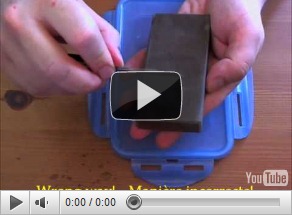
[1] WRONG way explained.
[2] Intro. stones – pierres.
[3] Intro. knife design.
[4] Other stone, soft metal blade.

Wednesday, January 26

Bug away and bug again!

What follows is crucial to musicians, don’t compromise your ability to perform with ease.

I think its a fear factor that makes musicians sulk away from these discussions, so I’ll try to keep it short. Fear not and don’t shrink away in denial: the quicker you act the easier it is to fix! Chances are, you don’t need to spend any money either.

If your country/province/state does not pay for simple doctor consultations, then consider medical insurance as the single most important investment in your musical career! Whatever you do, if you have any trouble performing a piece of music that normally works well for you, go see if there might be something physical like a pinched nerve or something.

For the past 10 odd years, doctors galore have been telling me there is nothing wrong with me: I’m good to train for the Iron Man Triathlon! Strange that I have been tired (not sleepy, tired) since the age of 7 and for the past 10 odd years I am always in pain! Sometimes, not often, the pain makes pray for death, but most of the time its a nagging jab or pull that just won’t let me do a normal day’s work. Sometimes its everywhere, sometimes its only the back or only the hips or only the neck or only something else.

I have seen a number of physiotherapists, massage therapists, acupuncture  for the rare times that a doctor did diagnose tennis elbow or sciatica – how banal can you get? Now, I have been bugging to see a specialist, buzzing from one doctor to the next until I finally found a physiotherapist specializing in both musicians injuries and chronic pain (web site) – she treats the performers of the National Arts Center Orchestra (NACO).

FINALLY! A professional has seen that my body is a mess, but also knows what to do about it! She gave me some preparatory exercises for a new form of treatment that will prompt my body to heal itself. After that, I’ll be able to start working on building strength again: notice that I used to be a Master Corporal in the Army and now I can’t squeeze against a little lady’s arms!

Things you should do (no cost at all) to prevent injury:

  • Do a Google Search on Ergonomics and Posture, especially seated and at the computer: apply what you learn!
  • Get a Kooiman thumb rest or the Music-Stand bell-hook
  • Do a full set of stretching every evening
    (find a book from your local library on standard stretching for golfers)
  • Drinking 2 liters of water (half a gallon) every day really makes a difference!
  • Keep in shape! I don’t care if its hockey, yoga, kick-boxing or hip-hop dancing, keep your body moving!

I’ll keep adding more on this subject as things develop.

Saturday, January 8

Bach and Blue: greatness can be painful!

In another post, I was asked why I left music instead of taking up the baroque oboe. One (out of many) is that I got tendonitis and other injuries. With my current experience, I really urge you all to understand that these injuries are preventable and they can get far worse if left unchecked.

Firstly, realize that where you feel the pain is probably not where the problem is.

Case in point: I was just now practicing Bach’s concerto for oboe d’amore, At the end of bar 64 in the 1st mvt., there is a rather easy turn (on modern instruments, piece of cake!) but I keep missing it. After “woodshedding” it, I developed real strain and pain in my right elbow. I let it rest and when I tried again, I realized my neck was very tense and a nerve was pinched.

bachTurn

A good physiotherapist does the trick to recover, but I’m angry to realize that all this could have been prevented from my earliest days as a student.

Although we are artists, our performance depends on our animal body doing its job. Spending time on the computer is the WORST thing we can do…. oh joy for a software engineer! Our bodies need to move (large moves) and keep strong. Mostly, the back and neck require certain postures that are completely contrary to sitting with an instrument and playing.

I don’t care if you are in to sports, hip-hop dancing or yoga and meditation: please honour my pain by preventing this from ever happening to yourselves!

I wish you all a balanced sporty artistic life!