Showing posts with label musician's physical activity. Show all posts

Thursday, February 16

Hautbois, cure-Miracle-cure Oboe

Blogger statistics has been showing people coming to this blog were looking for:

  • information on reed making, especially gouging machines
  • information on exercises to help sound and endurance
  • recording and music technology
  • pain conditions and treatment.

The topic I like to discuss the least is my own pain condition. After all, my oboe revival is the best medicine for me and the more I am musically active, the better I feel! Besides, over the past year and some, I have observed real improvement in many respects. So I don't want to present a sad story when the real story is encouraging!

But for the sake of all musicians, especially those of you who are on the verge of beginning a professional career, it is important that you understand them, because you are at high risk of living them yourselves. In my student days, I got tendonitis: it was one factor in my decision to quit music. But now I know that there were preventable reasons for my own problems, and others might benefit from this hindsight.

Les statistiques de Blogger montre que les visiteurs arrivent souvent suite à une recherche d'information concernant:

  • la fabrication des anches, surtout les machines à gouger
  • les exercices d'embouchure
  • l'enregistrement et et la technologie musicale
  • les conditions de douleur et leur traitement.

Ce que j'aime le moins discuter est ma collection de douleurs. Après-tout, ma renaissance hautboïstique est mon meilleur médicament et le plus je suis actif en musique, le mieux je me sens! De toute façon, depuis un an et quelque, j'aperçois une amélioration dans bien des sens. Je ne veux donc pas présenter une histoire triste: la vérité est encourageante!

Mais pour le bien des musiciens, surtout ceux d'entre vous qui entamez (ou presque) votre carrière professionnelle, il est important que vous compreniez que vous êtes à risque élevé de développer vous-même ces maux. Dans mes jours d'étudiant, j'ai eu la tendinite: ce fut un facteur décisif pour quitter la musique. Mais maintenant je sais qu'il y avait des causes sous-jacentes qui auraient pu éviter, et le monde peut bien bénéficier de mon expérience.

alljoints         physiotherapy_vancouver_silhouette          foamRollerButtocks

List of Complaints and Treatments

Liste de conditions et traitements

As I'm writing this, I realize there's enough material for a chronicle blog. Let's then just start with two lists: what's giving me trouble and what I can do about it. I'll give details about them in future posts.
    1.    FCFS : fibromyalgia and chronic fatigue syndrome
        (enigmatic)
    2.    DDD : disc degeneration disease
        (it's not a disease, it's a natural part of aging)
    3.    MF : myofasciitis and muscular shrinkage
        (enigmatic)

DDD is a natural part of aging. Everyone who approaches the age of 40 likely has it, some more than others. The ugly thing is that not everyone suffers pain as a result and the degree of damage does not predict the degree of pain: in other words, some people can have bad cases and never suffer, some people can have moderate cases and have a hard time walking. Medical literature is at a loss to explain why.

Il m'est devenu évident qu'il y a assez de matière ici pour remplir une chronique. Commençons donc avec deux simples listes: ce qui me fait souffrir et ce que je peux en faire. Élaborations à venir dans les prochaines entrées.
    1.    SFFC : syndrome de fibromyalgie et de fatigue chronique
        (énigmatique)
    2.    DD : dégénération des disques
        (fonction naturelle de l'âge)
    3.    MF : myofasciite et rétrécissement musculaire
        (énigmatique)

Tout le monde qui approche l'âge de 40 aura sûrement une mesure de DD, certaines personnes plus que d'autres. L'énigme est que le degré de dégénération n'indique aucunement le degré de douleur. La science médicale ne sait expliquer, mais un cas moyen peut débiliter tandis qu'une personne atteinte d'un cas avancé peut ne jamais le savoir.

In Terms of Treatment

En termes de traitement


    1.    medication (pain relievers, neuro-inhibitors)
    2.    physiotherapy and other physical therapies
        => in particular IMS: intra-muscular stimulation
    3.    athletic activity and physical fitness
    4.    rest, relaxation and stress-relieving practices
    5.    very careful attention to diet and allergic factors


So far, the only real benefits have been from IMS, physical fitness and, very importantly, being as active a musician as I can be. In my case, IMS has not relieved fibromyalgia, but it has eliminated considerable pains in the arms and recurring headaches that were interfering with both my musical activity and my engineering career. IMS has allowed me to begin physical fitness, which is the best tool against fibromyalgia and chronic fatigue I have found yet.

   1.    médicaments (anti-inflammatoires, neuro-inhibiteur)
    2.    physiothérapie et autres thérapies physiques
        => en particulier la SIM
    3.    activité athlétique et maintien de la forme
    4.    repos, relaxation et réduction du stress
    5.    attention soignée la diète et aux facteurs allergènes
   
Jusqu'à maintenant, les seuls vrais résultats positifs viennent de la SIM, travailler la forme physique et, très important, rester aussi actif musicalement que possible. Dans mon cas, la SIM n'a pas réduit la fibromyalgie comme telle, mais elle a éliminé des douleurs considérables dans les bras et réduit le nombre de maux de tête cycliques qui ennuyaient sérieusement ladite activité musicale ainsi que ma profession d'ingénieur. La SIM m'a permis de recommencer à travailler la forme physique, ce qui s'est montré le meilleur outil contre la fibromyalgie et la fatigue chronique jusqu'à maintenant.

IMPORTANT:

IMS is a patented Canadian form of treatment (Pointing up) that, because it really works, earned Dr. Gunn the 2 highest honours a Canadian citizen can possibly get. I is NOT an electric current to stimulate muscle activity. It is a stimulation of the body's own healing and growth mechanisms by scratching offending parts of the muscle with medical-acupuncture needles. It must be recommended by specially trained and certified professionals (doctors or physiotherapists).

IMPORTANT:

La SIM est un traitement Canadien breveté (Pointing up) qui, parce qu'il fonctionne pour vrai, a mérité au Dr. Gunn les 2 honneurs les plus élevés dont un citoyen Canadien peut être décoré. Ce n'est PAS un courant électrique pour stimuler l'activité du muscle. C'est une stimulation des processus naturels de guérison et de croissance du corps utilisant des aiguilles de type acuponcture-médical. Ça doit être recommandé par un spécialiste certifiés (médecin ou physiothérapeute).

Wednesday, July 20

IMS Update and Performance Endurance

A little note on recent observations because people have been coming to this blog have been Googling “IMS” and such.

Practice Endurance vs. Performance

I’m at the point now, where I can practice (alone) for about 2 hour “straight”. Seeing as I’m just about ready to record a short 4-movement baroque sonata, I figured I should be able to play all movements from beginning to end. Uuuuhhhh, no! No such luck. I can do the 2nd movement, though loosing the musical character, and my face just blows out half way through the 3rd.

More endurance is definitely required for a performance than practice, when we stop and retake and rest in between. I suppose, then, that Cooper Wright’s advice was well given (see comment from here). Also, I’ve noticed that:

  1. when the mouth gets tired, the shoulders and hands tense up;
  2. when the arms gets tired, the face tenses up.

I don’t know if this is just me (because of fibromyalgia) or if it’s a general rule for everyone, but I think young musicians should pay attention to this.

IMS treatment, one month later

I am now seeing my physiotherapist every month instead of every 2 weeks. The last few times (still bi-weekly) the needles did not hurt anymore, hardly felt any twinges at all. But this time, the reaction was similar to approximately the 6th treatments… that is, not too much pain, but still a lot of reaction (sweats, soreness, fatigue). My physiotherapist was pleased to explain that it wasn’t because of more time between treatments, but because I had begun swimming and training: I am challenging my body and it is reacting to it. This is good because pushing the limits and treating the symptoms will help improve.

She did emphasize that blips between the notes when playing is bad news: it means I am not taking enough care of nerve mobility. My nerves are still constricted, so I need to do her exercises more. The exercises I presented in a previous post  are far, far, far too advanced for me. She said, if I can comfortably do those, I don’t need physio anymore! Winking smile However, the roller foam exercises for myofascial release are excellent and important. Now, I do those with a rolling pin where the huge roller can’t easily reach, and I have noticed more relaxation and control of the pedals when driving!

She fully agreed with the trainer at my gym that I should not work on building the body quite yet, rather, I should stretch muscle groups that are almost always problematic in people who sit at a computer (or reed making table). Once I have gained enough flexibility in the legs and nerve mobility in the arms, then my body will be able to build muscle mass without risking anything.

Wednesday, July 13

Anniversary Recording + Knife Sharpening part 1

Last weekend marked 2 major milestones:
  1. Ten thousand visits to my blog:  really surprised and happy (71 countries)! Party smileThumbs up
  2. One year since I got my Lorée back from revoicing work at Teitelbaum Doublereed: and it still plays like a dream compared to before!
La fin-de-semaine dernière à marqué 2 étapes majeures:
  1. Dix mille visites à mon blogue:
    vraiment surpris (
    71 pays)! Party smileThumbs up
  2. Un an depuis le retour de mon Lorée de sa mise-à-niveau chez Teitelbaum Doublereed: et il demeure une merveille à comparer à avant son départ!
I was planning to celebrate by recording a full baroque sonata, but last week’s post explained that starting the gym and pool have backlashed with some disappointing results on the oboe. 2 weeks ago, there were no blips between the notes at all, now there are many. 2 weeks ago, I had more evenness and fluidity in technical passage than I ever had in my life, but beginning to work the muscles seems to have constricted my nerves and tensed my muscles and that fluidity is gone. Je comptais célébrer en enregistrant une sonate baroque complète, mais l’article de la semaine dernière a expliqué que débuter des activités au gymnase et piscine on entammé des résultats fâcheux. Il y a 2 semaines, belle fluidité technique sans entre-notes, maintenant, bien le contraire. L’écoulement des notes était sûrement meilleur que jamais auparavant, mais le travail physique semble avoir pincé des nergs et tendu des muscles de sorte à briser cette fluidité.
Actually, that sad story was last weekend, when I would have recorded the sonata. Since the weekend, I have been working with the roller foam, stretching machine and nerve flossing as per my physiotherapist, and things are looking much better, despite strain around the wrists and elbows. In fact, I am close to someone who has had severe arthritis in the spine and neck for many years. A few years ago, it was actually debilitating, but she undertook a lot of swimming and baths in salt water and has since recovered remarkably. In my case, I have to care for my nerve mobility before I can work out the arms, but her story echoes others I have encountered and so I am very encouraged. À vrai dire, cette histoire triste était la fin-de-semaine passée, quand j’aurais voulu enregistrer cette sonate. Depuis ce temps, je me suis entraîné avec un rouleau à masser, des machines à étirements et les exercices de ma physiothérapeute. Résultat, je me sens déjà mieux, malgré des serrements aux coudes et poignets.
Je suis proche de quelqu’un qui souffre d’arthrite sévère au dos et au cou. Il y a quelques annés c’en était débilettant, mais elle a entrepris la natation et les bains dans l’eau salée pour témoigner d’une récupération admirable. Dans mon cas, le problème est neuropathique, mais son histoire et celle d’autres reste encourageant.

Basic Knife Sharpening

Affûtage de base des couteaux

With any luck, next week I should be well enough to record the sonata to the best of my current abilities. In the mean time, I still read comments, questions and frustration over sharpening knives, so I thought it would be a good idea to present a few things.

Important: I use techniques for testing sharpness that can cause serious injury if done improperly. Do not do them without expert supervision! I accepts no responsibility of any kind for any incident resulting from misusing the information in the videos here included.

Avec un peu de chance, la semaine prochaine ira assez bien pour enregistrer cette sonate au meilleur de mes habiletés actuelles. Entretemps, je lis assez de commentaires, questions et frustrations au sujet de l’affûtage des couteaux que j’ai cru bon de faire quelques démonstrations.

Important: j’utilise des techniques pour vérifier la lame qui peuvent causer des blessures sérieuse si mal employées. Je n’admet aucune responsabilité d’aucune sorte en cas d’incident qui résulte de l’utilisation de l’information dans les vidéos ci-dessous.

These techniques are basic and you would be well advised to read more advanced references. Still, these are essentially all I do (progressing from coarser stone to smoother stone) to get my best results.

Ces techniques ne sont que la base et vous seriez bien avisés de lire d’avantage à ce sujet. Toujours est-il que c’est avec ces techniques (passant à des pierres toujours plus douces) que j’obtiens mes meilleurs résultats.
It turns out, even the basic considerations produced lots of videos, so I will only give half of them this time and the other time in another post. For a “crash-course” You can start with video [1], but the whole series should prove worth the time. Même si uniquement la base, les démonstrations ont fini par être assez nombreuses pour devoir les partager etnre deux articles. Pour un cours-éclair, passez au vidéo [1], mais la série entière devraît en valoir la peine.
Click the YouTube icon to see full size. Cliquez sur l’icône YouTube pour voir à pleine taille.

[0] Safety Concerns – Mise en Garde
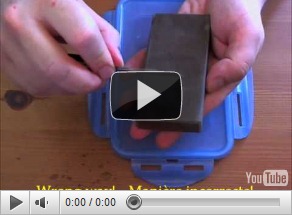
[1] WRONG way explained.
[2] Intro. stones – pierres.
[3] Intro. knife design.
[4] Other stone, soft metal blade.

Wednesday, July 6

Physical update – exercise: a double-edged dagger

Last week my wife and I took an enrolment in a local gym+pool. An orientation session was a real revelation, but the results have not all been positive. In fact, evenness of note flow while playing is not as easy, my neck nerve is pulling again and I’ve started feeling that scratch around my wrist and back-of-hand again…. not good!

I had asked my physiotherapist if I was ready to start going to the pool and she said it was fine, but gave many restrictions on what I could do: essentially, no straining of the arms …. how do you move in the pool without using arm strength? I started with back crawl (that was too much) and then just walking while using the arms to move away the water…. still too much. And also, using the hot-tub seems to have worsened the neck-strains that cause headaches. I’ve been getting headaches much more frequently, not so painful, just so annoying normal daily activities are difficult.

On the positive side, the trainer explained why I have a “dip” in my lower back which bulges my belly and also what is increasing constriction on the sciatic nerves, which results in weak legs and sciatica. Essentially, having spent too many years doing mostly computer work and math sitting at a desk really wrecked it for me. Good news, this gym has special machines that increase the effectiveness of key stretching movements that would not work half as well at home, on the couch.

Work the nerves, not just the muscles!
The physiotherapist had given me really simple exercises to do from the very beginning. I had also been neglecting these from the very beginning, mostly because they appear so simple and it’s hard to immediately see the benefits. Here is a video that explains the process, what I had to do was only one: lye on my back with arms out to the side and raise/lower them – that’s all!

Now, with the resumption of pain and blips when playing, I think I better understand why she gave me these exercises.

On another positive note, I had been wanting to ask for (and need to pay for) IMS in the legs as well as in the arms because I had been complaining for over 20 years of weak, sore legs, despite my proficiency on a bicycle and alpine skiing.

Luckily, the gym trainer gave me other exercises that just might work better: IMS is for neuropathic problems, my legs might be simply muscular concerns. He showed my how to use foam rollers to essentially roll-out knots in my muscles like a rolling-pin on a pie-crust…… it HUUUURRRRRTS!!! just as bad as IMS! But apparently the pain stops as the muscles get better. Strangely, when my wife does the exercise, she feels no pain at all while I literally sob from it! But the strain in my calves is likely reducing the depth of my sleep, so fixing that is really important.

So, for the next week, I’ll pay more attention to what the physiotherapist said, do her exercises and concentrate on my legs at the gym. Hopefully, musical fluidity will return quickly.

Saturday, January 8

Bach and Blue: greatness can be painful!

In another post, I was asked why I left music instead of taking up the baroque oboe. One (out of many) is that I got tendonitis and other injuries. With my current experience, I really urge you all to understand that these injuries are preventable and they can get far worse if left unchecked.

Firstly, realize that where you feel the pain is probably not where the problem is.

Case in point: I was just now practicing Bach’s concerto for oboe d’amore, At the end of bar 64 in the 1st mvt., there is a rather easy turn (on modern instruments, piece of cake!) but I keep missing it. After “woodshedding” it, I developed real strain and pain in my right elbow. I let it rest and when I tried again, I realized my neck was very tense and a nerve was pinched.

bachTurn

A good physiotherapist does the trick to recover, but I’m angry to realize that all this could have been prevented from my earliest days as a student.

Although we are artists, our performance depends on our animal body doing its job. Spending time on the computer is the WORST thing we can do…. oh joy for a software engineer! Our bodies need to move (large moves) and keep strong. Mostly, the back and neck require certain postures that are completely contrary to sitting with an instrument and playing.

I don’t care if you are in to sports, hip-hop dancing or yoga and meditation: please honour my pain by preventing this from ever happening to yourselves!

I wish you all a balanced sporty artistic life!