Showing posts with label affilage. Show all posts

Sunday, July 17

Knife Sharpening, part 2 – Affûtage, 2e partie.

Physical Update
My shoulder, elbow and wrist are doing much better than last week: the flossing and reduction in speed of activity definitely helped. But I want to give one more week before recording the sonata…. IT’S HARRY POTTER’S LAST MOVIE THIS WEEKEND!
I still think the 1st was the best!
État physique en bref.
Mon épaule, coude et poignet vont beaucoup mieux: les exercises physiothérapeutiques et la réduction d’activité ont définitivement aidé. Mais je veux donner une autre semaine avant d’enregistrer la sonate…. C’EST LE DERNIER DE HARRY POTTER CETTE FIN-DE-SEMAINE!
Je pense toujours que le 1er était le meilleur!
The secret to good reeds:
It has become a common saying that: “The 2 secrets for good reeds are: 1. sharp knives, 2. sharp knives.” …. well, I would like to amend that to 4 secrets of good reed-making: 1. good cane, 2. sharp knives, 3. good cane, 4. sharp knives!
MANY oboists have witnessed that you can do almost anything to a good piece of cane and it will play well, no matter how badly you handle it (and there’s nothing to be done with a bad piece of cane). However, the devastation caused by an improperly sharpened knife is undeniable and once you’ve used a well sharpened knife, nothing else will do.
Le secret des bonnes anches:
C’est devenu monnaie courante de dire que le secrèt des bonnes anches est d’abord un couteau bien coupant et ensuite un couteau bien coupant! Je voudrais bien modifier en disant: 1. bon roseau, 2. bon tranchant, 3. bon roseau, 4. bon tranchant!

BEAUCOUP de hautboïstes attesteront qu’on peut faire presque n’importe-quoi avec un bon roseau et il jouera bien (à l’inverse, rien à faire avec un mauvais roseau). Par contre, le dommage causé par un couteau mal affilé est indéniable et lorsqu’on en a utilisé un bien affûté, rien d’autre ne fera l’affaire.
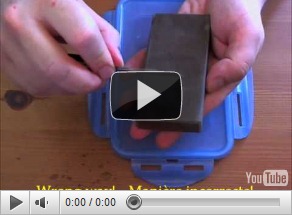
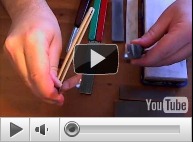
Click on the YouTube icon for full-sized video. Cliquez sur l’icône YouTube pour le vidéo à pleine-grandeur.
Bevelling a blade.
Sharpening a hollow-bevel knife.
Re-edge and fine-honing.
Get my free book here. Trouvez mon livret gratis ici.
The secret to sharp knives:
expensive stones!

Last time I only introduced stones and some knife designs, so here are the real demonstrations of sharpening. This technique is simple, basic, but used almost universally to achieve excellent results.  Depending on how badly the edge got rounded, it’s just a matter of progressing from a coarser stone to a finer one.
High quality (usually expensive) stones are a must. You get these stones from specialized woodworker shops, not your local hardware store. Cheap imitations just don’t do it and whatever miracle gizmo that comes out on the market has yet to prove reliability.
Le secret des bons couteaux:
les pierres dispendieuses!

La dernière fois, j’ai fait l’introduction des concepts de couteaux, alors voici les vraies démonstrations. La technique est simple, mais utilisée presqu’universellement pou obtenir les meilleurs résultats. Selon le degré de rondeur du bord coupant, il ne s’agit que de passer d’une pièrre plus rude à une pierre de plus en plus douce. 
Les pierres de haute haute qualité (habituellement dispendieuses) sont absolument nécessaires. Vous les trouverez dans les magasins spécialisés dans l’ébénisterie, pas votre caincaillerie du coin. Les imitations peuchères ne font simplement rien de bon et les bidules miracles qui arrivent sur le marché ont encore à prouver leur valeur.

Wednesday, July 13

Anniversary Recording + Knife Sharpening part 1

Last weekend marked 2 major milestones:
  1. Ten thousand visits to my blog:  really surprised and happy (71 countries)! Party smileThumbs up
  2. One year since I got my Lorée back from revoicing work at Teitelbaum Doublereed: and it still plays like a dream compared to before!
La fin-de-semaine dernière à marqué 2 étapes majeures:
  1. Dix mille visites à mon blogue:
    vraiment surpris (
    71 pays)! Party smileThumbs up
  2. Un an depuis le retour de mon Lorée de sa mise-à-niveau chez Teitelbaum Doublereed: et il demeure une merveille à comparer à avant son départ!
I was planning to celebrate by recording a full baroque sonata, but last week’s post explained that starting the gym and pool have backlashed with some disappointing results on the oboe. 2 weeks ago, there were no blips between the notes at all, now there are many. 2 weeks ago, I had more evenness and fluidity in technical passage than I ever had in my life, but beginning to work the muscles seems to have constricted my nerves and tensed my muscles and that fluidity is gone. Je comptais célébrer en enregistrant une sonate baroque complète, mais l’article de la semaine dernière a expliqué que débuter des activités au gymnase et piscine on entammé des résultats fâcheux. Il y a 2 semaines, belle fluidité technique sans entre-notes, maintenant, bien le contraire. L’écoulement des notes était sûrement meilleur que jamais auparavant, mais le travail physique semble avoir pincé des nergs et tendu des muscles de sorte à briser cette fluidité.
Actually, that sad story was last weekend, when I would have recorded the sonata. Since the weekend, I have been working with the roller foam, stretching machine and nerve flossing as per my physiotherapist, and things are looking much better, despite strain around the wrists and elbows. In fact, I am close to someone who has had severe arthritis in the spine and neck for many years. A few years ago, it was actually debilitating, but she undertook a lot of swimming and baths in salt water and has since recovered remarkably. In my case, I have to care for my nerve mobility before I can work out the arms, but her story echoes others I have encountered and so I am very encouraged. À vrai dire, cette histoire triste était la fin-de-semaine passée, quand j’aurais voulu enregistrer cette sonate. Depuis ce temps, je me suis entraîné avec un rouleau à masser, des machines à étirements et les exercices de ma physiothérapeute. Résultat, je me sens déjà mieux, malgré des serrements aux coudes et poignets.
Je suis proche de quelqu’un qui souffre d’arthrite sévère au dos et au cou. Il y a quelques annés c’en était débilettant, mais elle a entrepris la natation et les bains dans l’eau salée pour témoigner d’une récupération admirable. Dans mon cas, le problème est neuropathique, mais son histoire et celle d’autres reste encourageant.

Basic Knife Sharpening

Affûtage de base des couteaux

With any luck, next week I should be well enough to record the sonata to the best of my current abilities. In the mean time, I still read comments, questions and frustration over sharpening knives, so I thought it would be a good idea to present a few things.

Important: I use techniques for testing sharpness that can cause serious injury if done improperly. Do not do them without expert supervision! I accepts no responsibility of any kind for any incident resulting from misusing the information in the videos here included.

Avec un peu de chance, la semaine prochaine ira assez bien pour enregistrer cette sonate au meilleur de mes habiletés actuelles. Entretemps, je lis assez de commentaires, questions et frustrations au sujet de l’affûtage des couteaux que j’ai cru bon de faire quelques démonstrations.

Important: j’utilise des techniques pour vérifier la lame qui peuvent causer des blessures sérieuse si mal employées. Je n’admet aucune responsabilité d’aucune sorte en cas d’incident qui résulte de l’utilisation de l’information dans les vidéos ci-dessous.

These techniques are basic and you would be well advised to read more advanced references. Still, these are essentially all I do (progressing from coarser stone to smoother stone) to get my best results.

Ces techniques ne sont que la base et vous seriez bien avisés de lire d’avantage à ce sujet. Toujours est-il que c’est avec ces techniques (passant à des pierres toujours plus douces) que j’obtiens mes meilleurs résultats.
It turns out, even the basic considerations produced lots of videos, so I will only give half of them this time and the other time in another post. For a “crash-course” You can start with video [1], but the whole series should prove worth the time. Même si uniquement la base, les démonstrations ont fini par être assez nombreuses pour devoir les partager etnre deux articles. Pour un cours-éclair, passez au vidéo [1], mais la série entière devraît en valoir la peine.
Click the YouTube icon to see full size. Cliquez sur l’icône YouTube pour voir à pleine taille.

[0] Safety Concerns – Mise en Garde
[1] WRONG way explained.
[2] Intro. stones – pierres.
[3] Intro. knife design.
[4] Other stone, soft metal blade.

Sunday, April 10

En français, s’il-vous-plaît! – Affûtage des outils.

Croyez-le ou non, je suis canadien-français!

Normalement, je voudrais bien tenir mon blogue en français, mais soyons honnêtes, la très grande majorité des visiteurs sont anglophones; d’autant plus que tous les outils de réseautage social Internet que je connais sont américains.

Toujours est-il que la grande majorité de mon lectorat est surtout anglais, je me dois de continuer ainsi…. à moins qu’une vague de commentaires francophones n’arrive!

Mais étant donné que j’ai écrit mon livre sur l’affûtage des outils dans les deux langues, le voici en français aussi.
There should be no need to apologize, I am French-Canadian after all and the Facebook group “Oboists in the world” shows that this magnificent instrument is loved by not only English speakers, but every language from every part of the world. In fact, on that group, there must be 5 to 10 times more postings in Italian, Spanish and Portuguese combined than English from the U.S.A., Canada, U.K. and Australia combined.

Seeing as the readership readership of THIS blog is greatly English speaking, I‘ll continue in the same…. unless demand for French comes in…. and I suppose I could work on my German…. especially since I want to visit Gebrüder-Mönning…

Be that as it may, and seeing as I had originally written my book on knife sharpening in both languages, here it is in French.

Ce livre était d’abord écrit dans le context des Scouts et Guides du Canada. Il traite donc de bien d’autre chose que l’affûtage des couteaux à anches, reste que la théorie et l’application est ce qui me permet de prendre presque n’importe-quel morceau de métal et en faire un rasoir…. les couteaux à anches ne sont donc rien de spécial par comparaison.

Je le donne gratuitement parce que:

  1. Il est rendu vieux et mon expérience a crû depuis le temps (p.e.: je ne suis toujours pas jardinier, mais j’ai assez creusé de trous de pôteaux de clôture pour apprécier une pelle bien affûtée!)
  2. Il est fait sur un très vieux logiciel avec des graphismes de qualité moins que professionelle: d’ailleurs j’ai numérisé le papier plutôt que de chercher le fichier original parmi des tas de disquettes que les ordinateurs d’aujourd’hui ne lisent même plus.
  3. Quelques-uns des tours sont maintenant des outils commercialisés.
  4. Les étudiants de hautbois ont déjà assez de dépenses à faire. S’ils veulent acheter un livre, ils méritent un plus à jour.

Mais son contenu reste toujours valide et la comparaison avec d’autres outils domestiques peut aider à comprendre les concepts de base.

C’est toujours plus facile de faires des anches avec des couteaux très coupants. Vous pouvez acheter un couteaux à bon marché mais devoir l’affiler à toutes les 5 minutes (ça prend environ 10 secondes) ou bien acheter un couteau très dispendieux qui n’a besoin d’affilage qu’une fois par semaine (ça prend 10 minutes). J’utilise le Graf pliant depuis près de 20 ans et j’arrive encore à l’affiler suffisamment pour me raser les avant bras.


-

Sunday, April 3

Wisdom of teeth and Knife Sharpening

What a week that was on the good ol’ BBoard! I’m always amazed at how much ado is raised on the subject of gouging cane and gouging machines. The discussion threads are really long, but really worth reading, if you’re considering gouging your own cane.

  1. Gouger Thread
  2. Single/Double Radius

For tooth (sooth?), my oboe!

The extraction and healing process went well, but the stitches that closed my gums dissolved a week to soon! It’s a bit scary to feel the threads on my tongue and then look in the mirror to see the white of my actual jaw bone! But not to worry, an emergency call to my dental surgeon put me at ease: the critical part is the first 3 days (well passed) while the blood vessels close and the hole in the jaw clots. After that, the gums can take up to 6 weeks to fully close.

But the dentist had said 2 weeks to start playing the oboe again… I suppose giving it a 3rd week would be prudent, so I’ll start again next week…. and eating real food too! Stir-fry is good, but eventually gets boring?

Lesson to all students of wind instruments:

  1. if you’re around 18 years of age, consider getting your wisdom teeth extracted while the roots are not yet settled and while your career will not topple for a month and some of absence!
  2. My procedure went very easily because the roots were not overly curved and they were nowhere near the nerve (THANK GOD!). With many adults, this is not the case: a fair number of people need to have their jaw-bone cut (not me – again THANK GOD) in order to extract the tooth safely.

How to sharpen knives and a whole lot more.

There have been comments from time to time about how people sharpen knives. People are buying books on the subject…. and still getting it wrong! In the mid 1990’s, I was a Scout Leader and I had been asked to give workshops on how to sharpen camping knives and so on. As a result, I put this book together. I’m giving this for free for many reasons:

  1. The wording betrays my younger years and lesser experience.
    (e.g. I still don’t have a green thumb, but I have dug enough fence posts by now to say that sharpening shovels is VERY productive!)
  2. The age shows: some of the tricks described are now commercialized gadgets.
  3. I think oboe students have enough to buy, I hope this will help out.
  4. The Oboe BBoard has contributors that can give much better tricks!

But its contents are still fully valid. It uses an approach of theory-to-practice and by explaining other commonplace tools, the principles of what helps or messes-up a reed knife should be easier to grasp.

At any rate, it’s always easiest to make reeds with ultra sharp knives. You can either buy a cheap knife and sharpen it every 2 minutes (takes 15 seconds), or buy an expensive knives that you sharpen once a week (takes 10 minutes). I have been using the same Graf folding for nearly 20 years and I can still get it to shave the hairs off my fore-arms. This, I must admit is a little too sharp: it tends to dig-snag the cane, especially when working the tip. But burrs… NO… never good!


Sharpening Tools -