100 thousand visits! ALL RIGHT! Other very successful blogs also mention how people like to read how difficulties and frustrations are shared by everyone… and how perseverance really pays off! I think this post will confirm that pushing on in the enjoyment of music resulted in pretty good progress. | Baroque and Blue | 100 mille visites! SENSASS! D’autres blogues bien suivis mentionnent aussi combien le monde aime lire que leurs obstacles sont partagés … et combien ça vaut la peine de persévérer! Je crois que cet article confirmera qu’avoir poussé dans l’amour de la musique aura montré un progrès véritable. |
| I started practicing this last summer. I wanted to post it for Christmas, because Baroque and Blue is so playful and Irlandaise has the famous Chrismtas tune in it: a very comforting fire-side kind of feeling. It took me this long to get it ready, not just because of hectic work hours – those returned to normal after January – but also because my Tai-Chi is taking a more important role in my life and a few other home things. But in the end, it’s mostly about I wanted to do the best job I possibly could on these ones. Getting the sound right in the recording, mixing the trio MP3, my small-room track and the video take sure is a challenge… | Irlandaise | J’ai commencé à travailler ces pièces l’été dernier. Je voulais les enregistrer pour Noël, parce que Baroque and Blue est si joyeux et Irlandaise est un cantique de Noël si bien connu: sentiment chaleureux auprès du foyer. Ça m’a pris si longtemps les préparer, pas juste parce que le boulot empiète – les heures sont retournées à la normale après janvier – mais aussi parce que le Tai-Chi prend un rôle plus imoprtant dans ma vie et quelques autres histoires. Mais à la fin de l’histoire, je voulais faire de mon mieux dans ces enregistrements. Produire un timbre vraisemblable entre le MP3 du trio jazz, mon enregistrement de petite chambre et la vidéo présente un véritable défi… |
| Hommage to Jean-Pierre Rampal The original recordings by Jean-Pierre Rampal and the Claude Bolling Trio have been very special to me since my first years as a music student. Now, you’ll understand that having been raised in my teens and young adulthood on musicians with this kind of expressiveness, on many different instruments, I really cannot accept anything less from oboists. I never thought these pieces could sound well on anything other than the flute, but when I got the sheet music, just for laughs, I found them too much fun to resist! They are really challenging for the altissimo register, but that’s just part of the thrill! | Rampal & Bolling : Château de Versailles! | Homage à Jean-Pierre Rampal Les enregistrements originaux par Jean-Piere et le trio Claude Bolling me sont restés très chers depuis mes premières années en musique. Vous comprendrez maintenant qu’avoir été exposé, comme adolescent et jeune adulte, à des musiciens avec tant d’expressivité et sur toutes sortes d’instruments, je ne peux guère accepter moins du hautbois. Je n’ai jamais cru que ces pièces pouvaient bien sonner sur autre chose que la flûte, mais quand j’ai acheté la partition, juste pour rire, je les ai trouvés irrésistibles! Elles sont tout un défi pour le sur-aigü, mais ça fait parti de l’aventure! |
Showing posts with label performance progress. Show all posts
Showing posts with label performance progress. Show all posts
Saturday, March 29
Jazzy Classy


Saturday, December 31
HAPPY 2012! (A year in the blog)

A little over a year has gone by since this blog began: and a really exciting year it was! So many things have happened and so much has apparently changed.
- I started, barely able to play the oboe without embarrassing myself.
=> Now, I have 11 recordings on You-Tube that show, I hope, some good progress. - I started this blog, without really thinking anyone would visit, it was supposed to be a self-motivating journal.
=> Now, 23 thousand visits from 78 countries!
=> and I have been added to several international double-reed Facebook groups. - I had actually left Facebook because my initial circle of friends published mostly rubbish.
=> Now, the groups I participate with have opened doors to friendships with real professionals all over the world; creating the most captivating conversations. - I had started with only 2 or 3 oboists as reference points for style and sound.
=> Now, the You-Tubes of dozens of old and new soloists and orchestral oboists - shared by hundreds of people on Facebook - have really opened my horizons.
=> Now, I had the pleasure of many fascinating discussions with almost every oboe maker (my heroes).
A wonderful blessing in 2011
I am only an amateur and my age and situation won't really allow me to do much in music. But all the exchange with fantastic people all over the world through Facebook, the blog and the BBoard make me feel as excited about music like if I were a student again. A huge thanks is in order to these places have been a huge source of people visiting my own blog.
- Patti Emerson Mitchell and her blog Oboe Insight
- Bret Pimentel and his blog on playing all woodwinds
- Mark Charette and his Oboe BBoard
- Frédéric Moisand, Ivan Di Bello, Ambrogio Gentili, Sergio Mannu, Nicola Leone and Reynato M. Resurreccion Jr. for their fantastic Facebook groups.
- Michele Mancaniello for re-introducing me to Nino Rota.
Hopes for the coming 2012:
I don't know if I'm competent and capable enough to play on stage yet, but it is certain that this cannot happen without first meeting people to play with. So I hope I can meet up with local musicians of my calibre and aspirations.
As much as my musical progress is exhilarating, it cannot continue without a body that will cooperate and a home that will encourage a diversity of life activity ... sitting in front of the T.V. and Facebook all night, every evening doesn't help.
Finally, I mentioned a few times my gratitude to my professional employment; I think I did well this year, as an engineer, and I need to continue to be useful and productive, exploring new opportunities so it can continue to support and encourage all the other aspects of my life... for example going places to try different oboe makers.
My New-Year Wishes to All:
Time and the resolve to use it wisely and fully.
Optimism, faith and the resolve to be part of the solution, not the problem in all things.
May the year 2012 see you all safe, healthy, happy and strong all the way to the year 2013!
Monday, October 10
Tribute Recording of Gratitude!
HAPPY THANKSGIVING (Canada) !
Thanksgiving is a great holiday in terms of faith. It reminds us to reflect on the fact that, though many things are wrong in the world and need correcting, in virtually every circumstance there are always aspects that lend really good helping hands in life that provide hope for the potential of fulfilment. In my opinion, people who complain “How can an all powerful God allow such horror in the world” are guilty of reading only what they want from the Bible and other religions… they fail to realize that the troubles in this world come from people much more than God, and that people are also the biggest hope and potential for beauty and grace! Maybe that’s the actual purpose of our existence in this world…

- The name suggests gratitude,
- it is celebrated at the end of harvest time.
#2 explains why we celebrate it in Canada a month and a half before the U.S.A. Being “The true North, strong and free”, our harvest ends much sooner than down south… does it ever actually end in Florida or Texas?
In terms of home, there are many things I am grateful for, that will remain at home. In terms of the oboe, the focus of this blog, there are 3 things for which I am really grateful this year:
- physical therapists and fitness professionals,
- social media on the Internet,
- a good job and God’s blessing for apparent job security!
These have been really instrumental in motivating me to practice diligently and strive for the sound, technique and musical expression I know I am capable of. Right now, I cannot play as many hours in a day as I would like, but what I can play, the only obstacle remaining seems to be concentration: as long as I keep diligent with physio. exercises, I can re-train my technique to play as fast as I need. My mind keeps interrupting my fingers, but my fingers are capable again!
Facebook, You-Tube, Twitter, the Blog and the BBoard
I cannot overstate my appreciation for Mark Charette (at the BBoard – visit here) and the creators of Facebook groups (in order of when I joined them), Ivan Di Bello (visit here), Sergio Manu + Ambrogio Gentili (visit here) and Frédéric Moisand + Shi Li (visit here) for starting amazing communities where we can all share opinions, tips and tricks and examples of our favourite performances: I dedicate this recording to you! (I hope I do you justice!)

Thank you BBoard and Facebook people!
Thanksgiving Recording
In keeping with my observation of the last couple of posts, I did this recording without really feeling ready for it. But apart from lacking maturity, the single worst thing was a wandering mind: the more comfortable I get playing, the more my mind wanders and the worse I mess-up. This is nothing new: I also experienced it in the best of my days. But somehow, playing with others in concert sort of removed most of the problems. Playing with a recording of myself – with nothing at all when recording the 1st part – the mind is free to wander! In a concert, exam or audition, I would be told to have trouble with technique, but in fact, the faults in rhythms and fingerings here is due to concentration problems (and fatigue…).
Monday, September 26
Playing with myself (OBOE!!!)

Playing the 2 parts of the duet myself.
I think this went pretty well. I had never played this piece at all before and have been practicing less than 30 minutes a day for about a month because work has been rather demanding. I think the sound quality is much better than before:
- the microphone position in the room really helped quite a lot
- I think the season is helping me play with a better sound and develop more discriminating ears
- I think Facebook discussions have developed more demanding ears, requiring me to breathe better in order to achieve that sound I seek.
I am amazed at how much the Oboe BBoard, Facebook and You-Tube have helped me develop musically and artistically. This was simply impossible back in the days I was a music student and beginning pro, unless you were wealthy and could travel often overseas. This is truly an exciting time to be a budding musician!
Nerves while recording
Recording this required 2 runs at it:
- The first time, before lunch, I had to do many, many takes because I was always making silly mistakes that I just could not hide in any way. So I just stopped with one merely half-decent take.
- The second time, after a lunch break in front of the TV, I felt more relaxed and did everything just right on the first try! I fact, oboe 1 and oboe 2, I did two (relatively) fine full recordings without stopping or repeating anything. Though the recordings still have flaws, I decided to stop here while I was happy with the work.
Conclusion:
I stopped the first run completely discouraged and feeling ridiculous. This is NOT a difficult piece and when practicing, it always goes fine. Yes, it does need to mature: the 1 month I have gained its acquaintance is not enough to really feel its flow, but I have still been playing it with feeling from the very first reading. Different takes should be to change a phrasing, not because of mistakes.
During the second run, I was motivated and just enjoyed the energy of the piece while playing. Maybe I was hungry before and needed some energy and a break. But I think the mental aspect was the worst of it. I think I need to do more recordings, more often, and not care if they sound well or not. The exercise of recording and showing on You-Tube might act as a surrogate for live performance, challenging stage fright and allowing me to focus more on the musicality.
Wednesday, July 20
IMS Update and Performance Endurance
A little note on recent observations because people have been coming to this blog have been Googling “IMS” and such.
Practice Endurance vs. Performance
I’m at the point now, where I can practice (alone) for about 2 hour “straight”. Seeing as I’m just about ready to record a short 4-movement baroque sonata, I figured I should be able to play all movements from beginning to end. Uuuuhhhh, no! No such luck. I can do the 2nd movement, though loosing the musical character, and my face just blows out half way through the 3rd.
More endurance is definitely required for a performance than practice, when we stop and retake and rest in between. I suppose, then, that Cooper Wright’s advice was well given (see comment from here). Also, I’ve noticed that:
- when the mouth gets tired, the shoulders and hands tense up;
- when the arms gets tired, the face tenses up.
I don’t know if this is just me (because of fibromyalgia) or if it’s a general rule for everyone, but I think young musicians should pay attention to this.
IMS treatment, one month later
I am now seeing my physiotherapist every month instead of every 2 weeks. The last few times (still bi-weekly) the needles did not hurt anymore, hardly felt any twinges at all. But this time, the reaction was similar to approximately the 6th treatments… that is, not too much pain, but still a lot of reaction (sweats, soreness, fatigue). My physiotherapist was pleased to explain that it wasn’t because of more time between treatments, but because I had begun swimming and training: I am challenging my body and it is reacting to it. This is good because pushing the limits and treating the symptoms will help improve.
She did emphasize that blips between the notes when playing is bad news: it means I am not taking enough care of nerve mobility. My nerves are still constricted, so I need to do her exercises more. The exercises I presented in a previous post are far, far, far too advanced for me. She said, if I can comfortably do those, I don’t need physio anymore! 
She fully agreed with the trainer at my gym that I should not work on building the body quite yet, rather, I should stretch muscle groups that are almost always problematic in people who sit at a computer (or reed making table). Once I have gained enough flexibility in the legs and nerve mobility in the arms, then my body will be able to build muscle mass without risking anything.
Wednesday, July 13
Anniversary Recording + Knife Sharpening part 1
Last weekend marked 2 major milestones:
| La fin-de-semaine dernière à marqué 2 étapes majeures:
|
| I was planning to celebrate by recording a full baroque sonata, but last week’s post explained that starting the gym and pool have backlashed with some disappointing results on the oboe. 2 weeks ago, there were no blips between the notes at all, now there are many. 2 weeks ago, I had more evenness and fluidity in technical passage than I ever had in my life, but beginning to work the muscles seems to have constricted my nerves and tensed my muscles and that fluidity is gone. | Je comptais célébrer en enregistrant une sonate baroque complète, mais l’article de la semaine dernière a expliqué que débuter des activités au gymnase et piscine on entammé des résultats fâcheux. Il y a 2 semaines, belle fluidité technique sans entre-notes, maintenant, bien le contraire. L’écoulement des notes était sûrement meilleur que jamais auparavant, mais le travail physique semble avoir pincé des nergs et tendu des muscles de sorte à briser cette fluidité. |
| Actually, that sad story was last weekend, when I would have recorded the sonata. Since the weekend, I have been working with the roller foam, stretching machine and nerve flossing as per my physiotherapist, and things are looking much better, despite strain around the wrists and elbows. In fact, I am close to someone who has had severe arthritis in the spine and neck for many years. A few years ago, it was actually debilitating, but she undertook a lot of swimming and baths in salt water and has since recovered remarkably. In my case, I have to care for my nerve mobility before I can work out the arms, but her story echoes others I have encountered and so I am very encouraged. | À vrai dire, cette histoire triste était la fin-de-semaine passée, quand j’aurais voulu enregistrer cette sonate. Depuis ce temps, je me suis entraîné avec un rouleau à masser, des machines à étirements et les exercices de ma physiothérapeute. Résultat, je me sens déjà mieux, malgré des serrements aux coudes et poignets. Je suis proche de quelqu’un qui souffre d’arthrite sévère au dos et au cou. Il y a quelques annés c’en était débilettant, mais elle a entrepris la natation et les bains dans l’eau salée pour témoigner d’une récupération admirable. Dans mon cas, le problème est neuropathique, mais son histoire et celle d’autres reste encourageant. |
| Basic Knife Sharpening | Affûtage de base des couteaux |
| With any luck, next week I should be well enough to record the sonata to the best of my current abilities. In the mean time, I still read comments, questions and frustration over sharpening knives, so I thought it would be a good idea to present a few things. Important: I use techniques for testing sharpness that can cause serious injury if done improperly. Do not do them without expert supervision! I accepts no responsibility of any kind for any incident resulting from misusing the information in the videos here included. | Avec un peu de chance, la semaine prochaine ira assez bien pour enregistrer cette sonate au meilleur de mes habiletés actuelles. Entretemps, je lis assez de commentaires, questions et frustrations au sujet de l’affûtage des couteaux que j’ai cru bon de faire quelques démonstrations. Important: j’utilise des techniques pour vérifier la lame qui peuvent causer des blessures sérieuse si mal employées. Je n’admet aucune responsabilité d’aucune sorte en cas d’incident qui résulte de l’utilisation de l’information dans les vidéos ci-dessous. |
| These techniques are basic and you would be well advised to read more advanced references. Still, these are essentially all I do (progressing from coarser stone to smoother stone) to get my best results. | Ces techniques ne sont que la base et vous seriez bien avisés de lire d’avantage à ce sujet. Toujours est-il que c’est avec ces techniques (passant à des pierres toujours plus douces) que j’obtiens mes meilleurs résultats. |
| It turns out, even the basic considerations produced lots of videos, so I will only give half of them this time and the other time in another post. For a “crash-course” You can start with video [1], but the whole series should prove worth the time. | Même si uniquement la base, les démonstrations ont fini par être assez nombreuses pour devoir les partager etnre deux articles. Pour un cours-éclair, passez au vidéo [1], mais la série entière devraît en valoir la peine. |
| Click the YouTube icon to see full size. | Cliquez sur l’icône YouTube pour voir à pleine taille. |


 [0] Safety Concerns – Mise en Garde | 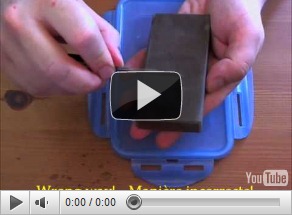 [1] WRONG way explained. |
 [2] Intro. stones – pierres. | 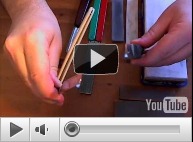 [3] Intro. knife design. |  [4] Other stone, soft metal blade. |
Wednesday, June 22
Reflexions on Video #2
So a little time has passed since my You-Tube of O Souverain and the following reflections should be made:
- My fingers move with much more fluidity and even rhythm than ever before, even in the best of my days and even though my physical condition is much worse than back then: thank IMS for that! I still have to regain speed and re-learn all scales, but I'm struggling much less than I ever used to.
- 30 minutes a day is not enough to build real endurance.... or if it is, it'll take more than the one year I spent on it.
- Strangely, I can practice for hours, but this relatively easy piece tired my lips enough to sag notes at the end of crescendi: baroque repertoire (especially the technical runs) seems easier.
During the winter, I had challenged myself to do one (small) recording per week, just to motivate myself to practice more and push to better quality of playing…. well….. that didn’t work out! No matter what, as soon as I hear the recordings, I notice “small things” that can be fixed with just one more take, then just another knife stroke on the reed, then another take!
Conclusion: recordings take time away from practicing and making reeds!
Video Production:
Making a good looking video is hard! Lighting is a huge deal and... well... let's just say I won't argue with my wife anymore when she tells me to use wrinkle cream under my eyes!
I bought an expensive web-cam because I thought it best to stream directly into the computer (not possible with affordable handi-cams)... I was wrong. I don't know if I need more RAM or if high-definition is just too much for Windows 7 (I must try Linux now). The choppiness in the video would have not happened with a handi-cam and I could still mix the audio track and synchronize easily enough with Windows Live Movie Maker (Macintosh has the equivalent and Linux is supposed to also): this would allow me to continue to do multi-track recording and use my special recording device.
What has improved:
- My sound quality (tone colour) is much deeper and more open, generally better than it has ever been, even in the best of my days. Is this due to better reed making and materials (staples, shaper, scrape technique) or is it due to my oboe being revoiced? This is difficult to say as it could also be due to better attention to what I hear and how I practice.
- My general sense of phrasing: articulation and dynamics were probably better years ago, but they have definitely improved since my 1st recording in February and I have definitely refined my sense of short and long term direction for the melody compared to 15 years ago.
What remains to work on:
- General sound control and finger technique. My rhythm is more even, but I still tend to anticipate the beat a lot, especially when doing a crescendo or running short on breath.
- Better breathing-in: the exhaling is fine, but my abdomen seems tight and I think this contributes to the fatigue.
- Learn to fully relax lips in just a few beats of rest.
- Acoustics: recording in a room with more reverberation!
This could mean moving my desktop computer to my dining room… need to try!
Friday, March 11
Wave for the camera!
 Firstly, a moment of reflection on the tragedy in Japan....
…our thoughts, prayers and encouragements are with you!
1st (Re)Appearance on “Stage”
The previous You-Tube videos were to prove to myself that I am still capable of playing half decently. But all that playing with the microphones could let one wonder if I was really playing or did I do a bunch of software tweaking. So I finally got myself a web-cam for real You-Tube performances. When I tested it... well..... I'm not sure I want to show myself on You-Tube!!! 
Music dances, but should the musicians?
In an Oboe BBoard thread, we had been discussing how ridiculous some oboists look by waving their bodies and flapping their arms while playing. Well you know what? The opposite is not much better! Looking at the first web-cam video of myself, I was dismayed at sounding fine but looking like a telephone post! .... really boring!

I won’t name oboists who crack me up with their waving because the sound and feeling coming out of their instruments (well, some of them) is simply fantastic. I may not like to look at them, but I sure love to listen to them! So instead, lets see those I find have the right balance between waving and stiffness. For example:
Then I thought: "Wait a minute, when I just meditate on the piece and hum to myself, my arms, shoulders and whole body sways with the music. Surely I can do this while playing the oboe too”.  In fact, as a conductor, my choir signers and orchestra players used to like my movements because they were technically meaningful and expressive of the musical character. But it seems that when I try that on the oboe, I just get distracted and forget what I'm playing:
CRASH AND BURN!
CRASH AND BURN!
Many of you will be surprized to read this from me, but I also believe the perfect balance of movement while playing is in Heinz Holliger!

I know I'm repeating myself, but for me, the ideal performance is Albrecht Mayer.
And in preparation for #BachChat, here's a real treat:Next Hobbyist Video:
So for #BachChat I'll put the recording of one Bach movement only when I get the hang of looking decent for the camera!
Friday, January 7
Frankenstein's First Steps
Frankenstein's Monster was a living creature made from parts of dead people. That's what I felt like when I was able to start practising for real again. Sure, I had blown a few minutes every month or so; in fact, about 5 years ago I was able to do a whole summer with 2 hours a day of experimenting on reed shapes and scraping techniques. But that’s nothing like knowing that you can now do up to an hour or more each day and know that the hopes of becoming good again are no longer in vain!

But Frankenstein's monster had his own problems: despite his huge size and strength, he was also rather weak and helpless. His sense of balance was all wrong, his muscular coordination was shaky at best, the mobility of his joints was impeded by all the surgeries and his speech ability was pretty well non existent. This is pretty much how it is for me, having fibromyalgia and degenerative disc disorder. I remember everything I used to be able to do, I still aim for better, but there are days when I am just not physically able. And also like the monster, let's not beat around the bush, I have a tendency to say what I think in ways that can very well get people irked! This is actually made much worse on days when "fibro-fog" sets in or when pain makes me just plain grumpy and impatient.
The first thing you lose when you get tired is rhythm... or at least that's what they used to tell us at the university. I found that, for the oboe, the first thing you lose is your mouth: endurance along with intonation and dynamics! But strangely enough though, and I had noticed this when I took week-ends off at the Conservatoire, it seems that my tone quality gets better! I guess its the softer embouchure. Well, there might be hope for the monster: endurance is still very difficult for me, but I do seem to be able to play reasonably in tune now. My dynamic range seems alright, but recordings contradict each other depending on the equipment I use. Long tones do help, but with so little time to practice each day, I don't tend to favour them. They are also discouraging because the consistency of sound is more difficult with less practise. Strangely, practising scales and such seems to help with endurance too.
Rhythm is truly difficult, I don't mean patterns and speed, I mean evenness and consistency. I had a problem playing just before the beat even in the best of my days. I find that practising with a metronome is useless unless I record myself: then, I can more easily grasp where and how I'm speeding up or anticipating. It's almost always a function of fatigue: when I'm running out of air or when my gut support is starting to strain, then I speed up. I will anticipate the beats at the beginning of passages when my mouth is tired. Even after several bars of rest, when the lips are tired, I tend to rush the metronome.
Well, at least I know what to work at and there are no angry village mobs out to burn me alive (yet).... or at least I was able to evade those from the past! ;-)

Monday, December 20
First breath.... again!
Well, I never thought I'd do a blog! After having laughed at social-networking for years while building web-sites that never quite serve the purpose right.... I finally decided to use the blog service.
Having posted quite a few replies and starting posts that have generated enthusiastic participation on the OboeBBoard (excellent spot, by the way!), I hope that this blog will be a useful tool in keeping the hot stuff in one place. Topics will include reed-making, breathing and sound, posture and physical endurance (lips, hands and others), specific performances and almost anything suggested by the comments.
I furthermore want to chronicle my process of re-mastering the instrument (and the art of music) after having left it in the closet for far too many years. Any oboist will concur on what horrible difficulties even a short leave of absence from practicing can ensue. But in the process of re-discovering the oboe, some things have already improved beyond my short-lived pro-days, though other issues are lagging far behind.
This blog should be interesting to amateurs and hobbyists of all ages, advanced music students and perhaps even seasoned pros who might find some reassurance here. This blog will discuss the joys and challenges of playing the oboe with fibromyalgia and degenerative disc disease, but mostly how a former (short-lived) pro. lost his way during years of Engineering school and is now being reborn to this wonderous family of instruments with the help of computer technology.
But, you know what? With the much more relaxed attitude my lifestyle now affords me (that is, I don't have to panic for the next concert every couple of weeks), I have been able to experiment with my sound, reed-making and style and I think they have actually improved significantly over way-back-when.... though my technique and endurance are nowhere near what they used to be!
So, God willing, I'll be back on stage soon enough. In the meantime, I'll work with recorded accompaniment and MIDI. I'll put up some clips on You-Tube soon enough, but not so soon as I'll embarrass myself! ;-)
Subscribe to:
Posts (Atom)