| The oboe has long held a nasty reputation of being extremely difficult to play, especially in tuning and sound control. I have long considered this nonsense: I really believe reeds can be made to suit a person’s physical characteristics and that the instrument should be responsible for ensuring proper tuning with full articulation and dynamic expression. Of course, an oboist must learn to play and develop proper embouchure, breath and control over the sound, lead by properly trained ears: what I mean is that advanced students and professionals should not need to complain that they can’t make a good reed when it rains or that “dizzy spells are normal: just don’t blow so hard” while simultaneously indicating how tone-support and air-speed are crucial… An oboist should never need to make reeds that cause discomfort to prevent the notes from going unstable. | Le hautbois tient une réputation de difficulté extrême à jouer, surtout quand-à la justesse et le contrôle du son. Je considères ceci ridicule: je crois vraiment que les anches peuvent être conçues pour les attributs physiques d’une personne et l’instrument doit être responsable de la justesse tout en appuyant la panoplie de nuances et d’articulations. Bien sûr, un hautboïste doit maîtriser l’embouchure, le souffle et le contrôle du son par l’ouïe: ce que je postule est que le professionnel et l’étudiant avancé ne devraient pas devoir se plaindre que ”les étourdissements sont normaux : soufflez moins fort” tout en soulignant par la même l’importance d’appuyer et soutenir le souffle… Un hautboïste ne devrait jamais devoir fabriquer des anches qui cause l’inconfort afin de prévenir l’instabilité des notes. | |
| Disclaimer: This post is about my own experience concerning the instruments I have personally tried and the reed styles I have used and made. I have my preferences, naturally other people will have their own contrasting preferences. I encourage everyone to perform your own experiments to find the right match . | | Désavoeu: Cet article concerne mes propres expériences sur les instruments que j’ai essayés personnellement et les styles d’anches que j’ai joués et gratté moi-même. J’ai mes préférences et il s’ensuit qu’autrui en aura de différentes. J’encourage tout le monde à expérimenter par vous-même afin de trouver la bonne combinaison. |
In my previous post ( ), I mentioned my tuning on “Ol’ Faithful” seems to be almost under full control, but also that this requires lots of effort. Days of very low energy make it frustrating to play even the easiest repertoire and range. To find an instrument with effortless tuning and tone would really revive the joy of playing the oboe: even when fibromyalgia is beating me down, I could concentrate on music, not the effort! ), I mentioned my tuning on “Ol’ Faithful” seems to be almost under full control, but also that this requires lots of effort. Days of very low energy make it frustrating to play even the easiest repertoire and range. To find an instrument with effortless tuning and tone would really revive the joy of playing the oboe: even when fibromyalgia is beating me down, I could concentrate on music, not the effort! | Dans l’article précédent ( ), j’ai mentionné que j’arrive maintenant à jouer assez juste sur ma “Vielle Branche”, mais au prix d’effort considérable. Mes jours d’épuisement fréquents rendent frustrant de jouer même les pièces de tessiture facile. Trouver un instrument qui joue juste et au beau timbre sans effort raviverait vraiment ma joie de jouer le hautbois: même lorsque la fibromyalgie me bat, je pourrais me concentrer sur la musique au lieu de l’effort! | |
| BUT I WANT A D’AMORE! On the other hand, in a past post (  ) I indicate how I have been in love with the Oboe d’Amore (forgive the pun) for maybe 30 years! You see, my favourite musical sound of all is the Baroque Oboe, but, of course, the modern instrument is much more versatile and friendly for Romantic and Impressionist music, etc… Let’s face it, I have always played modern instruments, and I don’t have the stamina to re-learn what is essentially a completely different instrument, especially since I want to play all styles of music. The Oboe d’Amore, when well constructed and well played, has a sound very reminiscent of the Baroque oboe. Now that I can play in tune and with dynamic expression on my Lorée, I could just keep it and buy a d’Amore instead… ) I indicate how I have been in love with the Oboe d’Amore (forgive the pun) for maybe 30 years! You see, my favourite musical sound of all is the Baroque Oboe, but, of course, the modern instrument is much more versatile and friendly for Romantic and Impressionist music, etc… Let’s face it, I have always played modern instruments, and I don’t have the stamina to re-learn what is essentially a completely different instrument, especially since I want to play all styles of music. The Oboe d’Amore, when well constructed and well played, has a sound very reminiscent of the Baroque oboe. Now that I can play in tune and with dynamic expression on my Lorée, I could just keep it and buy a d’Amore instead… Transposition? No worries! Of course, if I play with a group of people, a d’Amore would require serious transposition work, but as long as I continue to play alone with my computer, I can play anything, from Bach to Bolling: the computer can very easily transpose anything with only a few mouse clicks! | | MAIS JE VEUX UN D’AMOUR! Par contre, dans un article passé ( ) j’ai indiqué une passion pour le hautbois d’amour qui date d’environ 30 ans! À comprendre, ma sonorité favorite de tout est le hautbois baroque, mais bien sûr, les instruments modernes facilitent la tâche énormément pour le répertoire plus complexe Romantique, Impressionniste etc.…. La vérité en face, j’ai toujours joué d’instruments modernes et je n’ai pas l’énergie d’apprendre ce qui est essentiellement un instrument complètement différent, surtout étant donné que je veux jouer le répertoire de toute époque. Le hautbois d’amour, lorsque bien construit et bien joué, sonne assez près du hautbois baroque. Maintenant que je maîtrise raisonnablement le son de mon Lorée, je pourrais le garder et me payer un d’amour à la place…Transposition? Rien à craindre! Bien sûr, si je jouais avec un groupe, il faudrait de la transposition à nous en rendre fou. Mais aussi longtemps que je suis accompagné de l’ordinateur, je peux jouer n’importe-quoi sur le d’amour de Bach à Bolling : l’ordinateur transpose le reste pour moi avec quelque coup de souris! |
| Familiarity breeds comfort, NOT contempt! Someone recently asked me a question “knowing that I’m a big fan of Marigaux”. I found this funny because in one Blog post for IDRS 2013 ( ), I said I favoured Fossati and recently Marigaux’s representative thought I was dead-set on getting a Dupin! The truth is that I am a big fan of several instrument makers, especially after having tried them at IDRS 2013. So now, my “short-list” of choice makers (in alphabetical order) is Bulgheroni, Dupin, Fossati, Ludwig Frank, Marigaux, Mönnig, Püchner and Rigoutat. It is true that, for many reasons, if I could get a Dupin Imperial or Mozart (and afford it), you can bet your boots I would jump on the opportunity! Who could resist such intricate woodwork on the most exclusive instrument? On the other hand, completely by chance, there is one maker to which I have been more exposed than the others... When I started at le Conservatoire de Montréal in 1985, my teacher played a Marigaux, the same instrument he had brought back from Paris 20 years earlier… interesting that his sound and expressiveness had a big reputation in the French-Québécois circles… So when I started wondering if, perhaps, a different instrument might help with my complaints, the idea of trying Marigaux came strongly. Over the years, I have played on maybe two dozen Lorées from the very old to brand new, but also nearly one dozen Marigaux of various ages. This has allowed me to become very familiar with Marigaux and appreciate their qualities |  | L'habitude donne la confiance! Quelqu'un m'a récemment posé une question "sachant que je suis friand de Marigaux." J'ai trouvé ça comique étant donné un article blogue pour IDRS 2013 ( ) qui dit que j'étais sur le point de choisir Fossati et dernèrement le représentant de Marigaux croyais que je suis vendu mordicus à Dupin! La vérité est que j'admire un nombre de fabricants, après les avoir essayé à IDRS 2013. Alors à ce point, je peux établir une "courte-liste" (en ordre alphabétique) de mes marques favorites: Bulgheroni, Dupin, Fossati, Ludwig Frank, Marigaux, Mönnig, Püchner et Rigoutat. C'est vrai que, pour plusieurs raisons et si je pouvais me le payer, je ne manquerais pas l'occasion de mettre la patte sur un Dupin Impérial ou un Mozart... difficile de résister à de tel sculpture du bois et l'instrument le plus exclusif sur terre? Mais de l'autre côté de la médaille, tout-à-fait par hazard, il y a un fabricant auquel j'ai été plus exposé que les autres. Quand j'ai commencé le Conservatoire de Montréal en 1985, mon prof. jouait d'un Marigaux, le même qu'il avait rapporté de Paris 20 ans plus tôt…. intéressant que son timbre et expressivité était fort réputées au Québec. Donc quand j’ai commencé à me demander si un changement d’instrument pourrait m’aider contre mes plaintes, l’idée de Marigaux m’est venu fortement. A fil des années, j’ai joué environ deux douzaines de Lorées incluant les très âgés et les flambant-neufs, mais aussi environ un douzaine de Marigaux de divers âges. Ceci m’a permi de me familiariser avec les belles qualités de Marigaux. |
| Who plays what over here? The Marigaux 901 model has been a choice instrument in all parts of the world outside North-America. Tradition says that Lorée evolved to suit the American Scrape (might need some research in IDRS journals to verify if that is really accurate). I do believe that American scrape is probably much better to make a Lorée play well and dependably in the North-American aesthetic. Interestingly enough, Marigaux has also kept a presence here, from New-York to Las Vegas and from military bands to the opera hall; yes, these people I know personally do indeed play Marigaux with American scrape reeds! In Canada, Marigaux was the instrument played by one of my oboe inspirations: the late Cynthia Steljes (God rest her soul) from Quartetto Gelato. It is also making a comeback in Québec city where the very cold winters (much worse than Ottawa, which is colder than Moscow!) crack instruments like crazy: Marigaux Altunoir or those with synthetic top-joints only are very well appreciated by students and professionals alike. | Cynthia Steljes–Marigaux 901 | Qui joue quoi par ici? Le Marigaux 901 est l’instrument de choix en dehors l’Amérique du Nord. Généralement on dit que Lorée eut évolué avec le grattage des Anches à l’américaine (il faudrait fouiner les documents de l’IDRS pour vérifier). Je veux bien croire que le grattage à l’américaine doit améliorer la fiabilité de la justesse et du timbre sur un Lorée pour l’esthétique nord-américaine. Mais il est intéressant de noter la présence continue de Marigaux ici de New-York à Las Vegas, à partir des musiques militaires aux salles d’opéra; oui, les hautboïstes Marigaux que je connais personellement utilisent bel-et-bien des anches américaines! Au Canada, Marigaux était l’instrument de choix d’une de mes grandes inspirations, feu Cynthia Steljes (que Dieu garde son âme) de Quartetto Gelato. Marigaux redevient l’instrument de choix à la ville de Québec où les hivers bien plus froids qu’Ottawa (à son tour plus froid que Moscou!) font fendre les instruments. Marigaux Altunoir au corps supérieur ou entier sont fort appréciés des étudiants et professionels. |
| Do they all play the same? Over the past few years, I have tried maybe half a dozen Howarth XL’s and one thing really impressed me: regardless of the city (and climate) I was in, they all seemed to play the same, and that ranks very high marks from me. In contrast, Lorée is well known for needing to try many before finding the right one. I never felt the need to exchange my first Lorée for a newer one: they all have their faults and qualities and I consider it a matter of give-and-take. I have been told by some professionals that you also have to try several Marigaux to find the right one; I have also been told that they are praised for their dependability. In my personal opinion, I agree with both positions. The different Marigaux I have tried had their own personalities and they can “blow” differently: this is absolutely a good thing, in my opinion, because different people with different body builds will be looking for these differences. On the other hand, they ALL have impressed me for their extreme reed friendliness (flawless tuning and stability on almost any reed, even English Horn reeds in the oboe) and clear definition of all the notes. I have read some comments on the Internet that the Marigaux 901 has not changed since 1980 and their representative explained to me that the 901 model is essentially the same instrument since as far back as they can track the company. But because all Marigaux are made by hand, from beginning to end (apart from some obvious and necessary tools) under the guidance by performersof the highest stature, it does get periodically tweaked for both mechanics and sound/tuning qualities almost non-stop. Therefore, it has remained essentially the same instrument for well over 50 years, but has also evolved to stay in touch with changing professional needs. |
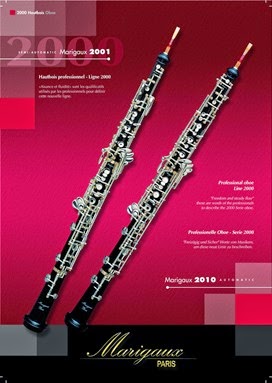  | Jouent-ils tous pareils? Depuis quelques années, j’ai essayé une demi-douzaine de Howarth XL : la chose qui m’impressionne vraiment est qu’ils semblent tous jouer pareil, indépendemment de la ville (et du climat). Par opposition, Lorée a la réputation qu’il faut en essayer plusieurs avant d’en trouver un bon. Je n’ai jamais ressenti le besoin de changer mon premier Lorée pour un neuf: ils ont tous leurs points forts et faibles, alors change pour change, je préfère le mien. Quelques professionnels m’ont dit qu’on doit aussi essayer plusieurs Marigaux avant de trouver le bon; je me suis aussi fait dire qu’ils sont appréciés pour leur fiabilité. Mon expérience confirme les deux points de vue. Les Marigaux individuels ont chacun leur “personalité” propre et ils peuvent “souffler” différemment: à mon avis, ceci est excellent parce que chaque personne avec ses propres caractéristiques physiques pourra trouver de quoi de mieux approprié. À l’inverse, TOUS les Marigaux m’ont impressionné par leur tolérance extrême aux anches (justesse et stabilité fiable avec presque n’importe-quelle anche de hautbois, d’amour ou même cor anglais) et une définition claire de toute les notes. J’ai lu des commentaires comme quoi le Marigaux 901 n’a pas changé depuis 1980 et leur représentant m’a expliqué que c’est effectivement le même instrument que depuis le début de la marque. Mais puisque chaque Marigaux est fait à la main, du début à la fin (hormis l’outillage qui va de soi) sous les conseils de d’interprètes du plus haut calibre, l’instrument subit continuellement des améliorations mécaniques et pour le son. Alors l’instrument est essentiellement le même depuis plus de 50 and tout en évoluant sans cesse pour répondre aux exigences professionnelles. |
| A recent (repeated) experiment: A friend in Ottawa, Jeremias Gramcko (fellow amateur oboe enthusiast) has 2 Marigaux, 3 Cabarts (from when that was a professional grade independent maker) a full-Conservatoire Linton and some really rare antique English Horns. His two Marigaux 901 are a regular Conservatoire and a special automatic with a 2nd octave key that can be enabled or stopped. I visited him a few times to compare my Lorée with all his instruments, using all my reeds, including English Horn and d’amore reeds. The latest visit was on a weekend of bad weather day when I was tired, with a twinge developing in my neck giving me a headache. PERFECT day to test an instrument: if the instrument makes it easy to play in such bad conditions, then it is really great! Well, the results were clear, the Lorée and Cabarts all had their usual “caprices” (quirks), sounding nicely only on great reeds. On anything but excellent reeds, they had very unstable notes (flop up and down in the middle of a crescendo/diminuendo). They also had stuffy notes, different notes depending on the reed. The two Marigaux, however, both played beautifully in tune. By this, I mean that some reeds were just too short and others just too long, so sometimes A=440, sometimes A=425 and sometimes A=455. BUT, the octaves, the fifths etc. were all in tune with each-other across the whole range! It did not matter which reed I used (wide, narrow, soft cane, hard cane, bright or warm sounding, even d’amore and EH), there were never any stuffy notes, and the note-center remained very stable in all dynamics. Changing the reed does change the tone colour and with embouchure, I was able to bend the note sharp or flat, but the note itself would always remain centered. It should be noted that this friend bought a full-Conservatoire Linton because he makes reeds (American scrape) for beginners, and he found it nearly impossible to tell which reeds were under par on his Marigaux! The instrument does not play instead of me and a bad reed remains a bad reed – in fact, some buzzier reeds sounded better in my Lorée. I fully respect those who prefer Lorée (after all, Bart Schneemann, Hansjörg Schellenberger and many American great names certainly command admiration), I just find Marigaux much more of a helpful ally in performing to the fullest of my soul (as do Nicholas Daniels, Johnathan Kelly, Louise Pellerin and a seemingly endless list). |   | Expérience récente (et répétée): Un ami à Ottawa, Jeremias Gramcko (camarade amateur passionné du hautbois) possède 2 Marigaux, 3 Cabarts (du temps que c’était calibre professionnel) un Linton système conservatoire complèt et quelques cor anglais atiques très rares. Ses deux Marigaux 901 comptent un à 2e clef d’octave et un automatique doté d’une 2e clef d’octave alternative. Je suis allé le visiter a quelques reprises pour comparer mon Lorée à ses instruments, utilisant toutes mes anches. La dernière visite était une fin-de-semaine de mauvaise météo et j’étais fatiqué avec des tensions dans le cou causant des maux de tête. PARFAIT pour faire le test: si l’instrument me rend le jeu facile en de telles conditions, alors il est excellent! Les résultats sont clairs: le Lorée et les Cabarts ont tous leurs caprices habituelles, ne sonnant bien qu’avec les meilleures anches. Avec des anches moins que parfaites, les notes instables habituelles (pivotent d’un quart de ton vers le haut ou le bas au milieu d’un crescendo/diminuendo). Ils ont aussi des notes congestionnées, notes différentes selon l’anche. Les deux Marigaux, par contre, jouaient parfaitement juste. Par ceci, l’anche pouvait produire La=440, 425 ou même 455, MAIS les octaves, les quintes etc. restaient en accord entre-eux sur toute la tessiture! L’anche choisie (large, étroite, roseau dur ou mou, même pour htb. d’amour ou cor anglais) ne changait rien, jamais aucune note congestionnée et le centre de la note restait stable avec toute nuance et articulation. Changer l’anche change effectivement le timbre et je suis cable de “plier” la note vers le haut ou le bas, mais la note elle-même reste toujours centrée. Il est à noter que mon ami a acheté le Linton parce qu’il fait des anches (grattage américain) pour des débutants; il a trouvé presqu’impossible de détecter les moins bonnes anches sur son Marigaux! L’instrument ne joue pas à ma place et une mauvaise anche reste mauvaise… au fait, quelques-unes de mes anches les plus nasillardes sonnaient mieux sur mon Lorée. Je respecte bien ceux qui préfèrent Lorée (après tout, Bart Schneemann, Hansjörg Schellenberger et tant d’excellents américains méritent l’admiration), mais je trouve que Marigaux rend simplement la vie plus facile et me permet d’exprimer en toute aise (opinion partagée par François Leleux, Domenico Orlando, Louise Pellerin et semble-t-il d’innombrables autres). |
| Sacrifice Comfort and Expressive Range? I have never found any reason to exchange my 1985 Lorée for a new one (or a few other makers not mentioned here), because every one I have ever played, if the reed(made worse by hot-damp weather), embouchure and air flow are not just right (made worse by hot-damp weather), the note will often “flop” sharp or flat on its own in the middle of a long tone (less so for one or two Royals, but not absent) – that is, I can control it by playing my dynamics and articulations with much less emphasis. Most people I know (advanced students, passionate amateurs and professionals) have been therefore advising for years me to make reeds that barely crow, which forces me to blow less than my comfort level and also reduce my range of dynamics and articulation….. but no maker on my short list I have tried impose no such restriction, so why reduce my expressive ability and make myself uncomfortable playing? | Choose reed for sound goals. | Sacrifier le confort et l’expressivité? Je n’ai jamais cru utile d’échanger mon Lorée de 1985 pour un neuf (ou même queleques autres fabricants pas mentionnés ici), parce que chaque autre que j’ai joué, si l’anche, l’embouchure et le souffle ne sont pas parfaitement à point (rempiré par la météo), la note bascule d’un quart de ton vers le haut ou le bas de son propre accord au beau milieu d’un son filé (un peu moins pire pour les Royals, mais pas absent). Je suis bien capable de les contrôler en modérant la portée des nuances et articulations. Plusieurs professionnels et étudiants avancés me conseillent de faire des anches qui crient (“crow”) à peine, ce qui m’oblige à souffler moins fort que ce qui m’est confortable et ce qui réduit mon expressivité… mais aucun instrument de ma liste courete que j’ai essayés ne m’imposent aucune telle restriction, alors pourquoi réduire mon potentiel et me rendre inconfortable en jouant? |
| Conclusion: This was just one experience among many over the past few years. They have all satisfied my benchmarks to confirm what I discussed here ( ) that the reed, the instrument and the musician form a three-way partnership. First impressions on my short-list (and others) from IDRS 2013 () were certainly encouraging. I have had more with Marigaux, so a certain level of comfort and trust has been established. Oboists I know (from Facebook and other places) who play Dupin, Püchner, Fossati and Frank/Mönnig attest of the same satisfaction, so I’m confident that IDRS 2014 will confirm my first impressions.I have to admit it, I can be a snob: I really like the idea of exclusivity, so to become a very rare North-American player of Dupin or Püchner or Bulgheroni or Fossati - especially the instruments with really fancy looking woodwork – that is a very appealing idea. But asTong Cui from Innoledy remarked, I don’t want to change instruments every couple of years just to get to know them, I want to buy one with the confidence will make me happy for the next 30 years. All I can say for now is that time and time and time again, Marigaux, made it a real jot to play with a more pleasant sound and much less effort. | | Conclusion: Ceci n’était qu’une expérience parmi d’autres depuis quelques années. Elles ont toutes satistisfaites tous mes étalons à confirmer ce que j’ai discuté ici ( ) : que l’anche, l’instrument et la personne forment un triple partenariat. Mes premières impressions à IDRS 2013 () sont certainment encourageants. J’ai eu plus d’expérience avec Marigaux, alors un certain niveau de confort et de confiance s’est établi. Des hautboïstes que je connais (via Facebook et autres) qui jouent Dupin, Püchner, Fossati et Frank/Mönnig attestent de la même satisfaction, alors je suis confiant que IDRS 2014 confirmera mes premières impressions.Je dois admettre être un peu snob parfois : j’aime bien l’exclusivité, alors devenir un très rare joueur en Amérique du Nord de Dupin, Püchner, Bulgheroni ou Fossati – surtout ceux avec un travail du bois stylisé – est une idée attrayante. Mais comme Tong Cui de Innoledy a remarqué, je ne veux pas changer d’instruments à chaque deux ans pour apprendre à les connaître; j’en veux un avec la confiance qu’il me rendra heureux pour les prochains 30 ans. Tout ce que je puisse dire pour l’instant est que coup après coup après coup, Marigaux m’a rendu la vie très facile et agréable à jouer avec un timbre plus plaisant (et sans effort). |
| BUT ….. I really want an Oboe d’Amore! Seeing that I am now capable of playing reasonnably in tune and with expression on my Lorée, maybe I should focus on that? AAAARRRRGGGHHHH! This is still really tough. Again, I’ll have to try everything again at IDRS 2014 and make my decision when I can figure out my priorities more clearly. | | MAIS….. Je veux vraiment un htb. d’amour! Étant donné que je suis maintenant capable de suis raisonnablement juste et avec expressivité sur mon Lorée, peut-être puis-je enfin viser cela? AAAAHHHHH! La question est décourageante. Encore une fois, je devrai tout essayer à IDRS 2014 et prendre ma décision lorsque je le pourrai plus clairement déterminer mes prioriés. |
Showing posts with label hautbois d'amour. Show all posts
Showing posts with label hautbois d'amour. Show all posts
Sunday, June 8
Oboe (or) d’Amore? / Hautbois (ou) d’Amour?


Saturday, May 18
Wide Reed Experiment/ation sur les anches larges
Heiko Frosh (Oboe-Shop.de  ) put this picture on Facebook, claiming that it allows English Horn reeds to play in tune in a modern oboe (the picture shows an old Marigaux 901). Apparently, the 2nd oboe from a prolific European orchestra does this to help play softly in the low register. ) put this picture on Facebook, claiming that it allows English Horn reeds to play in tune in a modern oboe (the picture shows an old Marigaux 901). Apparently, the 2nd oboe from a prolific European orchestra does this to help play softly in the low register.For years, I have tried to get English Horn and d’Amore reeds to play in my Lorée oboe, but have been frustrated time and time again. |  | Heiko Frosh (Oboe-Shop.de ) a mis cette image sur Facebook, affirmant que ça permet aux anches de cor anglais à jouer juste dans un hautbois (dans l’image, un vieux Marigaux 901). Paraît-il qu’un 2e hautbois d’un orchestre prolifique européen fait ceci pour faciliter un grave doux. Depuis des années, j’essaie des anches de cor anglais et de htb. d’amour dans mon Lorée, mais je me vois frustré presqu’à tout coup. |
| The sound is better in some respects and disappointing in others, but mostly, the difficulty in proper tuning and the loss of stability becomes maddening. But this image and its claims, coupled with some success using d’Amore reeds in New-York (see post ) make me want to try again. | La sonorié en est amélioré par certains critères mais décevante par d’autres. Surtout, la difficulté de jouer juste et la perte de stabilité est enrageante. Mais cette image et une mesure de réussite avec les anches de htb. d’amour à New-York (voir cet article ) me font vouloir essayer à nouveau. |
| Test Tune, work, weather and reeds: My apologies if being out of practice is an insult to the Strauss Oboe Concerto. I find this excerpt to be a fantastic test for a reed’s character. Cacked notes, messed slurrs, bad tuning and stuffiness are are precisely what I want to discover with the tests, so these recordings left them all in. There are no staccati, but it requires real flexibility of dynamics, feeling and super-dependable tuning and stability:
Because of this, the reeds mostly play flat. They will definitely get better over time, as they settle and with more finish-scraping, but even so early, a reed’s character can be found. Careful!The following recordings are experiments, not any claim of the right thing to do! As an hobbyist, it is very interesting for me to perform these experiments, but beginners or students risk wasting valuable time and fail to develop important skills by doing these. Professionals can decide for themselves if there is any value in performing such experiments. |   RDG–1 / Chiarugi #3 KM 720 / Chiarugi #3 RDG #2 / Chiarugi 3 | Pièce d’évaluation, boulot météo et anches: Mille excuses d’insulter le concerto pour hautbois de Strauss. Je considère cet extrait formidable pour trouver le caractère d’une anche. Les notes craquées, liaisons manquées, justesse foutue et notes étouffées sont exactement ce que les tests cherchent à découvrir, alors aucune cachotterie! Pas de stacatti, mais exige une vraie flexibility des nuances avec intonnation et stabilité sans failles:
Par conséquent, les anches jouent un peu (parfois beaucoup) trop bas. Ils vont absolument s’améliorer avec le temps et le grattage de finition, mais on y trouve déjà leur caractère. Attention!Ce qui suit consiste d’expérimentations, pas d’indications sur ce qui doit être fait. En tant qu’amateur, cette sorte d’enquête est captivante, mais un étudiant perdra son temps et risque de faillir à développer des habiletés importantes en répétant ces expérimentations. Les professionnels peuvent décider pour eux-mêmes s’il y a de la valeur dans la question. |
| Remarks Conclusion: Obviously, a professional will get much better results than this! But there is sufficient success to try those reed rings with the d’amore and EH reeds. I really like playing wide reeds more (KM 750 or RDG 2) and they lean toward the sound that I like more. The use of d’Amore staples does provide a depth of sound I like from baroque instruments. Heiko Frosh suggests that Guercio EH staples might be very better suited with the rings. But perhaps “strange setups” are not suitable to Lorée, so I will have to try all these reeds again on Marigaux, Mönnig, Howarth, Püchner, Fossati and all the others at IDRS 2013! | RDG–2 / Chiarugi 7 Kunibert Michel 750 (ob. d’am.) Kunibert Michel 750 (ob. d’am.) KM 750 / Guercio d12 KM 750 / Guercio d12 Kunibert Mchel 860 / Guercio | Remarques Conclusion: Évidemment, un professionel aura de bien meilleurs résultats que ceci! Mais ça montre assez de mérite pour essayer les anches de CA et de htb. d’amour avec les anneaux. J’aime beaucoup mieux jouer les anches larges (KM 750 ou RDG 2) et ils tendent vers la sonorité que je préfère. Les tubes de htb. d’amour donne une sonorité plus ample que je remarque chez les instruments baroque. Heiko Frosh suggère que les tubes de CA Guercio pourraient mieux marcher avec les anneaux. Il est possible que ces “montages étranges” ne soient pas utilisables avec Lorée, alors je devrai essayer toutes ces anches à nouveau sur Marigaux, Mönnig, Howarth, Püchner, Fossati et tous les autres au IDRS 2013! |
Thursday, November 1
Canadian Oboist in New-York, part 2. (Marigaux, Mönnig and Howarth)
Mes excuses de ne pas inclure une version française, l’article est trop long et le sujet mérite se faire exposer en entier. Je crois que je préfère traduire et en faire des articles complèts séparés (celui de Laubin aussi) que j’annoncerai, le temps venu.

During my visit to New-York, while my wife was on her 2nd day at the pro. photography event, I saw on TV that a super-storm was expected in the next few days... This was Hurricane Sandy and I listened carefully to see if we'd be able to drive home. We were lucky: we left on Saturday at noon and NYC closed its subways by the time we got home. Luckily, Laubin and Innoledy were not adversely affected, but the State of New Jersey (a big part of our drive home) was devastated. Our prayers and thoughts are with the victims of this storm.
Why do I own a Lorée?
Thinking back on it, my own Lorée is the only instrument I could possibly have purchased back in 1985, as I was auditioning for the Conservatoire de Montréal. It was on the only recommendation I could get and the only professional brand really available in Eastern-Canada at the time (if we rule-down Selmer) because stores in Montréal simply didn’t know of Laubin and going to N.Y. was not really an option. So I had the choice of 2 Lorées in Montréal and I took the one that eliminated the risk of cracking!
But my Conservatoire teacher played Marigaux and some students who went to Paris for the summer would come back with Marigaux or Rigoutat. Still, Lorée was considered top of the line, so the thought of trying other brands to help sound and tuning never occurred to anyone! Now, more than 25 years later, I was able to try brand new and very old Lorées (before 1970), an old Strasser and new Howarths from the collection at Gary Armstrong Woodwinds (see post here 

When Innoledy opened shop, and began to stock Marigaux, Mönnig and Howarth, the temptation to go visit became simply irresistible! Tong Cui built-up Innoledy (“Innovation in Melody”) to import the world’s finest and also to provide a platform by which the manufacturers can meet and discuss with the musicians: 
For me, contact with the manufacturers started long before through the internet. But the ability to try the instruments remained elusive, until Innoledy began to import them.
Innoledy is set-up in a posh part of Manhattan, accessible to everyone and providing both a very safe location and an inspiring setting. The instruments in the show-room are classy and sophisticated; which is accentuated by the atmosphere provided by the location. The same way that one might not trust buying a Ferrari in a flea-market, the show-room, repair shop and highly expert staff make Innoledy a choice place to try these choice instruments, which are hard to find elsewhere on the East Coast.
Criteria for oboe testing:
Everywhere I tried instruments, be it at the U. of O. Oboe Event (here
- Tuning: I do not mean A=438, 440 or 442, but rather how octaves, fifths and generally how notes tune in relation with each other across the whole range of the instrument.
- Stability of all notes during crescendi/diminuendi (both fast and slow) as well as with different articulations. Recall: I find most Lorées to “wobble” some notes when you least expect (or want) it – my own Lorée was greatly improved in this respect when Laubin re-voiced it.
- Sound characteristics : general description, stuffiness of specific notes and congestion (inability to crescendo) in general and for specific notes.
- Altissimo register (3rd 8va key range): especially above G.
Note: I did not ask about the price, I only want to know the instruments.
The Adventure
- First, I had a phone call with Tong to confirm the appointment:
- Tong Cui is a very straight-talking kind of guy who says what he thinks without wasting time on “decorating the truth”: something I appreciate a lot!
- He is also something of a philosopher and the questions he asked lead the conversation and really opened-up my understanding of how to deal with and absorb unexpected feelings that came up when playing on these fantastic instruments.
- Accomodation: Tong was actually in the middle of organising one of his events and his sales associate (Kristin Leitterman) had a full schedule of rehearsals and courses for her Doctorate program in performance. Nonetheless, they went out of their way to help me spend some time with the instruments and make my experience very pleasant indeed!
- Instruments: I think they have many more than what I tried (e.g. Other Mönnig, other Howarth and Adler) but I did not even ask because my curiosity centered around the list below and time was limited. More testing visits are in order!
- Reeds: no time to play with worst of them, but I did use good reeds and mediocre reeds.

- Howarth XL
- Two Marigaux 901
- Marigaux M2
- Gebrüger Mönnig Platinum (American model)
- Covey, almost new
- K-Ge, plastic, full Conservatoire
- Gebrüger Mönnig Platinum Oboe D'amore.... Chosen by Albrecht Mayer!
- My own Lorée: used as a benchmark.
My impressions:
- Altissimo: above G was very difficult and on some reeds, even D and above was difficult.
- I blame this on the approaching hurricane Sandy, because the altissimo was also difficult on my Lorée even if, in Ottawa, I go up to A and Bb without undue grief.
- I am very confident that if I can go to IDRS 2013 in California, the altissimo on all of them will be fine.
- Ergonomics:
- None of the instruments showcased at Innoledy cramped my fingers at all, but I suppose I would really have to play on each for hours to know for certain.
- Marigaux’s new design of the little finger palms in the M2, works out really well. At first, I thought it might inhibit some strange fingerings I like, but they work quite nicely.
- Mönnig does things differently (angles of keys and palms) from what I am used to. But after a few minutes of playing, it worked out fine.
- On all showroom instruments, tuning was impeccable with all reeds. My Lorée plays better than the brand-new AK models I have tried (thanks to the re-voicing done by Laubin), but it still suffers from some instability and some notes with iffy tuning. All instruments at Innoledy were great, in this respect.
- It needs more experimentation, but stability seemed fine with all reeds. I spent much less time testing stability on the Covey and K-Ge. Marigaux (all) and Mönig had strikingly dependable tuning and stabiltiy.
All new showroom instruments were simply easy to play, which is not true of all professional level oboes.
- All Howarth XL’s I have played up to now (3 of them) played the same way, so it appears to be a dependable model. It sounds closely enough to, but Lorée without the “framing” (and also without the unstable notes).
Marigaux:
- 901 is not “just a standard model”, it is a fully expressive instrument. Reputation confirmed, any reed plays well in a Marigaux! The two different 901s played slightly differently
- One was noticeably more free-blowing than the other, although both were amazingly stable and versatile for dynamics and articulation.
- The freer one, without changing anything in my reeds, embouchure or breath techniques, immediately improves my sound and musical expression.
- The M2 is just a heavenly instrument, so charming to play, but it shows the difference between good and mediocre reeds. It plays very well with all reeds, the character changes more than the 901 when changing reeds.
- 901 is not “just a standard model”, it is a fully expressive instrument. Reputation confirmed, any reed plays well in a Marigaux! The two different 901s played slightly differently
The Mönnig Platinum Oboe is also a magical instrument, a real pleasure to play. It also shows the difference between good and mediocre reeds, but has a much more cottony sound than the M2.
- This is the first time I play a German instrument, so I need more time to confirm my impressions. It appears to also play well with any reed and with all my bizarre fingerings.
- Kristin said that my sound was much more focussed on the XL, but I don’t know if this is really a flawed sound or a matter of taste and personal preference.
- Because I didn’t have time to take recordings, I don’t know yet if this cottony sound is the “baroque-esque” quality that I like so much from Albrecht Mayer. This is a difficult question, because on the Mönnig d’amore (both bells), I sounded like an English Horn, whereas Mayer sounds like a baroque oboe.
- Mönnig Platinum d’amore
- Selected by Albrecht Mayer himself! Again, a magical instrument!
- The reason for 2 bells becomes obvious when you try them: the round bell is perfect for chamber music and the conical bell for solo.
- I sounded like an English Horn when playing... but that is me and my reeds because obviously Albrecht Mayer has a very distinct d’amore sound on the same instrument.
- Both the Mönnig Platinum and the M2 would require me to work on my embouchure and breathing (the Platinum more so): they are truly high-character instruments that offer the widest range of expressive possibilities. Because I did formerly get Conservatoire and University training to the point of being able to start (though not continue) a professional career, I know what to do and it will not be hard: in fact it would be a very happy and welcome change to feeling boxed-in by the instruments I have known to this day.
- Covey:
- Less friendly to strong air pressure or hard reeds, although full range of dynamics and articulation.
- Very relaxed feeling when playing.
- It should be choice instrument for recording or stage performance where microphones and electronic mixing are key to the final result.
- K-Ge :
- Plays very well but no personality.
- Keywork fully functional, nothing that is not fully necessary (no split D).
- If the price is right, this is the ideal high-school instrument, or in preparation for auditions to the Conservatoire or College.
- It might also prove very useful as an outdoor stage instrument.
Conclusion & my pick
Choosing a favourite is really difficult. The XL is really excellent, but it is just not in the line of sounds I am looking for. Although the “better” 901 (the other one is amazing too) would just make my playing soar right now, I just really like the higher-end models more.
If I were an orchestral pro., I would probably go for the 901 because of its versatility. But as an amateur, I can follow my whims! So I choose either the M2 or the Platinum. Both the Marigaux M2 and the Gebrüder Mönnig Platinum are astounding instruments: choosing between them will require more experimentation. Hopefully, I will go to the IDRS 2013 conference this year and try them more fully!
Really Happy Conclusion
I still want to try Dupin, Rigoutat, Fossatti, Püchner, Bulgheroni and Viennese (Wolfe), but if for any reason I never get the opportunity to do so, I have definitely found 2 instruments that completely fulfil my expectations while opening the door to my aspirations for playing. These are just magnificent oboes!
Concerning my question (from this post): “Would a better oboe really speed-up the improvement of my playing?”, I think the answer should ring a resounding “YES”! The Marigaux M2 and the Mönnig Platinum really appear to want to make my life easier. At the very, very least, I do not have to fight with them to play in tune: the instrument helps me!
Oboe or d’amore?
This is the only thing that annoys me about my visit to NYC: for some time, I’ve been saying I want to buy a d’amore unless I find an oboe that really blows me away... Well, I have indeed found at least 3 oboes that blow me away, but both the Laubin and Mönnig d’amores also touched me strongly... more experimentation required to hopefully help me make a choice!
Friday, January 14
Amore d’Oboe?
That was actually a double play on words because in Italian (… well mock Italian, at least!) “Amore di oboe” would be the oboe’s love, and I really do believe the instrument loves to sing with the sweetest tones and expression.
One person asked me if I get to play the oboe d’amore much as I had mentioned loving it and because the repertoire is so limited. Well, that’s one of the advantages of being an at-home amateur: I can play any repertoire I like on any instrument I like.
Why Not?

Actually, I really like how Albrecht Mayer, and his friend who does the arrangements for his New Seasons Ensemble, use the d’amore in so many more pieces than requested. But, come to think about it, for years I’ve been hearing Bach’s Oboe d’Amore concerto played on the modern English horn… so why not? Why not play more baroque, or impressionist or anything? If the sound really fits the tune, then go with it! That’s something I really like about new ensembles of nowadays, like Quartetto Gelato, who will perform all kinds of repertoire on different instruments. Seriously, if Pasculli and Ravel work on the accordion (and these guys really do!) then why not?
Which instrument?
This leads to a question: if I am to replace my 25 year-old Lorée, will it be an oboe or oboe d’amore? Thing is, after its revoicing last summer, it plays really well… actually its the success that got me considering a new instrument: if Laubin’s finisher can make an old instrument with well-known flaws play so well, then the instruments they make must be incredible (and their legendary reputation well deserved). But do I get a new Laubin or, seeing as my oboe is quite good, a d’amore? And, what if Mönning’s, considering Albrecht Mayer’s recordings, are even better than that, not to mention the possibly more baroque-ish sound of Dupin’s Imperial and its classical bore. Besides, the picture of the Fossati Soloist Model V just keeps popping up in my mind!
The final problem is that, be it a d’amore or any of the makers above, to choose I still have to try them… not so easy considering most European vendors have stopped sending instruments on trial to Canada because of the very complicated customs tax system here… I guess, then, that my only solution is to save up and actually go to Europe, try them out and, hopefully, be able to make up my mind then.
What do you think?
Wednesday, January 12
Which oboe?
I’m amazed that this little self-glorifying blog would attract over 1000 visitors from a do


I’ve been receiving e-mails directly with comments and questions: I really like these because it jogs my ideas. It gets me to organize what to write.
For example, in a previous post [Back to my (blog) roots!] I mentioned being enchanted by the oboe d’amore and also my appreciation for Ludwig Frank and the Gebrüder Mönning manufacture. Well, this started a really good e-mail exchange with one reader who gave me very encouraging information about both the instruments and how they care for their customers.
Funny thing is, I never played a Frank or Mönning nor have I ever so much as touched a d’amore! I have only owned the same Lorée oboe for 25 years. I have played some Yamahas, many Lorées, a Selmer or two and some (Lorée) English Horns, but apart from the under $300 beginner-model 1921 Pan-American I got from E-Bay last spring to practice in my truck at lunch time, my good old Lorée is it!
Who can argue with sound?
The first few times I heard Albrecht Mayer on Internet Streaming radio, I thought: “Hmm, half decent sound for a baroque oboe.” 


Listen, Albrecht Mayer is not the only fantastic player… more for another post. But his productions really do open a lot of doors. More on this notion later… Thanks again for reading and please continue with the e-mails. But don’t be shy to leave a comment either!
Cheers!
Monday, December 27
Return to the (virtual) public spotlight?
Well, my preference would be to start playing with some ensemble, preferably chamber music. But I don’t know a whole lot of people right now with whom I can play – and not many people can introduce me to musicians seeking oboes right now. But – TA-DA! – You-Tube is out there where people are posting themselves left and right! Hey, maybe there’s some potential there for me?
Why play in public?
That’s an excellent question because I really don’t have an answer. Of course, some psychologists would argue that I need to be heard because of some childhood trauma or for some narcissistic need to expose myself… yyeeaaaahhh NO!
But some time ago, Hannah’s Oboes was selling a really special (and expensive) Oboe d’Amore and I was rather disappointed when someone else bought it (sigh!). I told her that I was glad it was sold to someone who would play it in concert: such a special instrument deserves to be heard.
THAT’s why I want to play in public. I don’t think I’m so great or anything, but I believe the oboe is an amazing instrument, music speaks directly to the soul and people need – especially in these parts – to share in its spirit. MP3s, streaming radio and CDs will just never compare with even a mediocre live performance: there is a connection that occurs. Of course all artists need to express themselves, and expression needs an audience, but its the shared experience that matters.
The stage still lures me strongly, in part because I want to make-up for some failings and in part because I live in denial that I have ever left it. In my soul, I "hear" the sound that I want, the character that the music should have, the voice that should be expressed when I play. Although it is very aggravating to miss the mark when I take my instrument and listen to myself in a recording, I cannot stop aiming for that voice, that character, that soul.
Now, what to play?
I have always been wild about the baroque, finding it easier than the post-impressionist or contemporary repertoire most players in my circles would usually prefer; they thought baroque was harder. But surprize, surprize, it seems now that the other way around is happening! It might be that, since the summer, I’ve been concentrating on sound so much that this is now best reflected by the likes of Debussy and some lesser known ones. At any rate, I have to limit myself to the one MMO CD I have and a few MIDI files: my “ensemble” will either be the CD or my Digital Piano played by the virtuoso Hewlett Packard (though less impressive than Angela Hewitt!!!). I’ll keep playing around and see what comes out well on my recordings.
Sunday, December 26
Back to my (blog) roots!
I had lost this URL during a SNAFU with Google services – not their fault, nor even mine fully – so I started another one (having "hautboys" - with a y - in it) under the impression that I had lost this one. Luckily, I got this one back! Everything from the temporary one (and more) is here now.
 The URL name is important to me because the nick-name Robin Des Hautbois has followed me since my high-school days: I considered it a sign of predestination! Robin des Bois is French for Robin Hood (Robin of the woods or Robin of Sherwood) and the spelling testifies that I remain with the modern instrument (the y was the spelling for the baroque/classical instrument).
The SNAFU is kind of funny, because I really do find the sound of the baroque instrument far superior to the modern instrument in a few ways:
Happy Holidays to all!
The SNAFU is kind of funny, because I really do find the sound of the baroque instrument far superior to the modern instrument in a few ways:
- It is usually darker, deeper and mellower.
- Though it has less projection, it has a larger feeling to it.
- It has a built-in echo quality that I compare to the deep honk of the Canada Goose, but without the honk!
- It is best approximated by the modern oboe d’amore: I have wanted one since the age o f 15, when I first saw one in an encyclopaedia!
Happy Holidays to all!
Subscribe to:
Posts (Atom)