100 thousand visits! ALL RIGHT! Other very successful blogs also mention how people like to read how difficulties and frustrations are shared by everyone… and how perseverance really pays off! I think this post will confirm that pushing on in the enjoyment of music resulted in pretty good progress. | Baroque and Blue | 100 mille visites! SENSASS! D’autres blogues bien suivis mentionnent aussi combien le monde aime lire que leurs obstacles sont partagés … et combien ça vaut la peine de persévérer! Je crois que cet article confirmera qu’avoir poussé dans l’amour de la musique aura montré un progrès véritable. |
| I started practicing this last summer. I wanted to post it for Christmas, because Baroque and Blue is so playful and Irlandaise has the famous Chrismtas tune in it: a very comforting fire-side kind of feeling. It took me this long to get it ready, not just because of hectic work hours – those returned to normal after January – but also because my Tai-Chi is taking a more important role in my life and a few other home things. But in the end, it’s mostly about I wanted to do the best job I possibly could on these ones. Getting the sound right in the recording, mixing the trio MP3, my small-room track and the video take sure is a challenge… | Irlandaise | J’ai commencé à travailler ces pièces l’été dernier. Je voulais les enregistrer pour Noël, parce que Baroque and Blue est si joyeux et Irlandaise est un cantique de Noël si bien connu: sentiment chaleureux auprès du foyer. Ça m’a pris si longtemps les préparer, pas juste parce que le boulot empiète – les heures sont retournées à la normale après janvier – mais aussi parce que le Tai-Chi prend un rôle plus imoprtant dans ma vie et quelques autres histoires. Mais à la fin de l’histoire, je voulais faire de mon mieux dans ces enregistrements. Produire un timbre vraisemblable entre le MP3 du trio jazz, mon enregistrement de petite chambre et la vidéo présente un véritable défi… |
| Hommage to Jean-Pierre Rampal The original recordings by Jean-Pierre Rampal and the Claude Bolling Trio have been very special to me since my first years as a music student. Now, you’ll understand that having been raised in my teens and young adulthood on musicians with this kind of expressiveness, on many different instruments, I really cannot accept anything less from oboists. I never thought these pieces could sound well on anything other than the flute, but when I got the sheet music, just for laughs, I found them too much fun to resist! They are really challenging for the altissimo register, but that’s just part of the thrill! | Rampal & Bolling : Château de Versailles! | Homage à Jean-Pierre Rampal Les enregistrements originaux par Jean-Piere et le trio Claude Bolling me sont restés très chers depuis mes premières années en musique. Vous comprendrez maintenant qu’avoir été exposé, comme adolescent et jeune adulte, à des musiciens avec tant d’expressivité et sur toutes sortes d’instruments, je ne peux guère accepter moins du hautbois. Je n’ai jamais cru que ces pièces pouvaient bien sonner sur autre chose que la flûte, mais quand j’ai acheté la partition, juste pour rire, je les ai trouvés irrésistibles! Elles sont tout un défi pour le sur-aigü, mais ça fait parti de l’aventure! |
Showing posts with label multi-track recording. Show all posts
Showing posts with label multi-track recording. Show all posts
Saturday, March 29
Jazzy Classy


Saturday, January 14
Nino Rota Duet for 2 oboes (2/3) … but 3rd recorded

3rd duet for 2 oboes by Nino Rota
Here it is, the triptych is now complete!
This one is called “il Mulino”: the mill (wind-mill, grain-mill, saw-mill, river-mill) and it is easy to imagine the squeaky machinery rolling and turning! The cool thing about this one is the 1st oboe part being mostly in the altissimo register, usually between:

Thank you Michele Mancaniello for re-introducing me to this fantastic composer and also for providing me with this very special music. The 3 duets were very enjoyable to play, funny to listen to but also really difficult to record the 2 parts together.
Reeds and Recording:
One thing I learned this year is that the entire process of recording influences the sound as much as (or more than) the reed! I’ll do a blog post about that and my thoughts on this recording next week.
What is “Allegro”?
This is a 12/8 movement marked allegro. The metronomes often indicate Allegro = [120, 160], but what is to be used as the beat? I think it’s important to put things in context, these words do not always denote speed (tempo) but often character:
- Moderato : moderate speed
- Allegro : happy
- Vivace : lively
- Presto : swift
… of course, these words can be interpreted differently, but in comparison to each other, this makes sense.
I played the 3rd duet at 
Physical Update: ouch
Just before the holidays, my physiotherapist scolded me for not doing my nerve flossing exercises. I told her it was because I never feel anything when I do them……. uuuhhhhh, now I feel a lot (ouch) when I do them!
The point of those exercises is to ensure mobility of the nerves to prevent irritation. Well, a few months of too much social networking (internet stuff) in front of the TV in the morning and evening has left its mark. Especially after having shovelled the snow last night, my shoulders are now rather bothersome, feeling as if I have strings inside my arms, neck and back that pull whenever I move.
…… ah well, back on the floor to do those simple exercises!!!!!!!
Also, if you do muscle strengthening exercises, the trainer I often see at my gym explained that the really easy exercises given by physiotherapists strengthen a set of small muscles. If you do the same exercises with heavier weights or stronger rubber bands, the bigger muscles will take over and the whole point of the workout is lost.
Thursday, June 16
video #2, recording #4 - MIDI Accompaniment and Faith in Music
Well over 8000 visitors: BRAVISSIMO! 65 countries: AUSGESEICHNET! To honour all you visitors, I will keep the list of countries in another tab. Eventually, I will put your flags next to your country’s name.
Blog: over 6 months
I started this blog for 2 reasons:
- to track my progress as I attempt to regain my former skills on the oboe, now that I am a software engineer living with chronic pain;
- to communicate with people of all descriptions and, hopefully, encourage others in similar situations to mine.
- oboe reed cases (the single most popular post by far),
- MIDI accompaniment and sound recording techniques,
- general oboe playing topics,
- IMS and physiotherapy concerns,
- playing with an extracted tooth!
I wish to express my gratitude to all of you for taking the time and making the effort to visit here. I really enjoy when people leave comments or send e-mails. All contact with people from several continents and from home is a real treat and I hope the favour is returned!
2nd video:
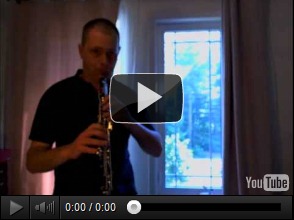
O Souverain: oboe & MIDI orchestra
Apart from a few sagging notes, undecided phrasing here and there and a bit of hasty rhythm (all predicted in this previous post), pretty good improvement in 4 months, if I may say so myself! If this trend continues, in a year, I should be a decent player again. My apologies for the bad picture quality: I have a lot to learn about lighting… nah, I’d rather spend my time practicing oboe! On the other hand, I really should have spent more time on the MIDI accompaniment…
A cute thing about making recordings at home is that I have to contend with my dogs not understanding that silence is more important than the cat running on the other side of the street! 

One thing that really amazes me is how much the choice of speakers and/or head-phones (ear-buds) change the quality of my oboe sound. On my real sound system, it sounds like I hear it when playing, also true on my desktop computer and an old head-set that came with a waterproof Sony Walkman tape-cassette player! But the high-quality new Sony ear-buds I just got or my lap-top speakers…. much brighter and a little buzzier.
MIDI accompaniment AND multi-tracking.
This is not the first time I use MIDI as accompaniment for a recording, but I’m glad to have found a file ready-made with dynamic expression already included. I’ll add links to MIDI sources and free sheet music to my page on great places as I come across them. I did use software to add some orchestration a little bit, but thankfully, most of the work was already done for me (thank you Aria-Database!). For this recording, I had to “clean up” the MIDI file before it could play well with instrumentation other than the piano. The only dynamics are done by adding or removing instruments and there is no rubato apart from the opening recitativo. I found it curious that playing the file without rubato or dynamics at all still conveyed an inspiring quality. I guess this is the evidence of an extraordinary composition.
Music is faith… in my point of view!

Ô Souverain, sung by Ben Heppner.
I must have already mentioned that I consider music to be more than an art form, more than a mathematical equation; in fact, I consider it a full-fledged expression of the living soul. I consider music to be the closest direct language of Divinity that humans are capable of understanding. Some songs, a small handful, seem to speak to my soul very directly and stir something that I cannot describe in terms of emotion or psychology. In fact, I don’t even understand what effect they produce, only that I can’t sing them because my throat gets a lump! “Ô Souverain” is one of these.
Music, greater than song!
I believe that songs are music with a handicap; that is, because words convey a clear meaning, they severely limit the potential panorama that we can experience from a melody is restricted to the meaning of the words. Some melodies, however, seem taylor-made for the words. These songs usually loose much when they are translated. In the case of O Souverain, the link between French words and the melody is so strong that I would play it with one pattern of dynamic phrasing and articulation, but would be disappointed when playing back the recording. When putting the words back on the notes, it became clear why my phrasing was wrong.
I’m really not a fan of opera, but I have to admit, Jules Massenet wrote an powerful song as part of his opera Le Cid. It might be an overstatement, but Radio hosts have said that the Metropolitan Opera would not have been able, at the time, to perform Wagner without Ben Heppner. So it is a privilege for me to include a You-Tube of this amazing Canadian Tenor. The performance I give does not follow his style. Apart from the fact that I play the oboe in my study rather than singing at the Met, one of the the miracles of music is that it speaks differently to everyone with a Cartesian product of different messages from each performer and at each performance.
| Ah! tout est bien fini. Mon beau rêve de gloire, mes rêves de bonheur s'envolent à jamais! Tu m'as pris mon amour, tu me prends la victoire, Seigneur, je me soumets! | Ah! It's all over now. My wondrous plans of glory, my beautiful dreams of happiness are all now dust in the wind! You have taken my love, You now take my victory, O Lord, I do submit. |
| Ô souverain, ô juge, ô père, toujours voilé, présent toujours, je t'adorais au temps prospère, et te bénis aux sombres jours. Je vais où ta loi me réclame, libre de tous regrets humains. | O Sovereign, O Judge, O Father always veiled, always present, I adored you in prosperous times and bless you still in troubled days. I go where your law commands, free from all human regrets. |
| Ô souverain, ô juge, ô père, ta seule image est dans mon âme que je remets entre tes mains. | O Sovereign, O Judge O Father, Your image alone fills my soul which I commend into your hands. |
| Ô firmament azur, lumière, esprits d'en haut, penchés sur moi, c'est le soldat que désespère, mais le chrétien garde sa foi. Tu peux venir, tu peux paraître, aurore du jour éternel. | O Firmament, azure blue light, Spirits on High leaning over me, it is the soldier that despairs but the Christian keeps his faith. You can come, you can appear dawn of the eternal day. |
| Ô souverain, ô juge, ô père! Le serviteur d'un juste maître répond sans crainte à ton appel, ô souverain, ô juge, ô père! | O Sovereign, O Judge, O Father! The servant of a just Master answers your call without fear. O Sovereign, O Judge, O Father! |
Sunday, February 27
2nd Recording: reeds are not enough!
Here it is: my second You-Tube recording! And just in time because during the week, 6 more countries have been added to the list! Welcome to: Belgium, Japan, Lithuania, Poland, Portugal, Venezuela and Vietnam !

2nd recording: my real sound, but more work on room acoustics needed!
In a few other posts, I had complained about my sound being adversely affected by where I put the microphone and where I stand. That is, the house itself can add buzz and make my sound more shrill. This time, I found a good layout that preserves my real sound BUT:
- I did the recording on 2 different days (same reed, same position of microphone and myself).
- There are settings for volume and recording level on the microphone (recording device) AND on the mixing software.
- I forgot to write down these settings: the 2nd day sounds different than the 1st day!
So, in both dances, you do have what I really sound like, but the sound is still different: it’s like if you were sitting and/or if the instruments were located different places in the concert hall on the different days.
I have to admit, I don’t like multi-track recording because of the required mixing: its not like taking a live performance…. but it is a WHOLE lot easier!
Impressionist Music
I had never heard of Laurischkus before this Music Minus One production. I cannot find much about him on the internet either. But there is definitely a Satie-esque impressionistic aura about these 2 dances.
I am mostly a lover of the Baroque, but I really like impressionist music, just as I really like impressionist painting though Rembrandt remains an incontestable master. Despite the simple melodies, it explores harmonic colouring and sound-scaping that delves more deeply than the very clear and precise imagery of the classical period or the technical supremacy (for composition, in my opinion) of the baroque. I’m sorry to use such fluffy and meaningless language, but its very hard to explain.
Impressionistic music, like the painting, has its difficulties: because it is not as clear and well defined as the classical, interpretation and soul must lead the way more than the notes and dynamic markings. Luckily, Max Laurischkus, like Eric Satie, wrote catchy tunes that help both the listener and the performer. Luckily, these tunes do not require a lot of facial endurance to play (unlike Bach)! Perhaps next time I’ll be able to do the Debussy and Glière I’ve been wanting to do from the start.
Subscribe to:
Posts (Atom)