Showing posts with label public performance. Show all posts

Saturday, May 14

Overdoing it & Recording Practice Sessions

Stuff going on this weekend, so pictures of the sides of my reeds comparing “manual” alignment with the Cane Guide will have to wait ‘till next week.

It’s been about a year now since I started lunch-time practicing with my fixed-up (almost) 1921 Pan-American beginner model and sent my Lorée to get revoiced in NY. I suppose my next You-Tube video should commemorate that milestone. I got the Lorée back at the end of June or beginning of July, so I still have time to get in better shape.

Update on physical progress.

No treatment this week. The weather was pretty sunny all last week, this week is turning to rain again. When the weather gets sunny, I get sore, when it gets cloudy/rainy, I get tired. But I’m doing much better than expected: yesterday the software development team spent the afternoon merging source-code all gathered around someone else’s computer. The twists and contortions I had to do to read his very small fonts should have given me a monster headache, but no, I’m doing fine! In fact, not even any Saturday morning headache. So the IMS treatments are evidently working.

(Not) Waving for the Camera

Musical, not physical expression.
In a previous post, I discussed how swinging the body while playing might help or hinder the expressive qualities of playing. My conclusion was that too much is distracting and completely stiff is boring. I also opened the question that perhaps body motion aids in phrasing.

Well, consider this video, one of my favourite pop songs of all time. I have never seen a band with fewer stage stunts … but close your eyes and just listen: there’s no denying the power and depth of their musical presence!

Can “expressiveness” be overdone?

I consider two kinds of dynamic expression: short expressions and long phrasing. The long phrasing is what we spend most of our years perfecting, the short expressions are anywhere from one to maybe 6 notes long, but describe our personal style and our understanding of how the particular style (baroque, classical, tango etc.) speaks.
Swelling notes, but not too much.

I’ve been recording my practice sessions lately, and I wonder if I’m not going to far in my dynamics. The long phrasing is fine, but the short expressions will go from a true pp to a true ff in a matter of one beat. When I just write/say that, it might sound like a dream come true for the oboe, but when I record myself and play it back, I’m not so sure anymore. Then again, I need to play with the microphone and computer “gain” (sensitivity) settings and their positioning: this changes the way the recording ends-up sounding quite a lot!

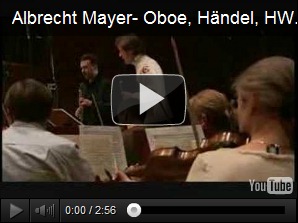
When I listen to my hero Albrecht Mayer playing what could go berzerk with dynamics, I find his playing much more tame than I would expect, but full of energy and vigour nonetheless!

Computer Aided Practice Recording.

More and more, I’ve been using the computer to record my practice sessions. I’m finding it downright revealing!  Using the free and powerful software Audacity, I recorded the piano accompaniment on one track. Every time I press the record button, a new track is added while playing all the tracks already there so I can hear the piano while recording. Previous tracks of my own performances can be muted one at a time or all together. This way I can compare the different performances and verify the progress.
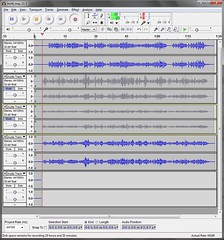
One REAL test for tuning is to play along with one of my previous tracks or have 2 of my tracks play together… OUCH! When playing this way, I am forced to adjust to the “other oboe”: nothing says that the “other oboe” is in tune Smile with tongue out, but there is an old saying in musical performance: “If the other guy is out of tune, it’s my fault!” [for not compensating]. This is much more difficult than playing with other instruments.

Getting the piano part is not too difficult, it requires a CD or any kind of computer file where the piano was recorded. A CD can be “ripped” with free programs such as WinLame and each tune or movement becomes a separate MP3 file. In all formats of recorded performance (actual sound file), just drag-and-drop the file onto Audacity and a new track is made for it. If you have a MIDI file, it can be converted into an actual sound file with other free software such as SUPER.

Friday, March 11

Wave for the camera!

JapanFirstly, a moment of reflection on the tragedy in Japan....
…our thoughts, prayers and encouragements are with you!

1st (Re)Appearance on “Stage”

The previous You-Tube videos were to prove to myself that I am still capable of playing half decently. But all that playing with the microphones could let one wonder if I was really playing or did I do a bunch of software tweaking. So I finally got myself a web-cam for real You-Tube performances. When I tested it... well..... I'm not sure I want to show myself on You-Tube!!! Tire la langue
 

Music dances, but should the musicians?

In an Oboe BBoard thread, we had been discussing how ridiculous some oboists look by waving their bodies and flapping their arms while playing. Well you know what?  The opposite is not much better! Looking at the first web-cam video of myself, I was dismayed at sounding fine but looking like a telephone post! .... really boring!
 
I won’t name oboists who crack me up with their waving because the sound and feeling coming out of their instruments (well, some of them) is simply fantastic. I may not like to look at them, but I sure love to listen to them! So instead, lets see those I find have the right balance between waving and stiffness. For example:
 
Then I thought: "Wait a minute, when I just meditate on the piece and hum to myself, my arms, shoulders and whole body sways with the music. Surely I can do this while playing the oboe too”.
In fact, as a conductor, my choir signers and orchestra players used to like my movements because they were technically meaningful and expressive of the musical character. But it seems that when I try that on the oboe, I just get distracted and forget what I'm playing:
CRASH AND BURN!
 
Many of you will be surprized to read this from me, but I also believe the perfect balance of movement while playing is in Heinz Holliger!
 
I know I'm repeating myself, but for me, the ideal performance is Albrecht Mayer.
And in preparation for #BachChat, here's a real treat:
 

Next Hobbyist Video:

So for #BachChat I'll put the recording of one Bach movement only when I get the hang of looking decent for the camera!

Monday, December 27

Return to the (virtual) public spotlight?

Well, my preference would be to start playing with some ensemble, preferably chamber music. But I don’t know a whole lot of people right now with whom I can play – and not many people can introduce me to musicians seeking oboes right now. But – TA-DA! – You-Tube is out there where people are posting themselves left and right! Hey, maybe there’s some potential there for me?

Why play in public?

That’s an excellent question because I really don’t have an answer. Of course, some psychologists would argue that I need to be heard because of some childhood trauma or for some narcissistic need to expose myself… yyeeaaaahhh NO!

But some time ago, Hannah’s Oboes was selling a really special (and expensive) Oboe d’Amore and I was rather disappointed when someone else bought it (sigh!). I told her that I was glad it was sold to someone who would play it in concert: such a special instrument deserves to be heard.

THAT’s why I want to play in public. I don’t think I’m so great or anything, but I believe the oboe is an amazing instrument, music speaks directly to the soul and people need – especially in these parts – to share in its spirit. MP3s, streaming radio and CDs will just never compare with even a mediocre live performance: there is a connection that occurs. Of course all artists need to express themselves, and expression needs an audience, but its the shared experience that matters.

The stage still lures me strongly, in part because I want to make-up for some failings and in part because I live in denial that I have ever left it. In my soul, I "hear" the sound that I want, the character that the music should have, the voice that should be expressed when I play. Although it is very aggravating to miss the mark when I take my instrument and listen to myself in a recording, I cannot stop aiming for that voice, that character, that soul.

Now, what to play?

I have always been wild about the baroque, finding it easier than the post-impressionist or contemporary repertoire most players in my circles would usually prefer; they thought baroque was harder. But surprize, surprize, it seems now that the other way around is happening! It might be that, since the summer, I’ve been concentrating on sound so much that this is now best reflected by the likes of Debussy and some lesser known ones. At any rate, I have to limit myself to the one MMO CD I have and a few MIDI files: my “ensemble” will either be the CD or my Digital Piano played by the virtuoso Hewlett Packard (though less impressive than Angela Hewitt!!!). I’ll keep playing around and see what comes out well on my recordings.