Showing posts with label revoice. Show all posts

Saturday, May 14

Overdoing it & Recording Practice Sessions

Stuff going on this weekend, so pictures of the sides of my reeds comparing “manual” alignment with the Cane Guide will have to wait ‘till next week.

It’s been about a year now since I started lunch-time practicing with my fixed-up (almost) 1921 Pan-American beginner model and sent my Lorée to get revoiced in NY. I suppose my next You-Tube video should commemorate that milestone. I got the Lorée back at the end of June or beginning of July, so I still have time to get in better shape.

Update on physical progress.

No treatment this week. The weather was pretty sunny all last week, this week is turning to rain again. When the weather gets sunny, I get sore, when it gets cloudy/rainy, I get tired. But I’m doing much better than expected: yesterday the software development team spent the afternoon merging source-code all gathered around someone else’s computer. The twists and contortions I had to do to read his very small fonts should have given me a monster headache, but no, I’m doing fine! In fact, not even any Saturday morning headache. So the IMS treatments are evidently working.

(Not) Waving for the Camera

Musical, not physical expression.
In a previous post, I discussed how swinging the body while playing might help or hinder the expressive qualities of playing. My conclusion was that too much is distracting and completely stiff is boring. I also opened the question that perhaps body motion aids in phrasing.

Well, consider this video, one of my favourite pop songs of all time. I have never seen a band with fewer stage stunts … but close your eyes and just listen: there’s no denying the power and depth of their musical presence!

Can “expressiveness” be overdone?

I consider two kinds of dynamic expression: short expressions and long phrasing. The long phrasing is what we spend most of our years perfecting, the short expressions are anywhere from one to maybe 6 notes long, but describe our personal style and our understanding of how the particular style (baroque, classical, tango etc.) speaks.
Swelling notes, but not too much.

I’ve been recording my practice sessions lately, and I wonder if I’m not going to far in my dynamics. The long phrasing is fine, but the short expressions will go from a true pp to a true ff in a matter of one beat. When I just write/say that, it might sound like a dream come true for the oboe, but when I record myself and play it back, I’m not so sure anymore. Then again, I need to play with the microphone and computer “gain” (sensitivity) settings and their positioning: this changes the way the recording ends-up sounding quite a lot!

When I listen to my hero Albrecht Mayer playing what could go berzerk with dynamics, I find his playing much more tame than I would expect, but full of energy and vigour nonetheless!

Computer Aided Practice Recording.

More and more, I’ve been using the computer to record my practice sessions. I’m finding it downright revealing!  Using the free and powerful software Audacity, I recorded the piano accompaniment on one track. Every time I press the record button, a new track is added while playing all the tracks already there so I can hear the piano while recording. Previous tracks of my own performances can be muted one at a time or all together. This way I can compare the different performances and verify the progress.
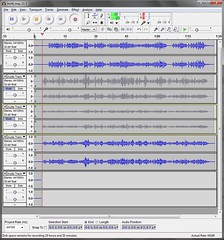
One REAL test for tuning is to play along with one of my previous tracks or have 2 of my tracks play together… OUCH! When playing this way, I am forced to adjust to the “other oboe”: nothing says that the “other oboe” is in tune Smile with tongue out, but there is an old saying in musical performance: “If the other guy is out of tune, it’s my fault!” [for not compensating]. This is much more difficult than playing with other instruments.

Getting the piano part is not too difficult, it requires a CD or any kind of computer file where the piano was recorded. A CD can be “ripped” with free programs such as WinLame and each tune or movement becomes a separate MP3 file. In all formats of recorded performance (actual sound file), just drag-and-drop the file onto Audacity and a new track is made for it. If you have a MIDI file, it can be converted into an actual sound file with other free software such as SUPER.

Monday, January 3

Reed Cases Galore

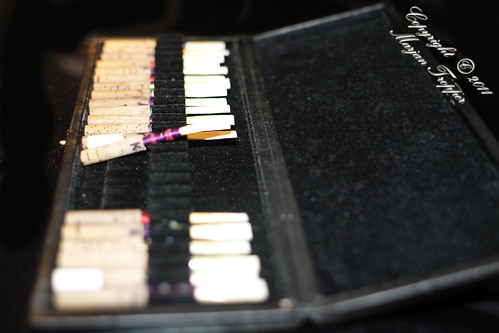
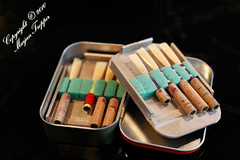
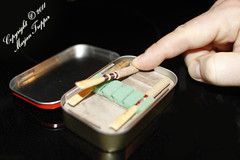
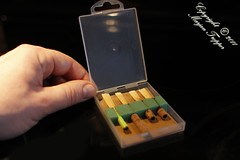
Awhile ago on the OboeBBoard (excellent place, by the way), someone asked where he could get affordable cases because he wants to carry as many reeds as possible with him. My wife took some excellent pictures of some reed cases I made myself which I linked on the BBoard and posted on my Facebook account… but I just realized that Facebook is kind of ephemeral, posts go down, down, down the page as one’s friends add their own posts. So here is a better selection of pictures with explanations. You can find more excellent photos on my wife’s flickr account. Except for one store-bought case, they are home made, inexpensive, very solid and dependable.

I’ll start with the store-bought case for 25 reeds (I got it from Le Roseau Chantant). I like it for many reasons (apart from keeping 25 reeds):

  1. it uses that ribbon pincher method which keeps the reeds nice and separated,
  2. they don’t move in the case
  3. mostly, it has a pivot mechanism built on a 2-level background: press on the bottom of the staple and a “dip” in the backing will lever the reed out of the pincher.

This is fantastic to prevent reeds rubbing one another or turning around and suffering breakages that way. Compared to many other cases I own with the same mechanism, this one seems better built and wants to last longer… other ones tend to loose their grip on the reeds. It was very expensive, even on sale, but I’m glad I have it as I use it a lot and it’s nice to have so many reeds side by side for comparison and categorising.

My most practical case is made of a tin box that comes when you buy Fishermen’s Friends Cough Pastilles. It has just the right dimensions to put 2 levels of 5 reeds each (oboe, d’Amore or E.H.). So I have 10 reeds in a virtually indestructible box that fits very nicely in the pocket of a shirt or jacket or tuxedo! Although not necessary to do so, but made side and top walls for the levels which does 3 things:

  1. it gives a little extra rigidity and support to the levels,
  2. prevents accidents with the reed tips
  3. helps lift up the upper level by pivoting on the walls of the lower level (no bottom wall to impede the pivot). 

I made the 2 levels of reed pinchers using thick cardboard and foam underpadding for carpets. The foam is just glued on the backing with carpenter’s wood glue and slits cut with an X-Acto knife (2 very handy things to keep around the house or apartment!). Slits cut in foam are much easier to make than those pincher ribbons and the pressure from the foam makes it easy to put the reeds in while keeping them very firmly in place. The walls are glued, but this is made easier by first taping them with ordinary office tape. The entire backing was painted with automotive spray paint: this makes it very resilient to wear, no worries about toxicity after drying, it is water proof and easy to clean with household rubbing alcohol. The foam is glued when the paint is dry and the slits are cut after the glue is very well set.

My last case works in the same way as the one above. It was made hastily when I shipped my Lorée to Peekskill N.Y. to be revoiced (the revoicer wanted to know how I like reeds to better assess the final work). Once closed, the box does not open unintentionally and the plastic protects the reeds well while fitting marvellously in the smallest pockets.

I didn’t bother painting the cardboard backing because I wasn’t expecting the reeds to come back. They did come back and it turned out to be a very practical box. I’m sure you can find such plastic boxes in a variety of places, this one came from specialized cotton swabs to clean my dogs’ ears. There would have been room for a pivot-band, but I didn’t bother as it was not intended to be as useful as it finally became!