Showing posts with label dent de sagesse. Show all posts

Tuesday, May 24

Binding Reeds and Blade Offset

Results from tying reeds.

A few weeks ago, someone at the BBoard had asked me to show high-definition pictures of my reeds tied using the Cane Guide (le Guide Roseau) and pre-binding. Look at the very large size of the picture by clicking on them: this will bring you to my wife’s photo stream where you can choose “original size”.  The binding colors are reeds with the following characteristics (from left to right):
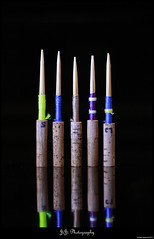
  1. IMG_0795Yellow (neon green): Shaped with a Weber Wide (0.60mm gouge) and tied using the Cane Guide on a Stevens #3 thin wall staple. This reed has not yet been chopped (only scraped for blank storage).
  2. Blue: Kunibert Michel 7.25 shaper with my own 0.57mm gouge tied on a Chiarugi #3 staple using the Guide Roseau. This reed has been scraped a 1st time and is playing remarkably well. A very slight slipping can be noticed. Evidently, it is not slipped at all near the thread and the blades are rather loose. I probably tied it too long and not tightly enough. At 73.5mm total length, it plays at A=440 to A=442 without any problem.
  3. Gold: Kunibert Michel 7.25 shaper with my own 0.59mm gouge tied on a Chiarugi #3 staple without any binding aid. This reed was finish scraped several months ago. There is a good sized offset on this one (it often slips even more while playing) that flares from binding to end. IMG_0790This means I did not hold the blades well aligned when binding. The reed still plays very freely, though the dynamic range is limited. I think the limited range is due to the offset, but the free playing is from a good selection of nicely flat cane.
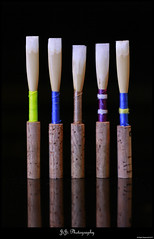
  4. Purple with 2 white bands: RDG –2 shaper (0.61mm gouge) tied on a Chiarugi #3 staple without any pre-binding aid. There is a moderate offset on this one which inhibits both free playing and dynamic range, otherwise, the reed is stable and responsive. The binding looks higher on this one than the others: most of my reeds finish the winding 1-2 winds before the end of the staple, so this one might be tied all the way to the end. It could also have half or one wind past the end, which would explain the inhibition. But usually, reeds that wind past the staple  behave much worse.
  5. Blue with 1 yellow band: Kunibert Michel 7.50 shaper with my own 0.58mm gouge on a Chiarugi #7 staple. Not yet chopped (only  scraped for blank storage).

Making good reeds is easy!

Testing the blue reed.
I have irked many people by saying this before, but I stick to that statement! It’s all about selecting the proper cane and shaper and binding properly. Here are some sound clips of the blue and gold reeds for a sound comparison. Note the blue one took my less than 5 minutes to scrape to get to this point! Also note that I am not making huge efforts for dynamic expression: I just wanted to get an idea of how they sound. Be careful: the 1st time a reed is scraped, it often plays very well quickly. Do not try to get it perfect on the 1st “sitting”: reeds tend to harden-up after a day and its best to do a 2nd scraping the next day and a 3rd scraping a week later.
Testing the gold reed.
On the 2nd and 3rd scraping, the reed should become as good as it gets, tough some adjustments can be made after that still.

Most important, never try to make a decent reed “perfect” when you’re tired and/or frustrated: you will ruin it irreparably!

Theory of Reed Slipping (offset in the binding)

The following  is explained at length in Jay Light’s book and the question has been asked on the BBoard. Many prolific oboists of the American reed technique do on purpose to offset the blades of their reeds while binding. I don’t like this mis-alignment, but it works for a whole lot of people and I did get a few really good reeds that way.

The question asked if it is OK for the cane to slip such that both sides of one blade are inside the other blade. Well, if a cane is correctly shaped and folded, this is impossible! For good slipping, when tying a good piece of cane, the symmetry will make one edge of each blade overlap the other. In other words, if only one side of the reed is slipped, something is wrong; if one blade is fully “inside” the other, it was not folded in the middle of the shape! So in other words, my preference is for the last diagram in this slide-show; the 2 middle diagrams are OK by American standards and the 1st is just plain wrong.

One thing I should note is that many people believe it is necessary to offset the blades to prevent air leaks: this is completely false as most of my reeds that leak also have offsets whereas those that are tied in perfect alignment never do.

Sunday, April 10

Blow that tooth hole!

O.K., three weeks have past after the extraction of my wisdom tooth. So here I go trying to play again. There is still a huge hole in my gums where my tooth used to be, but the dentist, a registered nurse and two very experienced oboists have reassured me that all should be fine. (One of these oboists had his jaw-bone cut for the extraction and still played after 2 weeks!) So get back on that oboe! Besides, the weather is getting good which means I need to start my lunch-break-in-truck rehearsing again.

FINALLY, recorded my real sound!

“Maybe” by Thom Pace.

One contributor on the BBoard requested sound clips of the other contributors so we could get an idea of the panorama of sounds that we have. I don’t really like my other You-Tube recordings because of recording issues I explained in previous posts. Also, someone reminded me of this lovely tune and I thought it would be a good comeback. This is a You-Tube of the original for the movie and TV series Grizzly Adams.

I finally recorded what I consider to be the same sound I hear when I play…. that is, if you’re listening on speakers with the same specifications as those that come with a Dell Dimension 9150 computer! It also sounds fine on my home theatre system, but if I listen to it through my lap-top: not the same…. through my Sony EX35-LP ear phones: not even remotely the same… and so on and so forth!

First play after 3 weeks post tooth extraction.

The layout was to sit at my computer desk with the Zoom H4n on the desk, pointing straight at me but me playing to the side (towards the door open to the hallway and stairwell). The microphone sensitivity was at 15%.

This is not what I consider my best sound, but it’s close to it. The dark warm tone is 80% of the way to my favourite but the dynamic range and stability are a little bit under. That’s O.K. I’d better get my gums used to the pressure slowly with easy reeds. This reed was shaped with a Kunibert Michel 7.25 shaper and the cane was gouged with my own gouger using my latest blade profile.

Oboe results with hole in mouth:

There’s only a little discomfort with my gums not fully closed yet. I feel a pulling sensation in the hole, that comes from the pressure of my cheeks holding back the air pressure. For that purpose, I’ll do only a few minutes at a time with more breaks.

As for the oboe sound…. this has little if anything to do with my tooth extraction, but I really need to work my breathing more. The sound is pretty good, but I can tell the fullness is not what I’m capable of getting. I can kind of hear that my thorax is not expanding very much, especially in notes of the 1st and 2nd octave keys. I cannot blame it on the tooth pulling because my thorax feels the same as always, I guess I’m just paying more attention to it now that I’m consciously observing the feelings in my gums.

Sunday, April 3

Wisdom of teeth and Knife Sharpening

What a week that was on the good ol’ BBoard! I’m always amazed at how much ado is raised on the subject of gouging cane and gouging machines. The discussion threads are really long, but really worth reading, if you’re considering gouging your own cane.

  1. Gouger Thread
  2. Single/Double Radius

For tooth (sooth?), my oboe!

The extraction and healing process went well, but the stitches that closed my gums dissolved a week to soon! It’s a bit scary to feel the threads on my tongue and then look in the mirror to see the white of my actual jaw bone! But not to worry, an emergency call to my dental surgeon put me at ease: the critical part is the first 3 days (well passed) while the blood vessels close and the hole in the jaw clots. After that, the gums can take up to 6 weeks to fully close.

But the dentist had said 2 weeks to start playing the oboe again… I suppose giving it a 3rd week would be prudent, so I’ll start again next week…. and eating real food too! Stir-fry is good, but eventually gets boring?

Lesson to all students of wind instruments:

  1. if you’re around 18 years of age, consider getting your wisdom teeth extracted while the roots are not yet settled and while your career will not topple for a month and some of absence!
  2. My procedure went very easily because the roots were not overly curved and they were nowhere near the nerve (THANK GOD!). With many adults, this is not the case: a fair number of people need to have their jaw-bone cut (not me – again THANK GOD) in order to extract the tooth safely.

How to sharpen knives and a whole lot more.

There have been comments from time to time about how people sharpen knives. People are buying books on the subject…. and still getting it wrong! In the mid 1990’s, I was a Scout Leader and I had been asked to give workshops on how to sharpen camping knives and so on. As a result, I put this book together. I’m giving this for free for many reasons:

  1. The wording betrays my younger years and lesser experience.
    (e.g. I still don’t have a green thumb, but I have dug enough fence posts by now to say that sharpening shovels is VERY productive!)
  2. The age shows: some of the tricks described are now commercialized gadgets.
  3. I think oboe students have enough to buy, I hope this will help out.
  4. The Oboe BBoard has contributors that can give much better tricks!

But its contents are still fully valid. It uses an approach of theory-to-practice and by explaining other commonplace tools, the principles of what helps or messes-up a reed knife should be easier to grasp.

At any rate, it’s always easiest to make reeds with ultra sharp knives. You can either buy a cheap knife and sharpen it every 2 minutes (takes 15 seconds), or buy an expensive knives that you sharpen once a week (takes 10 minutes). I have been using the same Graf folding for nearly 20 years and I can still get it to shave the hairs off my fore-arms. This, I must admit is a little too sharp: it tends to dig-snag the cane, especially when working the tip. But burrs… NO… never good!


Sharpening Tools -

Sunday, March 20

Pre-Gouging and tootH yanking…

I capitalized that H because apparently I forgot it on a Tweet and got some good laughs! Embarrassé

First – human (caused) tragedy:

What is happening in Libya right now can cause a lot of anger, for different reasons, directed at completely different “camps”. Regardless of the camp, this can result in anger, fear and pain. I firmly believe that what the general population is told about the motivations is, at best, a load of half-truths. So I beseech everyone, regardless of your political opinions to simply speak for and keep your mind set on a peaceful resolution of the current situation.
warAmpsStopWarI did serve the Canadian Armed Forces: I am Combat Leadership certified. More on that some other time, but I did serve 8 years with pride and honour.
The image to the right is from the War Amps: an organization that raises money to help children with amputated limbs and their families. The image with the downturned rifle is the Canadian Armed Forces’ symbol for mourning dead soldiers (“fallen comrades”). The organization uses this as a logo for their efforts to sensitize people to the horrors of (all) war and to the importance of trying to avoid it and find peaceful solutions to critical situations. Some of you will argue in favour of action to prevent worse trouble: history has yet to show this works at all.

One wisdom tooth gone!

The operation went really well. The “deep sedation” (getting me to sleep) was quick and efficient and the wake-up process went quickly and well. The extraction took an hour, but evidently without problems: today (approx. 48 hours later) no pain, no swelling. 2 weeks to oboe! In the mean-time, prepare reeds for scraping!

Pre-Gouging: the conception of an oboe reed!

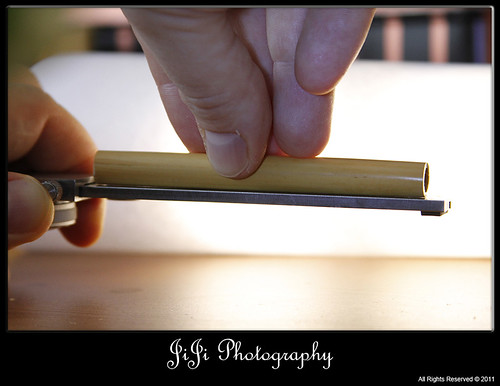
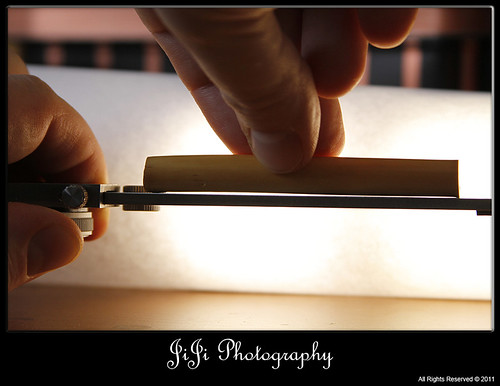
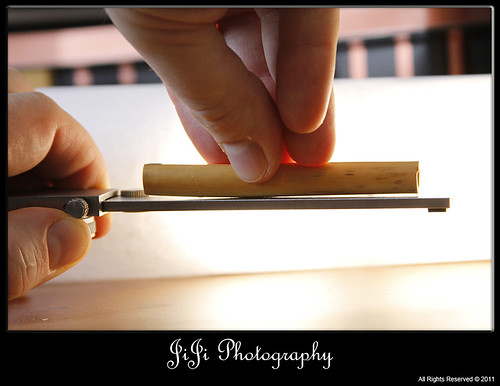
I was surprised, during the summer, to read LOTS of questions and discussions about pre-gouging. My wife took some excellent photos and I will use them to explain: many more can be found on her Flickr photostream. In a nutshell, “gouging” cane is giving it the right thickness and inner curve and “pre-gouging” is only about getting a piece of raw can to fit the gouging machine…. that’s all!

To me, the most important criterion for cane selection is flatness: this will greatly determine how “freely” the reed vibrates. Arching inwards will choke the reed and cause leaks close to the binding. Arching outwards will make the blades separate: I got excellent reeds with this, but they are usually difficult on endurance. I don’t care so much about “straightness” (side to side) as this will be cancelled by the shaping.

IMG_1885 IMG_1880 IMG_1881

Most references and stores only mention splitting in 3. For me, the inspection of flatness sometimes shows that it is possible to get 2 flat sides that would ruined by splitting in 3. Fully flat splits are not always possible, so I just aim for the best possible and choose to split in 2 or 3 depending on which will yield closest to flat.


The images below show:

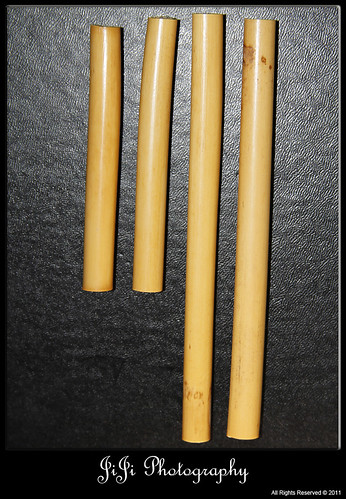
  1. Split lengths from a canon (tube cane) split in 2, split in 3 and pre-gouged.
  2. The split-only cane in the machine: it can work, but risks jamming the machine and messing-up the delicate adjustments.
  3. The pre-gouged cane: much easier to gouge.
IMG_1895 IMG_1914 IMG_1918

In terms of quality of cane the important factors are:

  1. density and “health” of the grains: hard to tell before scraping – I’ve lately made great reeds with canes of almost all hard/softness
  2. flatness of the final cut
  3. diameter and thickness of the selection
IMG_1970 IMG_1974 IMG_1976

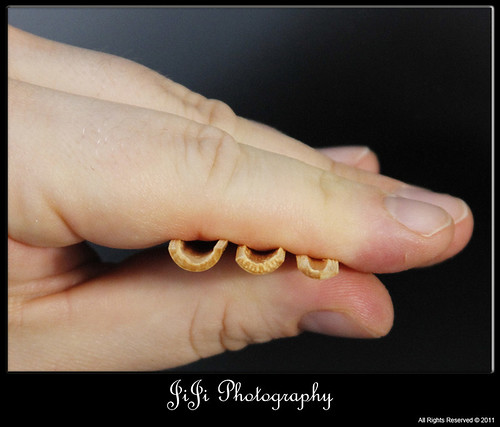
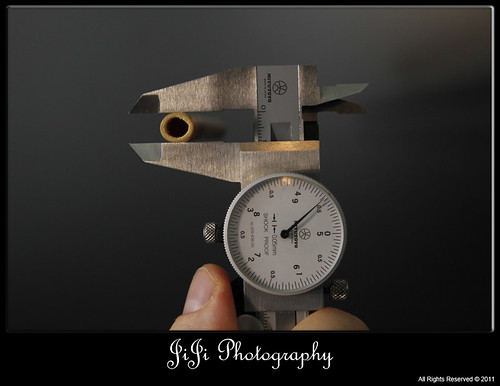
The thickness of cane will be the subject of another blog post (on gouging). As for the diameter, these pictures show that what looks like a HUGE difference in diameter can be as little as 1mm or 0.5mm. In fact, I consider the arc more important than the diameter because, in an ovoid tube, the diameter can be misleading, especially if you’re using drop-in rulers to measure it.


The pre-gouging demonstrations above work equally well with canons split in 2 or 3. I only have difficulty when a canon turns out to have a diameter for English Horn: a bigger pre-gouger (especially for E. H.) is required for that. In many internet guides on reed making, they show chopping the cane before pre-gouging it. I prefer the opposite because:

  1. it is easier to chop after the cane is thinned,
  2. some split cane lengths can produce 2 pieces for reed making, but the chopping first requires preparation that can ruin it.
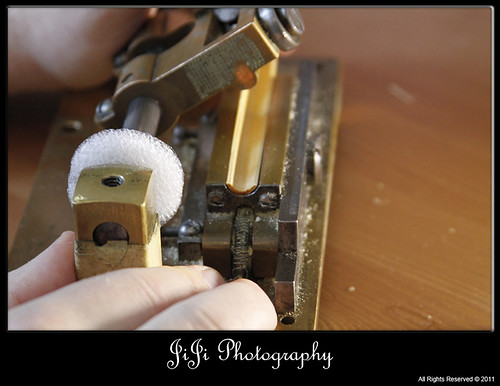
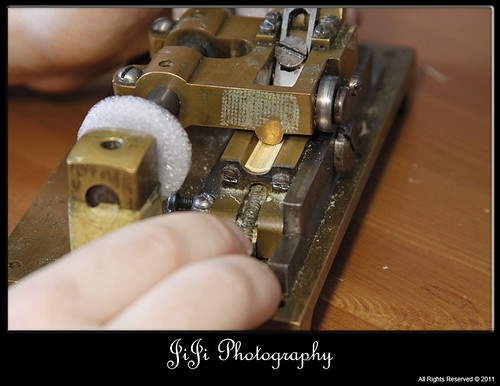
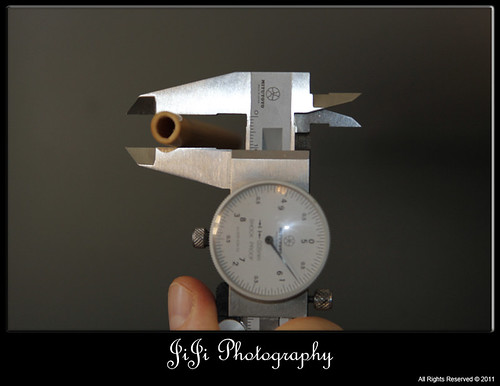
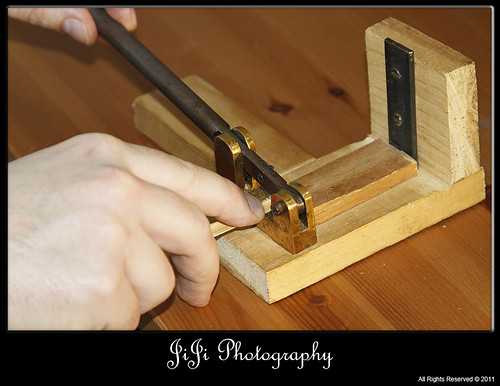
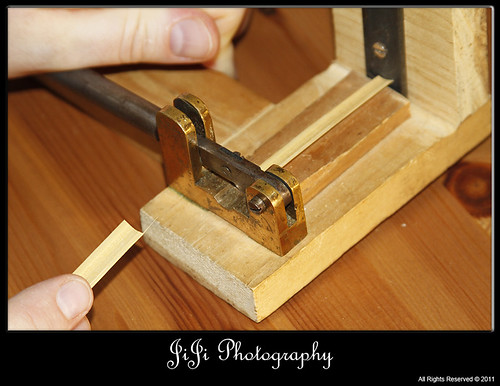
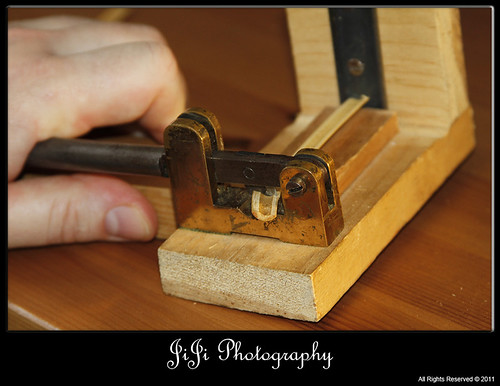
For chopping, I removed the guillotine from my beaten-up old gouging machine and made a wood-base for it. The reason is mostly that I could make a fixed-length stopper at the end, making it easier to measure the cut. The base does not need any degree of precision at all (±1.5mm is good enough) and the side bar allows it to take the pushing force from my hand more easily. The guillotine blade needs to be sharpened once in a while, but its nothing precise at all. The gouging is the really sensitive part.

IMG_1952 IMG_1961 IMG_1965

The above images show: (left) cutting a little bit off the end to keep the flatter part in the middle; (center) sometimes, 2 pieces of reed cane can be obtained from the same split length; (right) again, what counts most of all is correctly centering the cut to keep the flattest part.
Other than the above, I pretty well keep all cane, soft or hard, twisted or straight. The reason is that I have it, might as well use it. If it does not work out to be a good reed, well I only lost a few hours of my time. But throwing away the potential for a fantastic reed is a horrible thing!