Saturday, April 30

Oboe Reed Shaping and Fibro-Fog

Soleil Lovely day today: sunny and warm day
=> so staying in the comfortable cool shade of the TV room! Rire

Ugly stuff first,

The past 2 months were generally rough, but this week was especially harsh on the fatigue aspect. Most (not all) sufferers of fibromyalgia also get chronic fatigue syndrome.... again named that way because the medical field can find no explanation for it: nothing physically wrong! In other words, for no reason at all, we are always tired, not sleepy, but tired as if we had been chopping firewood all day.

Fibro-fog is when just being awake is like moving through a thick fog of confusion and physical resistance. Remember the Claritin commercial of a person taking out the garbage in a deep-sea diving suit? That explains it perfectly! The simplest tasks like getting milk for the coffee becomes confusing: exhausting to open the fridge door, and then not knowing what to do next! This is very different from dementia, Alzheimer's or senility because it is completely related to the physical aspect: as soon as the muscular crisis is abated, full mental faculties return; plus we are aware and feel ridiculous about the issue. But it’s not as easy as taking pain medication to restore mental faculties, the body has ways of insisting on giving us a hard time.

Occupation Hap-Hazard

Luckily, for my employment, some activities become so mechanistic and automatic that they can be done correctly with only some slowing down of the process. Even mentally complex tasks like debugging a program can be done. But if you ask me to get up and get printed pages across the floor, I will likely get lost on the way!

So I hesitate to embark in musical performance with an ensemble: I cannot predict when this will happen. There are also evenings when I get home and even watching TV becomes exhausting. I can really thank God for my truly wonderful wife who copes with full understanding: she just plays along with it, not making any big deal - which helps me accept it quite a lot! There are forums for fibromyalgia sufferers, but the number of hours in a week is limited and I get MUCH more benefit from participating in the BBoard and the Facebook group "Oboists in the World". Feeling like a musician again is powerfully uplifting!
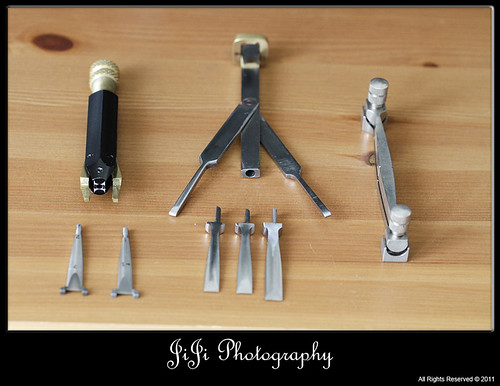
_MG_0680Now the good stuff.

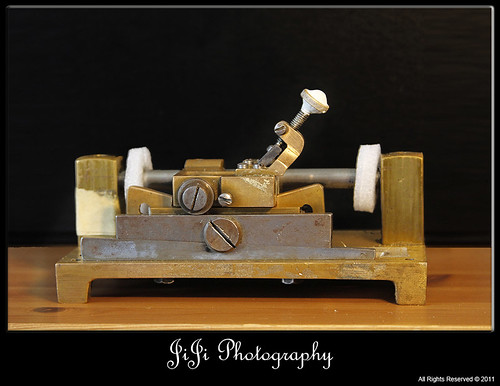
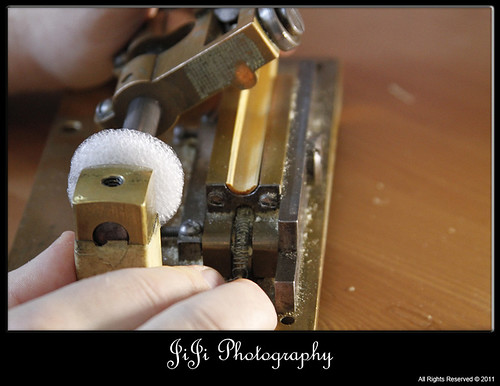
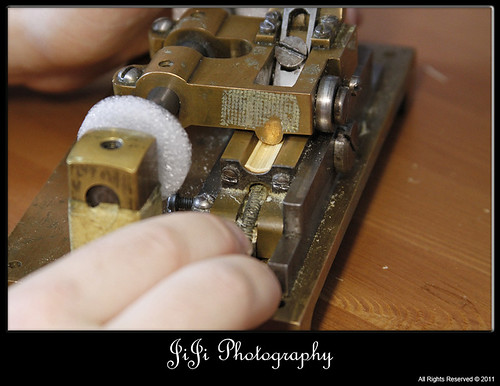
In terms of the sound quality and performance factors like stability, the shape and the binding are everything! The scraping has only one purpose: to let the cane do what it wants to do naturally – vibrate in response to the blowing. I find the choice of shaper and its combination with the staple size have even more effect than cane diameter, gouge thickness and any specific measurement around scraping. Please note that my wife put many more excellent images of shapers and more on her Flickr site.

Which shaper to choose is really an individual preference because it is a matter of responding to body parameters like teeth structure, characteristics of the lips, how the air pressure is channelled from the lungs to the mouth and very importantly, their interplay with the brand of oboe and even the individual instrument. This is why advanced oboists spend considerable money on shaper tips and to find the perfect staple.

There is really no right or wrong in choosing shapers, it’s all about what works for you: start with what your teacher recommends, then experiment and decide for yourself. For my part, and Europeans I know (French and German) who have tried the same, Kunibert Michel shapers (Germany) on Chiarugi staples (Italy) are a winning combination, vastly superior to all others. Comparisons will be left for another time.
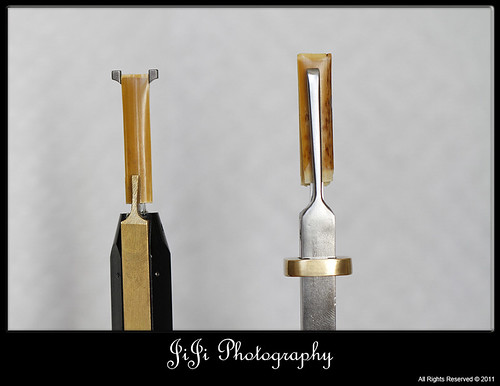
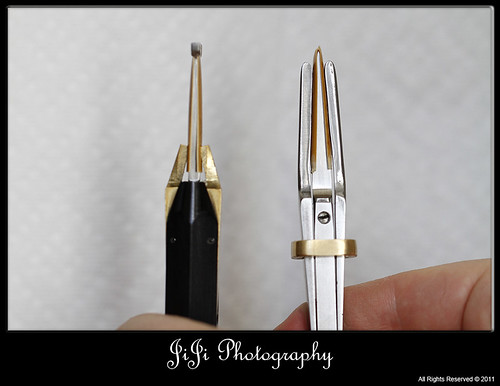
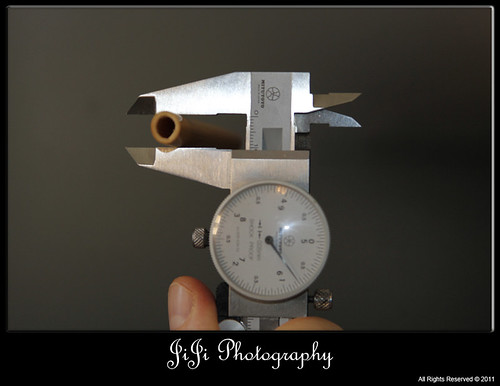
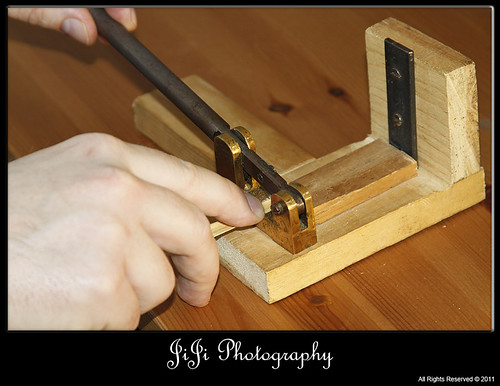
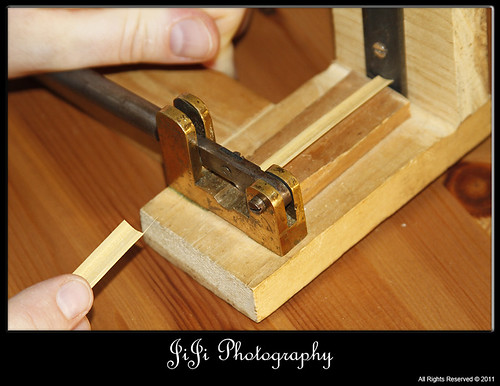
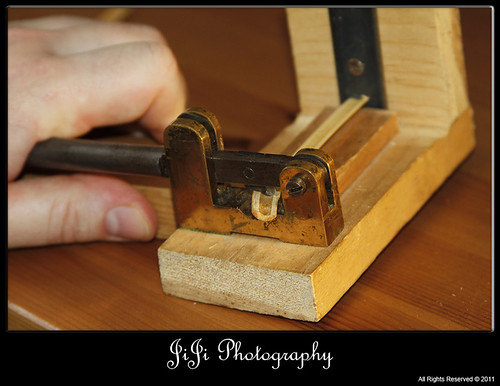
_MG_1078 _MG_1080 _MG_0645

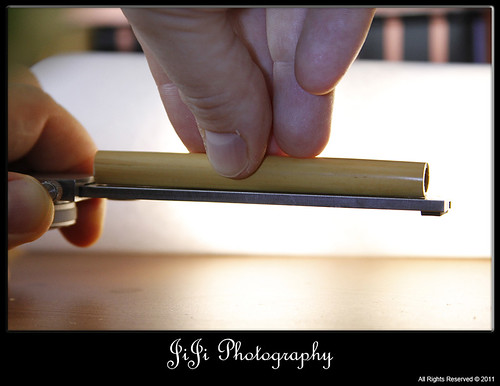
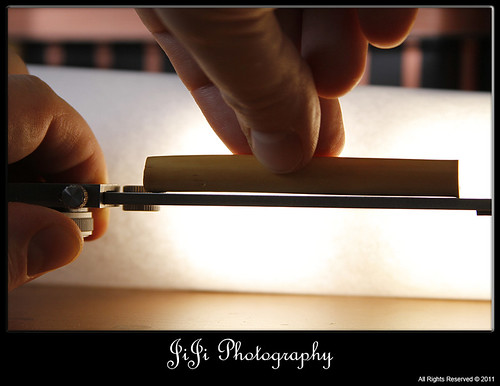
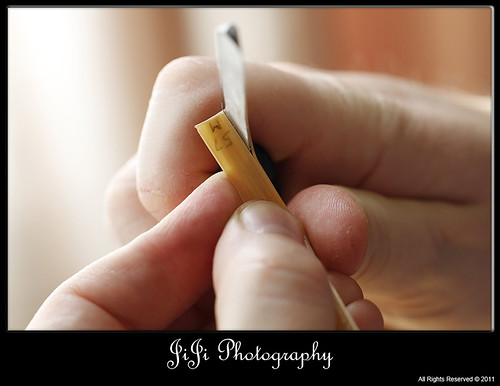
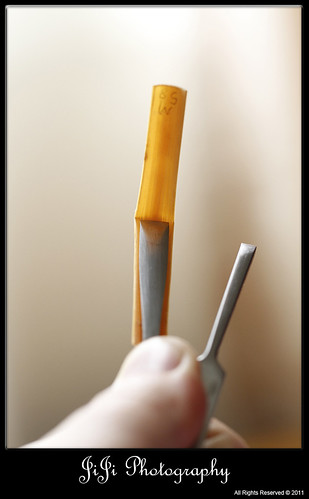
Finally, there are different types of shapers, which mean different ways to use them. The most common are interchangeable shaper tips that fit on a reusable handle: these require you to fold the cane over the tip. There are also “straight” shapers in which you insert non-folded cane: by completely covering the cane, there is no chance of nicking it or messing the shape. Finally, there is a new (expensive) machine that works on the principle of the straight shaper and is designed to roll-out hundreds of pieces of cane in very little time.
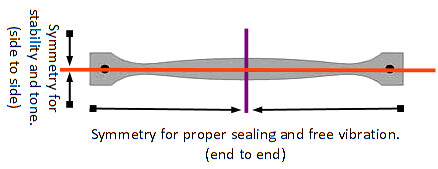
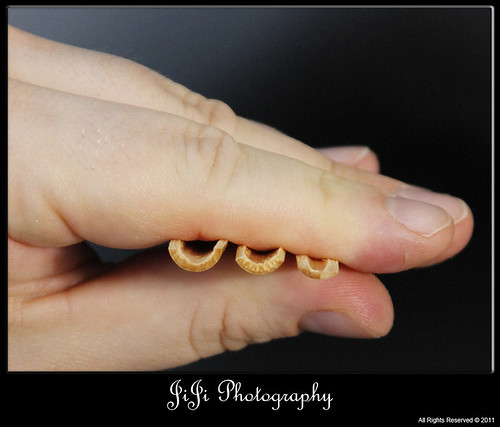
straightShaperSymmDespite the attractive idea of simplicity and safety with straight shapers, there is good reason why the fold-over interchangeable tips remain most popular: folding the can flattens it near the fold which resembles the real silhouette of the final reed whereas the straight kinds leave the cane curved; which means the reed will be much wider than the shaper leads to believe. The difficulty with manufacturing straight shapers (almost nil with fold-over tips) is that the important symmetry is from end-to-end: this ensures that when the cane is folded exactly the same curves meet, which is necessary for proper sealing and support for vibration.

With a little care, the fold-over tips will always yield excellent results, the only important consideration is a sharp cutting tool with no nicks in the blade: the tip really wrecks a blade! Many oboists use disposable razor blades, I use a retractable blade knife and break off pieces after every cane shaped.
_MG_0722 _MG_0710 _MG_0711

With shaper tips, there are again 2 types, and this makes really no difference at all in the quality of the final shaped cane: it’s just that they are used slightly differently. New-school shapers (have been around for generations!) have “ears” that introduce the blade to the sides of the cane. They leave “ears” on the cane that are easily removed after the cane is tied on the staple. Old-school shapers have no such ears and the shaped cane (ready for binding) is fully shaped. With ears, the cane must be sized to fit before closing the handle-clamps whereas no ears allows free positioning of the cane. In both cases, its just a matter of getting used to the moves.

These videos (made from still images) show how I cut the cane after folding to fit the ears. I cut the cane to ensure the thick center (dark line in the middle) remains centered. The last video shows a typical technique: the shaping is done with the knife perpendicular to the shaper, but to ensure a “clean cut” a few extra strokes are made with a slight (very) angle: this makes a smooth side of the cane.

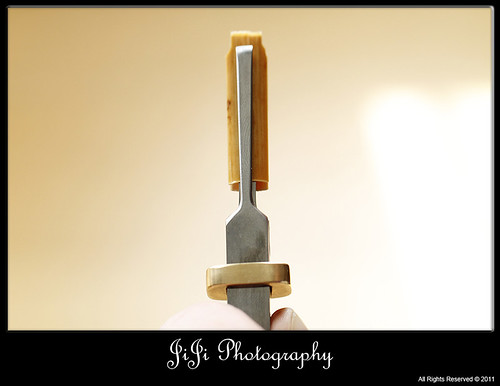
With heads that have no ears, I just center the line on the shaper itself. The two handles I use illustrate another consideration: the handle clamps. The shorter clamps are mounted on a tightening screw which makes it easy to reposition the cane; however, dents are left on it. With the German type handle, the clamps cover the entire cane are secured with a ring. This allows exactly enough pressure to secure the cane without denting it; I also like to use the ring as a leverage thumb-rest to more easily control the knife. With ears on the shaper tip, many people rest the ears on a table for better stability.

Conclusion:

Shaping is really not complicated, but the choice makes a HUGE difference. The choice of handle and tip description is entirely a matter of personal preference.

Friday, April 22

Engineering and Artistic Integrity

Whether you are Christian or Jewish or Zoroastrian

or Hindu or Muslim or Shinto or Neo-Pagan or what:

Arc-en-cielRire HAPPY EASTER! C'est la fêteCoeur rouge
For just this weekend, let’s all never mind the specific differences and look at the common grounds:

For Jews, the Passover is a celebration of the liberation from murderous bondage, liberated by God’s intervention through His Prophet Moses. For Christians, Easter is about the triumph of humanity’s bond with God through the Redeemer over the evil that seeks to enslave and destroy us (recall that it is not all Jews that condemned Christ, but the political coup of the Sanhedrin of that time and a band of revolutionary bandits). Muslims also proclaim that Jesus died on the Cross and that he resurrected and ascended into Heaven – Jesus never once spoke against the Jewish faith (which was His) and never allowed any one social group to disdain any other. Paganism celebrates Eostre as the revival of life after the dead seasons. Sheez, even hard-core atheists celebrate the return of comfortable weather… in the northern hemisphere anyway… those of the southern can still use another reason to have a party!

In my engineer’s point of view, do you see a pattern emerging here?
=> VICTORY OF OF LIGHT OVER DARKENESS!
Triumph of Freedom over oppression; Life over death;
Happiness over depression; Truth over lies; Love over hate.

So I beseech everyone to be happy, celebrate Easter together and enjoy the weekend!

Integrity: true strength is in the soul

I firmly believe that bullying is proof positive of weakness, stealing is proof of inability and lying is proof of desperation. Any idiot can insult or hurt someone. It takes much more power to earn trust and keep friendship. Striking fear invites retribution while fostering love invites cooperation. The person who steals proves that s/he is incapable of obtaining through her/his own merit. The person who shows contentment is victorious over peer-pressure and thus rises above the crowds; people who patiently make their way and build a different livelihood and surroundings show their ability to navigate the currents of society and contribute rather than siphon. Those who help others show a self-evident strength where pirates and mockers only show themselves as parasites. People with positive attitudes find solutions or at least inspire others to do so; those who complain their problems are someone else’s fault and rely on condemning others only bring more hostility onto themselves.

As a graduate student in Computer Engineering, I did a lot of Teaching Assistance (average 115% work load). I was amazed at how students cheated because, when I was in their shoes, my thought was always: “At the exam, there will be only me… in the real world, I will have to do the job… so I’d better do the work and develop the skills now”. In fact, I did have the opportunity to submit a senior classmate’s assignments: he gave me all his solutions from the year before knowing that I would only use them to learn or as a last result. In fact, I sometimes handed-in very flawed work instead of copying, because I preferred an honourable failure: how else could I learn and improve? Obviously, not everyone agrees.

How can you cheat in music?

My background is music performance. On stage, there is no cheating: it’s me, my instrument and the audience. There’s no way to use someone else’s performance and pass it as my own in an audition…. I can’t get someone else to audition in my place: they want the job too! If I put some great soloist’s recording on this blog, passing it off as mine… well, someone will hear me eventually and blow my cover: I will be left to face my deceptions alone, impressing only the weak and idle.

Showing my playing faults now will highlight my evolution, my improvement over the months and years will demonstrate the strength of my commitment, the worth of my efforts. If I do not improve, if I make a fool of myself over and over again, then it will be done with honour and prove my confidence in letting people know the truth rather than giving an impression that will just come crashing down on me should ever I wish to meet someone in person. Rather than closing doors by presenting a false image of my performance, I prefer to open doors to people of all levels and of all descriptions. Even if I never improve, or get worse, my enjoyment of the process should inspire other hobbyists and beginners and might impress upon professionals to remember the passion that lead to their “daily grind” as performers!

My best and most sincere wishes of
true strength and honest power to you all!

Friday, April 15

Engineering Oboe Players

Well over 5000 visits, now, from 58 countries! StarPouce levé 

I wish I had something to present in order to toot my own horn, but these past few weeks have been rather busy and I've only begun to practice again last Saturday. 3 weeks absence is rooouuugh on the endurance!

Here are a few pictures of how I practice at lunch time in the truck. Last summer, before buying our vehicle, I did the same thing in a Nissan Versa: so it's not the size, but how you use it!

So instead of showing off something of my own, I'd like to pay a little tribute to you, my readers. That is, I don't know what characterizes my readership (you), but the blog is geared towards:

  1. Oboe players (other instruments too, why not?)
  2. who are probably doing something else in life and/or still in school
  3. who must overcome hurdles to enjoy the wonderful thing which is practicing the oboe!

There are many oboists in situations like mine. Some play much more actively, some play even less than me. Some have no real trouble in life, some have much worse physical impediments than mine. Mostly, everyone contributes to society through their "day jobs" in a way that is made richer for being oboists. On the good ol' BBoard, I was surprised to see a good number of engineers and other non-musical professionals posting with lots of oboistic expertise. Some of their stories are on the BBoard. Some actually gained their engineering penchant by attacking oboe mechanical problems and improving reed making equipment.

... another odd thing is that it seems a whole lot of us are composers too! Yes, I compose, or used to: but that something for another time. For the purposes of this post, it seems that there is something inherently creative about the engineering personality which expresses itself as composition, when we don our composer's hat.

Which difficulty do you choose?

Whether you become an engineer or a nurse or or a teacher of English Literature or a financial consultant and so on, you have to devote years of harsh university training and certification. If you become an auto mechanic or a home contractor/renovator or a photographer, there is still training and certification involved (often ongoing) and to a great extent the safety of your clientele, their reputation and their comfort rests in your hands. Even garbage collectors and park cleaners have a huge impact on everyone’s enjoyment of life every day. To me, people who take their profession to heart are worthy people indeed.

Professional musicians must also devote years of their life training. The training is an enjoyable journey (I should hope so) but then they face an uphill battle for their livelihood: I know, I started up the path and quit! Although engineering was very hard for me because I didn’t have the talent for math and that kind of mental processes, finding a job was much easier once I got my degrees – so essentially, I traded one difficulty for another, but with an easier payoff in the end. What is really striking are the stories of people who have continued to play all through their alternate careers (e.g. engineering, nursing, government) and have been able, this way, to become as active as some professionals in their pre/retirement days. Many were fully trained at university (or equivalent) and almost none seem to regret the path they took.

Examples of how ordinary people use all the creative resources at their disposal to do some really amazing musical things. I can also mention a Registered Nurse who also suffers chronic pain and is, nonetheless, actually returning to music as means to earn her living. Same thing for a former government employee (now music teacher) who used to be sent to many countries in sometimes hostile situations as part of the job. I don't know if the oboe contributes or benefits from it, but these people (maybe you, now or later) are actually providing benefit to the world around whether they realize it or not. Hey, maybe there's hope for me yet!

In the meantime, thank you: Argentina, Australia, Austria, Belarus, Belgium, Brazil, Bulgaria, Canada, Chile, China, Columbia, Cyprus, Ecuador, Egypt, Finland, France, Germany, Guam, Hong-Kong, Hungary, Italy, India, Ireland, Israel, Japan, Jordan, Latvia, Lithuania, Malaysia, Mexico, Moldova, Morocco, Netherlands, New Zealand, Nicaragua, Nigeria, Norway, Philippines, Poland, Portugal, Romania, Russia, Serbia, Singapore, Slovakia, Slovenia, South Korea, Spain, Sri Lanka, Sweden, Switzerland, Taiwan, Turkey, Ukraine, United Arab Emirates, United Kingdom, United States of America, Venezuela

Sunday, April 10

Blow that tooth hole!

O.K., three weeks have past after the extraction of my wisdom tooth. So here I go trying to play again. There is still a huge hole in my gums where my tooth used to be, but the dentist, a registered nurse and two very experienced oboists have reassured me that all should be fine. (One of these oboists had his jaw-bone cut for the extraction and still played after 2 weeks!) So get back on that oboe! Besides, the weather is getting good which means I need to start my lunch-break-in-truck rehearsing again.

FINALLY, recorded my real sound!

“Maybe” by Thom Pace.

One contributor on the BBoard requested sound clips of the other contributors so we could get an idea of the panorama of sounds that we have. I don’t really like my other You-Tube recordings because of recording issues I explained in previous posts. Also, someone reminded me of this lovely tune and I thought it would be a good comeback. This is a You-Tube of the original for the movie and TV series Grizzly Adams.

I finally recorded what I consider to be the same sound I hear when I play…. that is, if you’re listening on speakers with the same specifications as those that come with a Dell Dimension 9150 computer! It also sounds fine on my home theatre system, but if I listen to it through my lap-top: not the same…. through my Sony EX35-LP ear phones: not even remotely the same… and so on and so forth!

First play after 3 weeks post tooth extraction.

The layout was to sit at my computer desk with the Zoom H4n on the desk, pointing straight at me but me playing to the side (towards the door open to the hallway and stairwell). The microphone sensitivity was at 15%.

This is not what I consider my best sound, but it’s close to it. The dark warm tone is 80% of the way to my favourite but the dynamic range and stability are a little bit under. That’s O.K. I’d better get my gums used to the pressure slowly with easy reeds. This reed was shaped with a Kunibert Michel 7.25 shaper and the cane was gouged with my own gouger using my latest blade profile.

Oboe results with hole in mouth:

There’s only a little discomfort with my gums not fully closed yet. I feel a pulling sensation in the hole, that comes from the pressure of my cheeks holding back the air pressure. For that purpose, I’ll do only a few minutes at a time with more breaks.

As for the oboe sound…. this has little if anything to do with my tooth extraction, but I really need to work my breathing more. The sound is pretty good, but I can tell the fullness is not what I’m capable of getting. I can kind of hear that my thorax is not expanding very much, especially in notes of the 1st and 2nd octave keys. I cannot blame it on the tooth pulling because my thorax feels the same as always, I guess I’m just paying more attention to it now that I’m consciously observing the feelings in my gums.

En français, s’il-vous-plaît! – Affûtage des outils.

Croyez-le ou non, je suis canadien-français!

Normalement, je voudrais bien tenir mon blogue en français, mais soyons honnêtes, la très grande majorité des visiteurs sont anglophones; d’autant plus que tous les outils de réseautage social Internet que je connais sont américains.

Toujours est-il que la grande majorité de mon lectorat est surtout anglais, je me dois de continuer ainsi…. à moins qu’une vague de commentaires francophones n’arrive!

Mais étant donné que j’ai écrit mon livre sur l’affûtage des outils dans les deux langues, le voici en français aussi.
There should be no need to apologize, I am French-Canadian after all and the Facebook group “Oboists in the world” shows that this magnificent instrument is loved by not only English speakers, but every language from every part of the world. In fact, on that group, there must be 5 to 10 times more postings in Italian, Spanish and Portuguese combined than English from the U.S.A., Canada, U.K. and Australia combined.

Seeing as the readership readership of THIS blog is greatly English speaking, I‘ll continue in the same…. unless demand for French comes in…. and I suppose I could work on my German…. especially since I want to visit Gebrüder-Mönning…

Be that as it may, and seeing as I had originally written my book on knife sharpening in both languages, here it is in French.

Ce livre était d’abord écrit dans le context des Scouts et Guides du Canada. Il traite donc de bien d’autre chose que l’affûtage des couteaux à anches, reste que la théorie et l’application est ce qui me permet de prendre presque n’importe-quel morceau de métal et en faire un rasoir…. les couteaux à anches ne sont donc rien de spécial par comparaison.

Je le donne gratuitement parce que:

  1. Il est rendu vieux et mon expérience a crû depuis le temps (p.e.: je ne suis toujours pas jardinier, mais j’ai assez creusé de trous de pôteaux de clôture pour apprécier une pelle bien affûtée!)
  2. Il est fait sur un très vieux logiciel avec des graphismes de qualité moins que professionelle: d’ailleurs j’ai numérisé le papier plutôt que de chercher le fichier original parmi des tas de disquettes que les ordinateurs d’aujourd’hui ne lisent même plus.
  3. Quelques-uns des tours sont maintenant des outils commercialisés.
  4. Les étudiants de hautbois ont déjà assez de dépenses à faire. S’ils veulent acheter un livre, ils méritent un plus à jour.

Mais son contenu reste toujours valide et la comparaison avec d’autres outils domestiques peut aider à comprendre les concepts de base.

C’est toujours plus facile de faires des anches avec des couteaux très coupants. Vous pouvez acheter un couteaux à bon marché mais devoir l’affiler à toutes les 5 minutes (ça prend environ 10 secondes) ou bien acheter un couteau très dispendieux qui n’a besoin d’affilage qu’une fois par semaine (ça prend 10 minutes). J’utilise le Graf pliant depuis près de 20 ans et j’arrive encore à l’affiler suffisamment pour me raser les avant bras.


-

Sunday, April 3

Wisdom of teeth and Knife Sharpening

What a week that was on the good ol’ BBoard! I’m always amazed at how much ado is raised on the subject of gouging cane and gouging machines. The discussion threads are really long, but really worth reading, if you’re considering gouging your own cane.

  1. Gouger Thread
  2. Single/Double Radius

For tooth (sooth?), my oboe!

The extraction and healing process went well, but the stitches that closed my gums dissolved a week to soon! It’s a bit scary to feel the threads on my tongue and then look in the mirror to see the white of my actual jaw bone! But not to worry, an emergency call to my dental surgeon put me at ease: the critical part is the first 3 days (well passed) while the blood vessels close and the hole in the jaw clots. After that, the gums can take up to 6 weeks to fully close.

But the dentist had said 2 weeks to start playing the oboe again… I suppose giving it a 3rd week would be prudent, so I’ll start again next week…. and eating real food too! Stir-fry is good, but eventually gets boring?

Lesson to all students of wind instruments:

  1. if you’re around 18 years of age, consider getting your wisdom teeth extracted while the roots are not yet settled and while your career will not topple for a month and some of absence!
  2. My procedure went very easily because the roots were not overly curved and they were nowhere near the nerve (THANK GOD!). With many adults, this is not the case: a fair number of people need to have their jaw-bone cut (not me – again THANK GOD) in order to extract the tooth safely.

How to sharpen knives and a whole lot more.

There have been comments from time to time about how people sharpen knives. People are buying books on the subject…. and still getting it wrong! In the mid 1990’s, I was a Scout Leader and I had been asked to give workshops on how to sharpen camping knives and so on. As a result, I put this book together. I’m giving this for free for many reasons:

  1. The wording betrays my younger years and lesser experience.
    (e.g. I still don’t have a green thumb, but I have dug enough fence posts by now to say that sharpening shovels is VERY productive!)
  2. The age shows: some of the tricks described are now commercialized gadgets.
  3. I think oboe students have enough to buy, I hope this will help out.
  4. The Oboe BBoard has contributors that can give much better tricks!

But its contents are still fully valid. It uses an approach of theory-to-practice and by explaining other commonplace tools, the principles of what helps or messes-up a reed knife should be easier to grasp.

At any rate, it’s always easiest to make reeds with ultra sharp knives. You can either buy a cheap knife and sharpen it every 2 minutes (takes 15 seconds), or buy an expensive knives that you sharpen once a week (takes 10 minutes). I have been using the same Graf folding for nearly 20 years and I can still get it to shave the hairs off my fore-arms. This, I must admit is a little too sharp: it tends to dig-snag the cane, especially when working the tip. But burrs… NO… never good!


Sharpening Tools -

Tuesday, March 29

Gouging Oboe Cane, part 2

It might be interesting to explain what all the screws do on the machine, but if you have to ask the question, buy a one-piece construction machine that requires no calibrating! There is also a no adjustment machine called a ”Crank Gouger” only available at Innoledy. There is a thread on this machine at the Oboe BBoard. Personally – apart from preferring to save my money for an oboe d’amore – I like the idea of being able to change the shape of my blade, which I think is impossible on those machines.

Calibrating the machine – general principles.

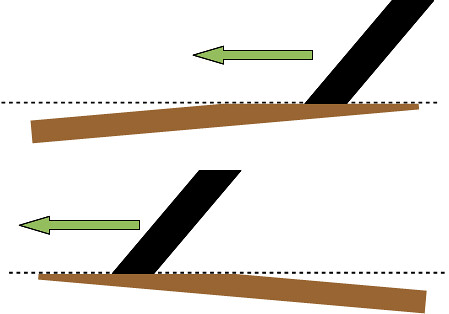
Now comes the time to actually use the gouging machine. Again, a few principles for the adjustment. I don’t know if this is justified with any scientific theory or even practical experience, but intuitively, we want any end-to-end line on the cane to have exactly the same thickness. angleTaperingTherefore, of extreme importance is complete parallelism of the bed in comparison with the arm that the plane glides on. If there is a vertical discrepancy, either the ends or the middle of the cane will be too thin compared to the overall length at that point…. The middle getting thinner should be impossible regardless of which direction the guide or bed might be slanting. But this has happened to me a lot. Maybe my guide that has a curve in it… very possible.
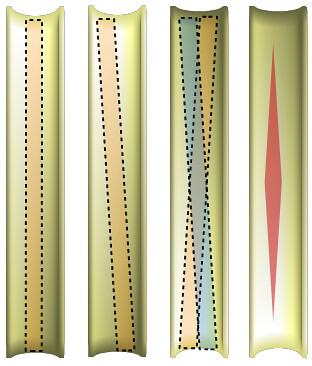
gouge centerHorizontal (sideways) angles, no matter how small, means that the center thick part will not stay centered. In theory, this should actually produce a diamond-shape  thick part, but in practice… again, maybe the beaten-up condition of my machine. For years, without realizing it, my machine was unable to do anything else than this because little holes in the bottom of the bed were drilled by adjustment screws tightened too tightly! No matter how I pushed or pulled with the side adjuster screws, the under screws would pull the bed back in the exact same position by sliding back in the holes.
I fixed this by filing down a flat surface for the screws with a “Dremmel tool”, but most people would criticize (correctly too) that this risks the introduction other imprecisions.

Fitting the cane: chopping length.

_MG_2028This is so simple, I don’t know why I mention it. The chopping length has one purpose alone: to make the cane fit in the gouging machine. If you use an easel to score the cane before folding, and this easel is of a different length than your gouger bed, TOO BAD: it’s the gouger that matters! On either end of the bed are usually little plates to hold the cane in place: the spring-mounted hook “pinchers” actually do very little but prevent the cane from sliding above those end-plates. Because the plane glides past these plates, to let the blade can cut the entire cane length, there must be curved holes in them to allow free movement without damaging the blade or the plane bottom itself: the bottom helps hold down the cane to prevent ripping and lifting off the bed.
The cane can be a little shorter (up to 1.5mm), but the less snugly it fits, the more risk there is of snagging in the blade and being pulled over the end plates. My machine only has one end plate: I don’t care about the one in back (right side) because it was too difficult to get the right curve on it to prevent damaging the plane and the blade. The one in front (left side) is the only one that really matters, when we’re careful, because it’s the one that keeps the cane in place while cutting.

_MG_2020Shaving Thickness: cut vs. rip.

Pretty much all sources of information I have been able to find agree that the cane shavings must measure between 0.05mm and 0.1mm. Thinner than that simply does not cut enough: not only will it take a very long time to gouge (risking compression of the cane), but it just might not cut, period. More than that seems to rip the grains rather than cut them. This is significant because if grains are pulled or torn from each other, then the cane lacks its living properties; it does not “hold together” and all kinds of strange issues happen with the finished reeds.

This “video” is a bunch of still images taken at short interval. I flip the cane around every now and then because the blade stops cutting in that direction: I start the blade a little bit inside the cane, so the back always remains a bit thicker until the gouge is complete. The gouge is complete when the roller starts rolling: having reached the guide, there’s nowhere for the blade left to go. Towards the end, notice hat the cane came off the bed a little bit: this is because the cane is a bit concave (curving inward). This piece did not break and I was able to finish it nicely. The shavings change in thickness and appearance. Towards the end, it becomes barely more than dust. At that point I very carefully flip a few more times: even if the roller is rolling, there are often little bumps left over from some degree of ripping.

Grains: good and sponge-cane – a sharp gouger blade.

This is the last point on cane selection. There exist density testers for metals, hard woods, ceramics, polymers and so on. I don’t know how effective they are for cane. For myself, I roll the inside of cane on my thumbnail: if it feels smooth, it’s excellent cane (densely packed grains). There are varying degrees of soft cane and I usually don’t like them. One kind of cane I call “sponge cane” because when scraping the bark, the under part looks porous like a sponge. This is usually horrible and not worth scraping at all.
It’s actually hard to predict while gouging because a rough thumbnail roll is similar for both soft and spongy cane. Also, to really emphasize and clearly identify good, medium and soft canes, the gouger blade must be very sharp. I use the same techniques as I do on my reed knives, but with even better honing stones. Some oboists talk about leaving burrs on their knives…. aye-aye-aye-chihuahua!!! Burrs tear, they don’t cut! But getting rid of them requires great stones and a hard metal blade (always the case with gougers).
All in all, I actually have had a couple of amazing practice (not concert) reeds with sponge cane. So, again, I don’t throw much away anymore. I use coloured thread with bands of other colours to identify which reed is which and I log in a book the variables (thickness, cane quality, shaper used etc.) associated with each colour combination.

Once the machine is calibrated, no more need to measure, right? – WRONG!

The density and health factors of the cane will change the actual final thickness of the cane. This means that:
  1. the machine can be made of the best metals: this ensures tolerances of 0.01mm or less
  2. cutting other metals, polymers, ceramics and glass would confirm these tolerances
  3. cane is a plant (soft, not actually wood) and some degree of compression, “bounce-back” and ripping will occur.
_MG_2008
I have not compiled any statistics (variance extremes and standard deviation), but as much as 0.08mm variation has been observed….. due to the beaten-up condition of my very old brass machine that does not even use ball-bearings? Perhaps, but the following observations should hold true on even the best of machines:
  1. The hardest (densest) cane seems to gouge the thinnest, but not always.
  2. The softest, spongiest cane tends to resist thinning due to “bounce-back”. It absorbs most downward pressure from the plane and seems to decompress afterwards. End result, less effective cutting.
  3. Sunny days tend to gouge thinner than cloudy/rainy days.
Until recently, I had always soaked my cane for at least an hour before gouging to prevent cracking. This naturally increases the degree of bounce-back, even in the hardest cane. Lately, I have started to gouge dry and have not noticed any extra cracking. It really makes gouging easier by providing more resistance to the blade, so less evasion of being cut. It changes nothing, however, in the density of the cane and the thumbnail rolling test still works.
Theoretically, gouging wet means the thickness measurement should reduce as cane dries and shrinks. This does not matter as long as measurements are always taken in the same state (wet or dry). And people have been reported to like their cane with thicknesses ranging from 0.42mm to 0.68mm, so the important thing is that each oboist determine her/his preference and go from there.

Friday, March 25

Gouging Oboe Cane, part. 1

Honestly, a person would be justified to ask what the blazes makes me an expert on gouging cane: I’ve only always used the same beaten-up machine for about 20 years (10 of which were almost absent of oboe activity) and I only actually fixed a very serious flaw with it (preventing any real adjustment) last summer!
Well, it’s true that I don’t know even a quarter of what a real cane producer does. But what I do know, I can substantiate with engineering principles and my beginnings were founded on the advice of machine-shop tool maker (my late brother, God rest his soul) who fixed and calibrated machines that built engine parts for air-craft used in the roughest manoeuvres! Also, information on gouging is very hard to find, so by laying out here what I know, I hope to be of service to advanced reed-makers who need something to start their adventure with gouging.
For a more detailed discussion, check-out this thread on the Oboe BBoard.
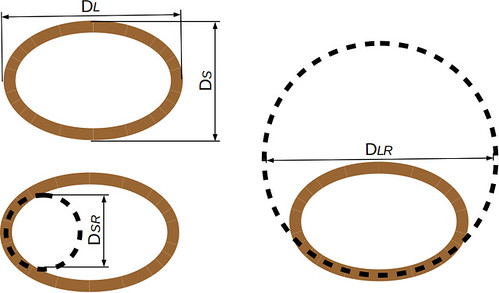
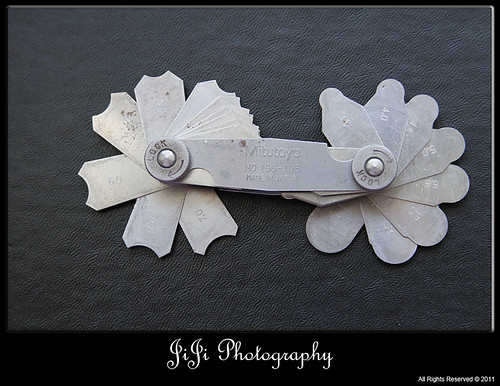
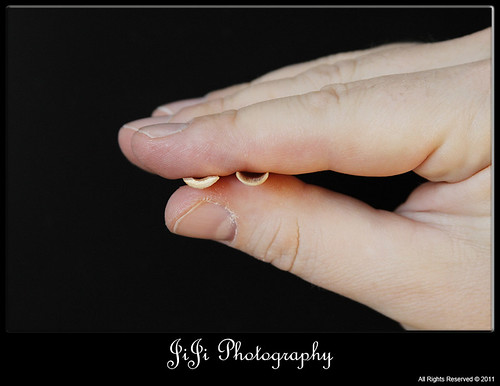
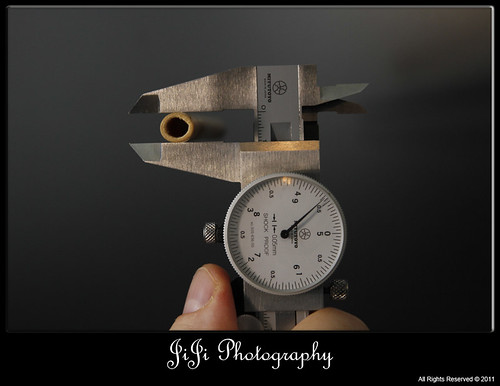
cane diameterIn my last blog post, I talked about how measuring the diameter can be misleading and the arc is more important than the diameter. This picture shows (top left) how using a micrometer or calliper or most diameter-rulers will measure what we think are the long diameter (DL) and short diameter (DS). But in reality, the real short diameter (DSR) is actually smaller and the real long diameter (DLR) is actually longer. Using a radius gage solves this problem by measuring the actual arc.
_MG_1981    _MG_1998
This means that, when you buy cane, you have to be sure that your supplier is measuring the same way (with the same tool) you are! But that only matters, when you buy gouged or shaped cane, because when you buy canon (tube) cane, the measurement range is really just an average of what you can expect. After a piece of cane has been gouged, it is virtually useless to do any kind of measurement of diameter or arc, because the actual tensions in the cane grains pull the sides together a little bit: a curl results and the arc has changed. Diameter measurements, then, must be done at before splitting or before gouging and then the cane must be stored in well marked containers.

Pitfalls of the scientific method.

Personally, I think we tend to over-value the importance of any given measurement. Cane is a plant, not a high density polymer! Diameter is one issue, but the thickness of the cane wall must certainly mean something too! There is also age, density, health and many other factors, not even considering the staple being used, the shape and the weather (when making and when playing)!
Do keep a record of measurements, binding, shaping and scraping characteristics (not to mention observations on cane quality), but don’t draw conclusions based on less than 5 to 10 reeds and don’t immediately discard cane or a reed you’re working on just you think one or two measurements were missed. I have had amazing reeds with almost all descriptions of cane and often the best “setup” has produced reeds that just went to the garbage.
Modern science works by attempting to isolate a single variable and see the effects when that variable changes: then the study is performed again by isolating another variable. This assumes that a model can be built from those different variable changes: a tenuous assumption at best which most serious scientists will hold as difficult. Proof: weather prediction is probably the most sophisticated and intensely researched multivariate model – how well does that work?
For making oboe reeds, this means that it might be best to just keep all the cane (throw away what we know from experience just won't work) and learn to adapt our technique to get as good as possible a reed from whatever piece of cane we get.

Gouging means correct measuring.

A serious reed maker should begin shaping cane as soon as possible. Jay Light wrote something to the effect of: "an intelligent chimpanzee can shape cane". But one of the really important elements of quality control in cane, especially for the oboe, is the gouging: the thickness and inner curve of the cane used. This is much more difficult than shaping, unless you know a vendor of gouging machines that will adjust your setup. The equipment is VERY expensive and there are different ways to gouge the cane. Overall, if you can get a good supplier of gouged cane, I recommend leaving it at that. But here's some theory for curiosity's sake!
micrometer perpendicular micrometer in-line
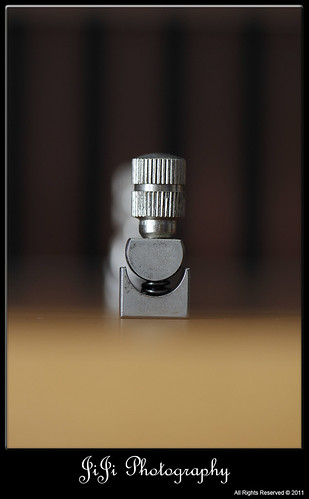
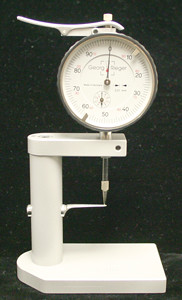
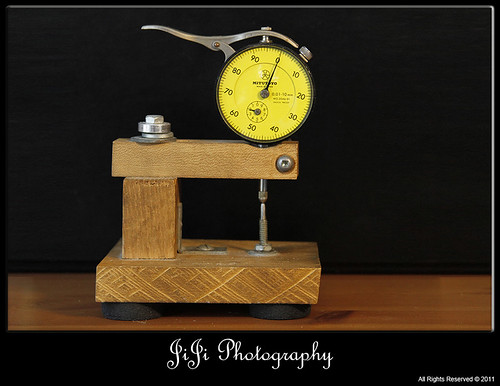
As soon as we start gouging, we need ultra-precise measuring tools. The micrometer is a dial (or digital) comparator mounted so it points to another pin, either perpendicular or inline. The perpendicular pin is necessary for the measuring of finished reeds, but the inline type is better for gouging because of the risk of incorrect angle.
In my last blog post, I showed pictures of a home-made wood base for chopping pre-gouged cane. I also made a base for my dial indicator ($35, at the time) because I could not afford the full micrometer ($250, at the time). I made the base of wood and the other point with a screw that I filed into a ball point using metal files and fine sharpening stones. I don't recommend anyone else do this or even use my micrometer, because any displacement of the arm will cause incorrect readings.
_MG_1988 comparatorSetting
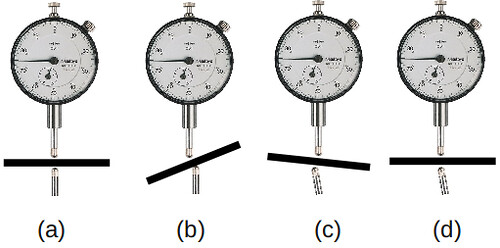
In the image above (a) and (d) are correct because the ball-points of each are in line: this is evidenced when a piece of flat metal is perfectly perpendicular to the measuring prod. Otherwise, when there is displacement the read measurement is longer than the real thickness as proven by the equation familiar to everyone who did trigonometry:
realThickness = | measuredHeight X sin( angle )|
Perpendicular means sin( angle ) = 1, so no flaw in the measurement. Displacement can happen front to back and side to side, so when it gets maladjusted, it can take 15 minutes to get it right again!
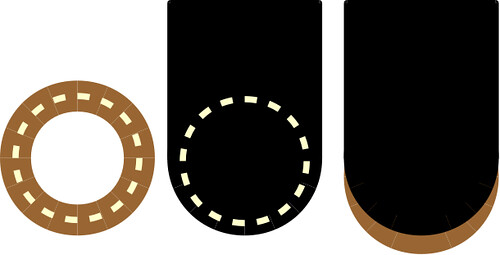
Now, The blade is shaped to have roughly the same diameter as the cane tube. Because it is elevated from the base, when gouging, it will make the sides thinner than the center: this is usually what we want.caneGouge_1 In fact, most of us want a much thicker center compared to the sides for better tuning stability and warmer sound. Thinner sides also help the reed close, saving on endurance. Because my machine is old and beaten up, I do this myself by reshaping the curve of the blade.
Here is the blog page of one well respected American Scrape reed maker and vendor on his adventure learning how to make (and shape) gouger blades. This should be enough to dissuade anyone (even me) from attempting it! A lot of experience and skill is required, and the appropriate tools are not a luxury, they are absolutely required.
caneGouge_2
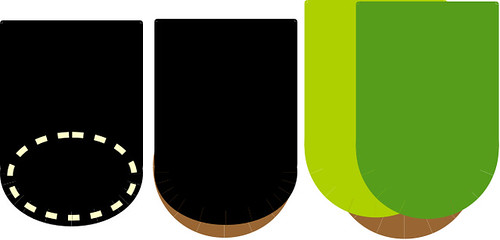
There is also another technique called "double-radius" whereby the blade is a little off-center. When the cane is flipped around in the machine, the offset automatically goes to the other side of the cane. This causes 2 grooves to occur in the cane producing a stronger center. In the picture, the 2 green blades illustrate how flipping the cane changes where the blade cuts the cane. Not all machines do this (mine does but I don't dare attempt it with its difficult setting screws), so sometimes reshaping the blade is the only way to get a thicker center <=> thinner sides._MG_1994
Different mechanisms exist to control the final thickness of the cane: the height adjustment of the blade assembly (plane) is stopped by a roller. My gouger uses a double-wedge guide: pull the bottom wedge to the left to make the cane thinner and to the right for thicker cane. There are pitfalls with this, most notably the difficulty in fine adjustment, but also it lacks any guarantee of parallelism with the cane bed.
If you choose to buy a gouging machine, I HIGHLY recommend you get one with the following characteristics:
  1. First choice: one-piece construction with fewest adjustments possible!
  2. Second choice: exchangeable beds so you can use most of the machine for oboe and English Horn.
  3. In all cases: height adjustment should be on the wheel, not the guide... keep away from those 2ble wedge height adjusters (like mine)

Sunday, March 20

Pre-Gouging and tootH yanking…

I capitalized that H because apparently I forgot it on a Tweet and got some good laughs! Embarrassé

First – human (caused) tragedy:

What is happening in Libya right now can cause a lot of anger, for different reasons, directed at completely different “camps”. Regardless of the camp, this can result in anger, fear and pain. I firmly believe that what the general population is told about the motivations is, at best, a load of half-truths. So I beseech everyone, regardless of your political opinions to simply speak for and keep your mind set on a peaceful resolution of the current situation.
warAmpsStopWarI did serve the Canadian Armed Forces: I am Combat Leadership certified. More on that some other time, but I did serve 8 years with pride and honour.
The image to the right is from the War Amps: an organization that raises money to help children with amputated limbs and their families. The image with the downturned rifle is the Canadian Armed Forces’ symbol for mourning dead soldiers (“fallen comrades”). The organization uses this as a logo for their efforts to sensitize people to the horrors of (all) war and to the importance of trying to avoid it and find peaceful solutions to critical situations. Some of you will argue in favour of action to prevent worse trouble: history has yet to show this works at all.

One wisdom tooth gone!

The operation went really well. The “deep sedation” (getting me to sleep) was quick and efficient and the wake-up process went quickly and well. The extraction took an hour, but evidently without problems: today (approx. 48 hours later) no pain, no swelling. 2 weeks to oboe! In the mean-time, prepare reeds for scraping!

Pre-Gouging: the conception of an oboe reed!

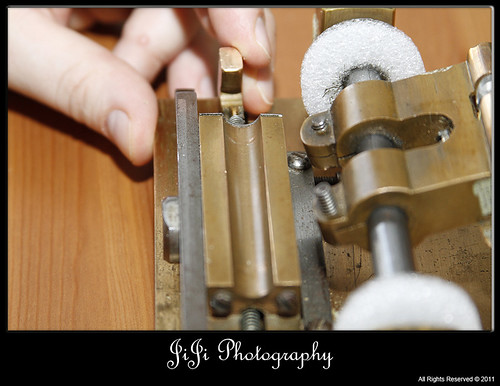
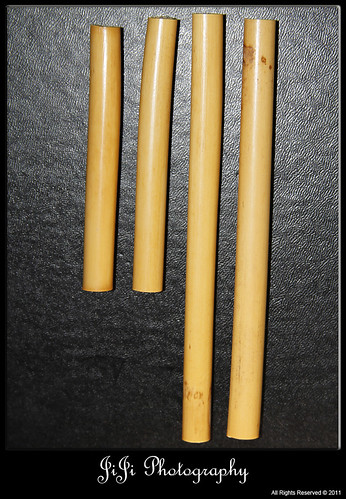
I was surprised, during the summer, to read LOTS of questions and discussions about pre-gouging. My wife took some excellent photos and I will use them to explain: many more can be found on her Flickr photostream. In a nutshell, “gouging” cane is giving it the right thickness and inner curve and “pre-gouging” is only about getting a piece of raw can to fit the gouging machine…. that’s all!

To me, the most important criterion for cane selection is flatness: this will greatly determine how “freely” the reed vibrates. Arching inwards will choke the reed and cause leaks close to the binding. Arching outwards will make the blades separate: I got excellent reeds with this, but they are usually difficult on endurance. I don’t care so much about “straightness” (side to side) as this will be cancelled by the shaping.

IMG_1885 IMG_1880 IMG_1881

Most references and stores only mention splitting in 3. For me, the inspection of flatness sometimes shows that it is possible to get 2 flat sides that would ruined by splitting in 3. Fully flat splits are not always possible, so I just aim for the best possible and choose to split in 2 or 3 depending on which will yield closest to flat.


The images below show:

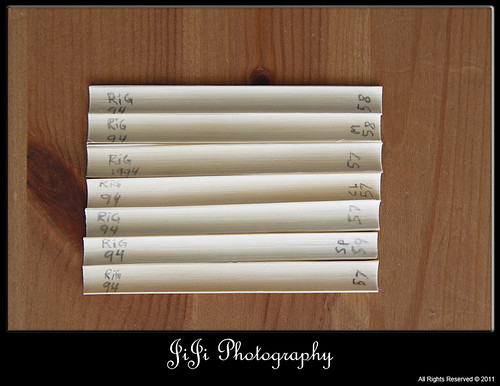
  1. Split lengths from a canon (tube cane) split in 2, split in 3 and pre-gouged.
  2. The split-only cane in the machine: it can work, but risks jamming the machine and messing-up the delicate adjustments.
  3. The pre-gouged cane: much easier to gouge.
IMG_1895 IMG_1914 IMG_1918

In terms of quality of cane the important factors are:

  1. density and “health” of the grains: hard to tell before scraping – I’ve lately made great reeds with canes of almost all hard/softness
  2. flatness of the final cut
  3. diameter and thickness of the selection
IMG_1970 IMG_1974 IMG_1976

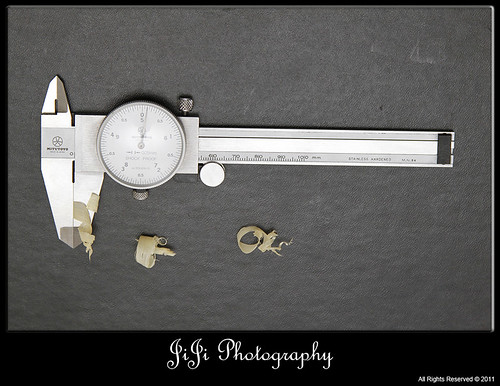
The thickness of cane will be the subject of another blog post (on gouging). As for the diameter, these pictures show that what looks like a HUGE difference in diameter can be as little as 1mm or 0.5mm. In fact, I consider the arc more important than the diameter because, in an ovoid tube, the diameter can be misleading, especially if you’re using drop-in rulers to measure it.


The pre-gouging demonstrations above work equally well with canons split in 2 or 3. I only have difficulty when a canon turns out to have a diameter for English Horn: a bigger pre-gouger (especially for E. H.) is required for that. In many internet guides on reed making, they show chopping the cane before pre-gouging it. I prefer the opposite because:

  1. it is easier to chop after the cane is thinned,
  2. some split cane lengths can produce 2 pieces for reed making, but the chopping first requires preparation that can ruin it.
For chopping, I removed the guillotine from my beaten-up old gouging machine and made a wood-base for it. The reason is mostly that I could make a fixed-length stopper at the end, making it easier to measure the cut. The base does not need any degree of precision at all (±1.5mm is good enough) and the side bar allows it to take the pushing force from my hand more easily. The guillotine blade needs to be sharpened once in a while, but its nothing precise at all. The gouging is the really sensitive part.

IMG_1952 IMG_1961 IMG_1965

The above images show: (left) cutting a little bit off the end to keep the flatter part in the middle; (center) sometimes, 2 pieces of reed cane can be obtained from the same split length; (right) again, what counts most of all is correctly centering the cut to keep the flattest part.
Other than the above, I pretty well keep all cane, soft or hard, twisted or straight. The reason is that I have it, might as well use it. If it does not work out to be a good reed, well I only lost a few hours of my time. But throwing away the potential for a fantastic reed is a horrible thing!

Tuesday, March 15

First Video: Musical Offering to #BachChat

45 Countries have visited my blog for a total of over 3 500 visits! StarC'est la fêtePouce levé 
The bottom of this page has the list: please let me know if I missed yours!

The Twitter event #BachChat is on Monday, but I'm getting a wisdom tooth pulled out on Friday: I won't be able to play for at least 2 weeks after that. I will spend my "practice time", during those 2 weeks, gouging cane, shaping cane and tying reeds.... I'll get to try out that new Cane Guide gadget.

So I had to hurry-up and get my video together on the weekend and today. This is the 3d movement from Bach's Sonata for Flute in E minor BWV 1034.
First “public appearance” in about 15 years!
I call it "le corps humain" (the human body) because it was the theme song and background music for a documentary series (named "Le Corps humain") by Université de Montréal in the 1980's.
 
RECALL:
I have only been practicing an average of 30 minutes a day for about 9 months now, after a near total absence of 10 years (average 30 minutes a month).... my apologies for trashing this beautiful piece!

My endurance has somewhat improved since the 1st video: two months ago, I would not have been able to perform this piece at all (practice, yes – perform, no), let alone do several takes for the video! In the take used for this video I'm already tired, so the tuning went off at times, otherwise I think my tuning has actually improved compared to 15 years ago. This might be due to the revoicing done on my oboe and better reeds.

Explanation of oboe reed crowing.
The reed I used in the video was very good, not amazing, but very good: satisfactory concert reed. There were questions on the Oboe BBoard about crowing, so here’s a demonstration using the reed I used in the video.

This time, I did a little bit of a warm-up (maybe 5 minutes worth) before the first take. More warm-up would have been good: I noticed my reed got easier, better sounding and simply played better after the 3rd take.

I did the MIDI accompaniment and managed to get rubato and dynamics in the most essential places. The computer played out the speakers and the recording captured that with me on oboe as if it were a live performance. It’s really hard to synchronize a cadenza and start the return of the melody with a machine that does not hear you! En pleurs

Getting the right settings for microphone gain (sensitivity) was difficult: 5% on the microphone, mic volume of 30% and no more than 30% gain inside the Windows driver, otherwise, crackling noise was just deafening. I don’t know if these settings change the sound, perhaps more gain on the mic and less in the computer would be better?…. need to experiment. For sure, it would have been MUCH easier if I had done multi-track recording like in my 2nd recording. I think the video capture software that came with the webcam is not suited for the complex sounds in music: I did not have these troubles on the device directly or when using Audacity.

Which to choose: better sound? Video really annoying!
Making a video is HARD!

What did not help my endurance at all are the computer problems during the recording! How many times did I start over just because it failed to start recording or because the accompaniment went berzerk? If you get the impression my computerized accompaniment sometimes “yawns” and stretches a beat or two: it’s true! Some of the takes I had to reject had much worse breaks in the video than this.
 
Maybe I need to get more memory and/or deactivate the Internet and a bunch of other things, because at every few takes, the MIDI playback would slow down terribly for a few beats and then pick up again.... was Windows 7 running updates in the background? Also, because I recorded directly to the computer rather than in the recording device, the computer seems to have added pops every once in a while..... maybe I need a MacIntosh? I still have to try Linux (Ubuntu Studio). I could not use Windows Movie Maker at all because of the pops!
 

IMS #6:

last week (#7 tomorrow), went well, but this was a rough week. The weather heated up a lot and this caused my arms and shoulders to get painful again... not as bad as a month ago, but stiff and sore. Towards the end of the video, there are two arpeggios including is that infamous dominant 7th on D. They are not "clean" because of strain in the shoulder: a few weeks ago, I had no trouble with these at all.
 

Thanks again to everyone

I get visits almost every day from every country on the list. I guess this means there is something interesting here! I really enjoy your (rare) comments and e-mails: don’t be shy to criticize, that’s useful too! One thing is for sure, your visits really encourage me. I hope this can also encourage you and motivate you in your endeavours too!

Thank you:
Argentina, Australia, Austria, Belarus, Belgium, Brazil, Bulgaria, Canada, Chile, China, Columbia, Cyprus, Egypt, Finland, France, Germany, Hungary, Italy, India, Ireland, Israel, Japan, Latvia, Lithuania, Malaysia, Mexico, Netherlands, New Zealand, Nigeria, Norway, Poland, Portugal, Romania, Russia, Singapore, Slovenia, South Korea, Spain, Sweden, Switzerland, Taiwan, Turkey, U.K., Ukraine, U.S.A.,  Venezuela