Sunday, September 14


Saturday, August 23
Why do we play? – IDRS 2014 & FIFA!, art. 2 – Pouquoi jouns-nous?
People seem eager for a post about my impressions on the different instruments. I want to take my time to write it well because I think it’s important to:
| | Les gens semblent avoir hâte à mes impressions sur les insttruments. Je vais prendre le temps de bien songer parce qu’il est important de:
|
| Years ago, if I disagreed with something, I used to criticize it, comparing with what I did prefer and essentially be demeaning. I now find that this attitude is very easy when a person has been exposed to a small sample of styles and performers. I have found that becoming exposed to and discussing with many more highly competent artists changes perception and develops an appreciation for widely differing aesthetics throughout the world. Thanks to the internet, I have been exposed to many, many more musicians of all levels and performance styles as well as musical giants who each explain why something is done in a particular way and what any given aesthetic is aiming for. Thanks to the IDRS conferences, I had the opportunity to try a wide variety of instruments and hear many great performers in person: this provides a depth of experience, feeling and understanding that CDs and internet video recordings, useful and valuable as they are, utterly fail to convey. I still have my preferences and no one can tell me to like something I don’t: I require demonstration and experience to change my mind, but I am now capable of changing my mind without losing integrity in my convictions. | Flash Mob
Bravo Ensemble | Il y a des années, lorsque de quoi contrevenait mes attentes, je critiquais férocement. Aujourd’hui, je trouve qu’il est facile de médire lorsqu’on ne connaît un échantillon limité de styles et d’interprètes. Je trouve qu’être exposé à (et discuter avec) une variété croissante d’artistes compétents change la perception et développe une appréciation pour l’évantail d’esthéquites dans le monde. Grâce à l’internet, j’ai fait connaissance à un grand nombre de musiciens de tous les niveaux et de styles d’interprétation ainsi que des géants de la musique qui expliquent chacun pourquoi quelque-chose est fait d’une manière particulière et ce que vise précisément une esthétique donnée. Aux conférences IDRS, j’ai eu l’occasion d’essayer une grande variété d’instruments et rencontrer de nombreux hautboïstes formidables en personne: ceci procure une profondeur d’expérience et une compréhension que les CD et vidéos internet, utiles et précieux qu’ils soient, échouent complètement à transmettre. Mes préférences restent fermes et que personne ne médise le fait. Me changer d’avis prendrait la démonstration et l’expérience, mais je suis capable d’ouverture d’esprit sans perdre l’intégrité de mes convictions. |
| Keeping the faith! I wanted to get this recording done before IDRS 2014. I did get it done and put it on You-Tube and Facebook, but I didn’t have time to do the blog post on it. One reason I wanted to hurry-up to do the recording (it would have benefited of more practice…) was that I thought I might be selling Ol’ Faithful to buy something new in NYC, so I wanted to be sure it had a crowning glory! This is another part of the Suite for Flute and Jazz Trio by Claude Bolling – I just can’t resist these tunes, so much fun to play! – and definitely the most difficult piece I have recorded so far. It does a whole lot of altissimo, going all the way up to Bb, which is doable enough for professionals (or advanced students), but rather tiring for me. At the IDRS exhibits, I have tried other instruments that make this very easy, actually. Since my return for the conference, the altissimo has remained easy. I think this is a combination of the season now turning to an early autumn (perfect for the best reed behaviour) and possibly having played so much more in NYC than I usually do at home just developed the breathing and embouchure…. Now up to me to keep them in shape! | | Envoyons d’l’avant, nos gens! Je voulais produire cette vidéo et le mettre sur You-Tube avant IDRS 2014, mais je n’ai pas eu le temps d’en faire un article blogue. Une raison de me dépêcher (un peu plus de répétition n’aurait pas nui) est que je considérais vendre ma Vieille Branche à New-York, alors je voulais lui accorder une dernière gloire. C’est un autre morceau de la suite pour flûte et trio Jazz de Claude Bolling – je suis tout simplement incapable de résister le plaisir de les jouer! – et définitivement la pièce la plus difficile que j’ai enregistrée jusqu’à date. Plein de sur-aigü, je monte jusqu’au si-bémol, ce qui est assez faisable pour les professionnels (ou étudiants avancés), mais un peu épuisant à mes babines! À vrai dire, aux expositions IDRS, j’ai essayé plein d’autres instruments qui reproduisaient le passage assez facilement. Depuis mon retour, le sur-aigü reste assez facile. Je crois que c’est dû à la conjonction du changement hâtif de saison (le début de l’automne est le meilleur temps pour les anches) et qu’avoir tant joué à New-York a renforcé mon souffle et mon embouchure….. à moi de les garder en forme! |
| AUSGEZEICHNET DEUTSCHLAND (way to go Germany) for FIFA in Brazil! This brings me to the question again: why do we play? The oboe is renowned for being especially difficult, but the question can be asked of any musician. I have no professional aspirations right now, no notion that I could get paid for playing, in fact no clue if I’ll even play on stage this year… so why bother practicing difficult repertoire and go nuts making reeds? Why not just spend that money enjoying great performances by amazing artists all over the world, or simpler yet, build a monster collection of CD’s? And most important: why did I mention FIFA in the section title? | | AUSGEZEICHNET DEUTSCHLAND (bravo Allemagne) pour FIFA au Brazil! Ce qui me fait poser la question à nouveau: pourquoi jouons-nous? Le hautbois est reconnu pour sa difficulté, mais la question peut être posée à n’importe-quel musicien. Je n’ai actuellement pas d’aspirations professionnelles; aucune idée si je vais même me produire en scène cette année… alors pourquoi me donner la peine de travailler le répertoire difficile et m’embêter à faire des anches? Pourquoi ne pas juste dépenser le même argent à aller voir en personne les meilleurs musiciens du monde. Encore mieux, me monter une collection du tonnerre de CD? Et la question la plus importante: c’est quoi le rapport avec FIFA? |


| Well, the answer to the question about playing music is the same as the answer to these ones: why do children love to play football (or “soccer” as we say in Canada and USA)? Why do Canadian adults continue to spend late nights playing hockey at the community rink even if it will make them sleepy the next day and miserable at work? Why is baseball still the great American passtime (is this still the case?) when we have no hope of becoming a pro or why do we go play golf and tennis when we have no hope of entering a tournament series? Like Christoph Hartmann, I personally love cycling even if I have no hope of ever doing Tour de France! Well the answers are the same in all cases: WE ENJOY IT! Isn’t that what life is all about, enjoying ourselves and the activities we can experience? Of course, the news and corporate-consumerism would want us to value only is to accumulate wealth in order to build the wherewithal to purchase everything we might desire. Consequently, we are motivated to spend as much time and effort possible pursuing professional careers. But where is benefit of wealth if we sacrifice our passions and the enjoyment of living? Similarly, world charity corporations have produced very wealthy executive administrators who will tell us that our pursuit of wealth is to help the poor of the world (while the bulk of donations go to politics and executive benefits). I’ll leave this point of discussion to each person’s own experience and reflection. Yes, I do contribute to charity: local and well trusted organizations with visible effects on real people and wildlife in need. I just think that self-determination and the enjoyment of being alive are the main goals we should all be living for. So why do we play music? Because that is what makes us alive! Modern day life wants us to “live for our work” – this is fine if our work is a true passion (some business people really do thrive on it) – but for my part, the correct balance between the necessities of life in society and self-fulfillment is the very definition of “working for a living”. | Et bien la réponse à la question de jouer de la musique est la même réponse aux suivantes: pourquoi les enfants aiment-ils jouer au foot (ou bien “soccer”, comme on dit par ici)? Pourquoi les adultes Canadiens passent des nuits tardives à jouer dans des ligues communautaires même si ça veut dire un lendemain à dormir debout au boulot? Si nous n’avons aucune chance de devenir athlète de carrière, pourquoi jouer au golf ou au tennis? Comme Christoph Hartmann, je rafole du vélo, même si j’ôse même pas rêver au tour de France! Encore une fois, la réponse est la même dans tous les cas: PARCE QUE ÇA NOUS AMUSE! N’est-ce pas le but-même de vivre; se plaire aux expériences de la vie? Bien sûr, les nouvelles et le commercialisme nous encourage à ne valoir que l’accumulation richesse afin de se procurer tous les biens matériels que nous pourrions convoiter. Par conséquent, nous sommes motivés à consacrer tout notre temps et tous nos efforts à nos carrières professionnelles. Mais à quoi bon la richesse si celà exige le sacrifice de nos passions et la perte de la joie de vivre? De même, les charités-corporatives ont produit de très riches administrateurs qui prétendent que notre poursuite de la richesse peut servir à porter secours aux démunis (alors que la masse des dons charitables rempli les poches des politiciens et administrateurs exécutifs). Je laisse ça à la réflexion sur l’expérience de chacun. Oui, je fais des dons aux organismes charitables, organismes locaux où je peux voir moi-même le bénéfice apporté aux personnes et vie sauvage en crise. Je crois, par contre, que la poursuite de son propre chemin dans la vie et la jouissance dans le fait de vivre sont les buts ultimes de vivre. Alors pourquoi jouons-nous la musique? Parce que c’est ce qui nous fais sentir vivants! La vie moderne veut que notre gange-pain soit notre passion alors qu’il me semble que nous ganons notre pain pour le plaisir bien de manger, non? |
Saturday, August 16
SURPRISE NEW-YORK! - IDRS 2014 art. 1
| Aug. 5-9, 2014: Conference of the International Double Reed Society (IDRS) in New-York, NY! WOW, what an adventure! So many things to talk about: meeting people, instrument trials, performances and soulful revelations. …let’s start at the beginning: | | Du 5 au 9 août 2014, conférence de la Société Internationale des Anches Doubles (IDRS) à New-York, NY! Holà, toute une aventure! Tant de choses à discuter: rencontres, essais d’instruments, spectacles et révélations. …. commençons au début: |
New-Yorkers are great!I have lived in Montréal for 9 years, so I am habituated to city living, but I must admit that New-York is like Montréal on steroids! Montréal driving might be aggressive, but people and traffic are so packed that NYC driving actually slows down! The subways are made scarier by packing people like sardines on a platform that is open on both sides…. no walls to lean on or keep back away from the big hole where the trains might run over me! The people, like in Montréal, come in a wide variety of ethnic origin, fashion statements, behaviours and physical builds…. this can be somewhat intimidating to a short-haired white guy with a shoulder bag and two big suitcases trying to find his way downtown. But you know what? Every single New-Yorker I have met on the street, in the busses or in the train has proven really friendly – don’t be fooled by the loud and harsh accent, the more “unique” they look the more helpful they were! Hey, there are people walking their dogs of all sizes at all hours of the day and night and the dogs look mostly happy…. that makes these people great in my book! | | Les New-Yorkais sont bien corrects! J’ai habité Montréal pendant 9 ans, alors je suis habitué à vivre en ville, mais je dois avouer que New-York fait paraître Montréal comme la campagne! La circulation automobile à Montréal est agressive parce qu’il y a la place: beaucoup trop de piétons (et voitures) à NY, alors tout ralentit! Dans le métro, les gens s’entassent avec des fossés à train des DEUX côtés de la plateforme… pas de mur pour se cacher le dos! Comme à Montréal, les gens reflètent toutes les ethnies, modes vestimentaires (ou autrement esthéthiques) et formes physiques… ça peut parfois intimider un homme blanc à cheveux courts traînant deux valises et sac-à-dos, de toute évidence perdu en chemin. Mais chaque New-Yorkais que j’ai rencontré dans l’autobus ou sur la rue s’est montré vraiment aimable. Ne vous laissez pas détourner par l’accent dur et plus il/elle paraît “unique”, plus il/elle s’efforce à prêter main-forte! Hé, les gens promènent leurs chiens de toutes tailles à toute heure du jour et nuit. Les pitous ont l’air bien heureux, alors tant qu’à moi, ça fait des New-Yorkais du bien bon monde! |
| Meeting old/new friends: APOLOGY: it’s easy for me to write on a blog, but beware any false impressions: I actually have difficulty with normal social graces and I can behave like a navel-gazing snob! So I want to thank every one at both IDRS conferences who tapped me on the shoulder and said “Hello”, I am very flattered and grateful every time! I also forget names. In fact, I still mess-up who my cousins are in relation to aunts and uncles! So please, send me an e-mail or get me on Facebook (“RobinDesHautbois” or Robin Tropper) and let’s keep in touch. I want to hear your stories too! (I won’t post anything without your OK). One guy from Saskatchewan and another from D.C. told me how they continue to play very serious music in settings where being a full-time performance professional is next to impossible: I am impressed like crazy with you and the others who told me similar stories. On Facebook and the Oboe BBoard, I have met lots of people, forming connections with a few of you. I had the great pleasure of spending lots of time with 2 friends that way, going to the same events and having meals together. Apart from IDRS conventions, it is not likely we’d meet much, but it was like we had lived in the same neighbourhood for years! | Conference buddies
Great to finally meet | Retrouvailles: APOLOGIE: j’ai la plume facile, mais ne vous laissez pas leurer; à vrai dire, j’ai tendance à la maladresse sociale, ce qui peut me donner l’air d’un nez-dans-le-nombril! Je tiens donc à remercier tous et chacun qui m’a pris par l’épaule pour me saluer: j’en suis très ravi chaque fois! J’ai aussi une mémoire atroce pour les noms, au point de mêler mes cousin/es par rapport à mes oncles et tantes! Alors pourriez-vous me faire signe par courriel ou sur Facebook (“RobinDesHautbois” ou Robin Tropper)? J’aimerais bien connaitre vos histoires! (Discrétion assurée.) Un gars du Saskatchewan et un autre de l’état de D.C. m’ont raconté comment ils continuent à jouer très sérieusement dans l’orchestre dans endroits où il est presqu’impossible de faire carrière professionnelle en musique: de telles histoires m’impressionnent ”au boutte”! Sur Facebook et le BBoard, j’ai renctontré plen de monde, formant des connexions avec quelques-uns. C’est avec plaisir énorme que j’ai ainsi passé beaucoup de temps avec 2 amis, allant aux mêmes événements et mangeant ensemble. Hors les conférences IDRS, il est peu probable que nous puissions nous rencontrer, mais il semblait que nous nous connaissions depuis toujours! |
| City Adventure At IDRS 2013 in Redlands, everything was held at the campus, slightly separated from the main town and on rather flat grounds that centered around the cafeteria (I must admit to really liking the simplicity). This time, the organisers immersed us in the full New-York City experience (which was also very enjoyable). The different locations moved closer or further from Washington Square Park – this made the whole experience actually quite pleasant, giving us a “retreat” location where we could collect our thoughts and calm our minds. The park surrounds a huge wading-fountain with plenty of gardens and trees to give shade to park benches, squirrels and birds by the bushel and even dog parks! Crowded with people all the time, yet always a sense of tranquility. I do admit, however, I am glad to not live in a big city anymore. Cities are fine for adventure (college-studies and living as a performing artist are adventures) but not for settling-down. Also, the smell of garbage and train exhaust everywhere…. seriously, I prefer the natural smells of the country (yes, even skunk and farm). But hey, that’s why different people live in different places, right? |
(images: thank-you, Jean-Luc
| Aventure citadine À la conférence IDRS 2013 à Redlands, tout se déroulait sur le campus, un peu séparé de la ville et sur un territoire assez plat centré autour de la cafétéria (je dois avouer bien avoir aimé la simplicité). Cette fois, nous étions immergés dans l’éxpérience de grande ville (aussi plaisante à sa façon). Les emplacements se rapprochaient plus ou moins du parc Washington Square, ce qui permi une “retraite” où nous pouvions nous reposer et calmer les esprits. Le parc entoure une grande fontaine avec un tas de jardins et d’arbres qui abrientent bancs, écureuils et oiseaux. Il y a même des parks à chiens clôturés! Toujours achalandé par d’innombrables visiteurs , mais toujours un sentiment tranquile. Je dois toutefois avouer me sentir soulagé de ne plus habiter la grande ville. C’est bien pour l’aventure (y compris les études et vivre en tant qu’artiste) mais je préfère m’installer dans une vie plus calme. Aussi, la puanteur des déchèts et l’échappement des trains partout…. sérieusement, je préfere les ôdeurs naturelles en campage (oui, moufettes et fermes aussi!). Mais les différentes modes de vie vont de pair avec milieux contrastantes, pas vrai? |
| Naturally, on the first day, I was obsessed with trying instruments, especially oboes d’amore, as fast and as many as possible – I missed a few good recitals because of this… But the travelling had wrecked my back and missing Tai-Chi did not help. On the first few days, either the heat and humidity or maybe the air pollution beat me pretty hard. I could not try instruments for more than a few minutes without getting dizzy spells. The different instrument makers and vendors got used to being handed the instrument I was playing so I could put one knee on the ground to avoid fainting! By Thursday afternoon, the temperature became much cooler so things went back to normal, but by this point, I was sitting down in concert halls more too. Maybe, from now on, I should stay home and become a cyber-tourist? | With Delmar Williams With John Abberger | Bien sûr, le premier jour, j’étais obsédé à essayer autant d’instruments, surtout les hautbois d’amour, aussi vite que possible; j’ai donc manqué quelques bons récitals. Mais le vol et la route m’ont magané le dos et avoir négligé le Tai-Chi n’a pas aidé. Les quelques premiers jours, soit la chaleur intense, l’humidité ou la pollution aérienne m’a frappé fort. Je ne pouvais pas essayer un instrument plus de quelques minutes sans devenir étourdi. Les fabricants d’instruments sont devenus habitués à se faire passer l’instrument que je tenais pour pouvoir m’agenouiller – question d’éviter de m’évanouir! Rendu à jeudi après-midi, la météo s’est grandement rafraîchi et je me sentais mieux, mais à ce point, je m’asseoyais beaucoup en salle de concert. Peut-être vaudrais mieux que je reste voyageur cybernétique? |
| Instrument Surprises I believe in being honest even when it is embarrassing. I’ve written before that, even though “Ol’ Faithful” remains precious to me, I am not a big fan of Lorée oboes because I find it difficult on tuning, stability of notes during dynamics and restriction in dynamics. Well, in New-York, all Lorées I tried played beautifully: mine, other used Lorées or new ones, AK, standard or Royal models, stability on the usual notes at all dynamic levels was fine. Not a single Lorée there prevented a real fortissimo on any of my decent reeds. I’ll be mentioning more about instrument surprises in another post. In general, my previous opinions on instruments remain true (here) but it seems the different climate in New-York does change their sound and character, compared with Redlands, California or Ottawa, Ontario. Consequently some of my preferences actually flipped around. | 
Heckelphone | Surprises d’instruments Je crois en l’honnêteté, même si cela me soit embarrassant. J’ai dit auparavant que même si ma “Vieille Branche” me reste précieuse, je n’aime pas tellement les hautbois Lorée parcequ’ils rendent la justesse difficile et instable dans les nuances, retreignant aussi la puissance expressive. Et bien, à New-York tous les Lorées que j’ai essayés, (le mien, d’autres usagés comme neufs, modèles AK, normal ou Royal) se sont montrés bien stables sur les notes difficiles et sur toute la gamme de nuances, du plus doux au plus puissant. Pas un seul ne m’a restreint sur mes anches raisonnablement bonnes. Je discuterai davantage des surprises dans un article à venir. En général, mes opinions précédentes (ici) tiennent toujours, mais il semble que le climat différent de New-York affecte effectivement leur timbre et caractère à comparer à Redlands, Californie ou Ottawa, Ontario. Par conséquent, quelques unes de mes préférences ont virevolté. |
| The instrument does not make the music In the end, I did not buy a new oboe or a d’amore. The reason is only slightly in part because of impressions on the instruments, the most important reason being is Jean-Luc Fillon and Jacques Tys. These two astounding performers triggered a total re-examination of what I am aiming for with the oboe: a deep inward meditation on what my goals and motivations may be. I therefore do not want to be distracted by a new instrument; preoccupied by re-assessing it on a daily basis… Though they play very different styles, from the freest jazz to the most sophisticated classical, they exude authentic soul and project powerful inspiration that goes far beyond simple notions of technique or tone production or instrument characteristics. Seeing and hearing these masters in person on stage cannot be compared to any CD or video recording – there is somehow much more happening – this is what I must aspire to. Of course the instrument must aid and not hinder performance, and I still believe my “short list” (from this post) is better than Lorée (mine or others), but I think that, seeing as my Lorée did play well in tune and with full expression in New-York, I need to work on soul more before I change instruments….. more on that in future posts. |  Jean-Luc Fillon,
 Jacques Tys: No comparison with live-performance! | L’instrument ne fait pas la musique En fin de compte, je n’ai pas acheté de nouvel hautbois ou htb. d’amour. La raison n’est qu’en petite partie dûe à mes impressions sur les instruments; la grande partie étant une révolution mentale que m’a fait les performances de Jean-Luc Fillon et Jacques Tys. Ces deux interprètes indescriptibles ont suscité une rééxamination totale de ce que j’essaie d’accomplir avec le hautbois; une profonde introspection de mes buts et motivations. Je ne veux donc pas être distrait par un nouvel instrument; trop préoccuppé à le ré-évaluer chaque jour… Bien qu’ils jouent de styles musicaux presque diamétralement opposés, les deux exudent une âme authentique, projettant une inspiration puissante tout-à-fait au-delà d’impressionantes techniques, sonorités ou caractéristiques instrumentales. Voir et entendre ces musiciens en personne sur scène ne peut être comparé à un CD ou enregistrement internet – il y a de quoi de vastement plus vivant qui se produit – c’est donc à cela que je dois aspirer. Bien sûr, l’instrument doit aider et ne pas nuire à l’interprétation, et je crois toujours que ma courte-liste (voir ici) me va mieux que Lorée (le mien ou d’autres), mais étant donné que ma “Vieille Branche” a si bien joué à New-York, je dois travailler mon âme musical avant de changer d’instruments… à discuter davantage. |


Sunday, June 8
Oboe (or) d’Amore? / Hautbois (ou) d’Amour?
| The oboe has long held a nasty reputation of being extremely difficult to play, especially in tuning and sound control. I have long considered this nonsense: I really believe reeds can be made to suit a person’s physical characteristics and that the instrument should be responsible for ensuring proper tuning with full articulation and dynamic expression. Of course, an oboist must learn to play and develop proper embouchure, breath and control over the sound, lead by properly trained ears: what I mean is that advanced students and professionals should not need to complain that they can’t make a good reed when it rains or that “dizzy spells are normal: just don’t blow so hard” while simultaneously indicating how tone-support and air-speed are crucial… An oboist should never need to make reeds that cause discomfort to prevent the notes from going unstable. | Le hautbois tient une réputation de difficulté extrême à jouer, surtout quand-à la justesse et le contrôle du son. Je considères ceci ridicule: je crois vraiment que les anches peuvent être conçues pour les attributs physiques d’une personne et l’instrument doit être responsable de la justesse tout en appuyant la panoplie de nuances et d’articulations. Bien sûr, un hautboïste doit maîtriser l’embouchure, le souffle et le contrôle du son par l’ouïe: ce que je postule est que le professionnel et l’étudiant avancé ne devraient pas devoir se plaindre que ”les étourdissements sont normaux : soufflez moins fort” tout en soulignant par la même l’importance d’appuyer et soutenir le souffle… Un hautboïste ne devrait jamais devoir fabriquer des anches qui cause l’inconfort afin de prévenir l’instabilité des notes. | |
| Disclaimer: This post is about my own experience concerning the instruments I have personally tried and the reed styles I have used and made. I have my preferences, naturally other people will have their own contrasting preferences. I encourage everyone to perform your own experiments to find the right match . | | Désavoeu: Cet article concerne mes propres expériences sur les instruments que j’ai essayés personnellement et les styles d’anches que j’ai joués et gratté moi-même. J’ai mes préférences et il s’ensuit qu’autrui en aura de différentes. J’encourage tout le monde à expérimenter par vous-même afin de trouver la bonne combinaison. |
In my previous post ( ), I mentioned my tuning on “Ol’ Faithful” seems to be almost under full control, but also that this requires lots of effort. Days of very low energy make it frustrating to play even the easiest repertoire and range. To find an instrument with effortless tuning and tone would really revive the joy of playing the oboe: even when fibromyalgia is beating me down, I could concentrate on music, not the effort! ), I mentioned my tuning on “Ol’ Faithful” seems to be almost under full control, but also that this requires lots of effort. Days of very low energy make it frustrating to play even the easiest repertoire and range. To find an instrument with effortless tuning and tone would really revive the joy of playing the oboe: even when fibromyalgia is beating me down, I could concentrate on music, not the effort! | Dans l’article précédent ( ), j’ai mentionné que j’arrive maintenant à jouer assez juste sur ma “Vielle Branche”, mais au prix d’effort considérable. Mes jours d’épuisement fréquents rendent frustrant de jouer même les pièces de tessiture facile. Trouver un instrument qui joue juste et au beau timbre sans effort raviverait vraiment ma joie de jouer le hautbois: même lorsque la fibromyalgie me bat, je pourrais me concentrer sur la musique au lieu de l’effort! | |
| BUT I WANT A D’AMORE! On the other hand, in a past post (  ) I indicate how I have been in love with the Oboe d’Amore (forgive the pun) for maybe 30 years! You see, my favourite musical sound of all is the Baroque Oboe, but, of course, the modern instrument is much more versatile and friendly for Romantic and Impressionist music, etc… Let’s face it, I have always played modern instruments, and I don’t have the stamina to re-learn what is essentially a completely different instrument, especially since I want to play all styles of music. The Oboe d’Amore, when well constructed and well played, has a sound very reminiscent of the Baroque oboe. Now that I can play in tune and with dynamic expression on my Lorée, I could just keep it and buy a d’Amore instead… ) I indicate how I have been in love with the Oboe d’Amore (forgive the pun) for maybe 30 years! You see, my favourite musical sound of all is the Baroque Oboe, but, of course, the modern instrument is much more versatile and friendly for Romantic and Impressionist music, etc… Let’s face it, I have always played modern instruments, and I don’t have the stamina to re-learn what is essentially a completely different instrument, especially since I want to play all styles of music. The Oboe d’Amore, when well constructed and well played, has a sound very reminiscent of the Baroque oboe. Now that I can play in tune and with dynamic expression on my Lorée, I could just keep it and buy a d’Amore instead… Transposition? No worries! Of course, if I play with a group of people, a d’Amore would require serious transposition work, but as long as I continue to play alone with my computer, I can play anything, from Bach to Bolling: the computer can very easily transpose anything with only a few mouse clicks! | | MAIS JE VEUX UN D’AMOUR! Par contre, dans un article passé ( ) j’ai indiqué une passion pour le hautbois d’amour qui date d’environ 30 ans! À comprendre, ma sonorité favorite de tout est le hautbois baroque, mais bien sûr, les instruments modernes facilitent la tâche énormément pour le répertoire plus complexe Romantique, Impressionniste etc.…. La vérité en face, j’ai toujours joué d’instruments modernes et je n’ai pas l’énergie d’apprendre ce qui est essentiellement un instrument complètement différent, surtout étant donné que je veux jouer le répertoire de toute époque. Le hautbois d’amour, lorsque bien construit et bien joué, sonne assez près du hautbois baroque. Maintenant que je maîtrise raisonnablement le son de mon Lorée, je pourrais le garder et me payer un d’amour à la place…Transposition? Rien à craindre! Bien sûr, si je jouais avec un groupe, il faudrait de la transposition à nous en rendre fou. Mais aussi longtemps que je suis accompagné de l’ordinateur, je peux jouer n’importe-quoi sur le d’amour de Bach à Bolling : l’ordinateur transpose le reste pour moi avec quelque coup de souris! |
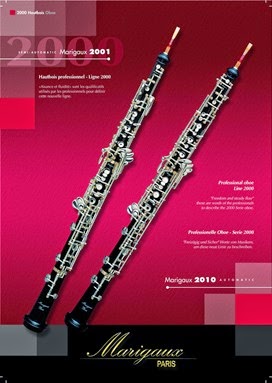
| Familiarity breeds comfort, NOT contempt! Someone recently asked me a question “knowing that I’m a big fan of Marigaux”. I found this funny because in one Blog post for IDRS 2013 ( ), I said I favoured Fossati and recently Marigaux’s representative thought I was dead-set on getting a Dupin! The truth is that I am a big fan of several instrument makers, especially after having tried them at IDRS 2013. So now, my “short-list” of choice makers (in alphabetical order) is Bulgheroni, Dupin, Fossati, Ludwig Frank, Marigaux, Mönnig, Püchner and Rigoutat. It is true that, for many reasons, if I could get a Dupin Imperial or Mozart (and afford it), you can bet your boots I would jump on the opportunity! Who could resist such intricate woodwork on the most exclusive instrument? On the other hand, completely by chance, there is one maker to which I have been more exposed than the others... When I started at le Conservatoire de Montréal in 1985, my teacher played a Marigaux, the same instrument he had brought back from Paris 20 years earlier… interesting that his sound and expressiveness had a big reputation in the French-Québécois circles… So when I started wondering if, perhaps, a different instrument might help with my complaints, the idea of trying Marigaux came strongly. Over the years, I have played on maybe two dozen Lorées from the very old to brand new, but also nearly one dozen Marigaux of various ages. This has allowed me to become very familiar with Marigaux and appreciate their qualities |  | L'habitude donne la confiance! Quelqu'un m'a récemment posé une question "sachant que je suis friand de Marigaux." J'ai trouvé ça comique étant donné un article blogue pour IDRS 2013 ( ) qui dit que j'étais sur le point de choisir Fossati et dernèrement le représentant de Marigaux croyais que je suis vendu mordicus à Dupin! La vérité est que j'admire un nombre de fabricants, après les avoir essayé à IDRS 2013. Alors à ce point, je peux établir une "courte-liste" (en ordre alphabétique) de mes marques favorites: Bulgheroni, Dupin, Fossati, Ludwig Frank, Marigaux, Mönnig, Püchner et Rigoutat. C'est vrai que, pour plusieurs raisons et si je pouvais me le payer, je ne manquerais pas l'occasion de mettre la patte sur un Dupin Impérial ou un Mozart... difficile de résister à de tel sculpture du bois et l'instrument le plus exclusif sur terre? Mais de l'autre côté de la médaille, tout-à-fait par hazard, il y a un fabricant auquel j'ai été plus exposé que les autres. Quand j'ai commencé le Conservatoire de Montréal en 1985, mon prof. jouait d'un Marigaux, le même qu'il avait rapporté de Paris 20 ans plus tôt…. intéressant que son timbre et expressivité était fort réputées au Québec. Donc quand j’ai commencé à me demander si un changement d’instrument pourrait m’aider contre mes plaintes, l’idée de Marigaux m’est venu fortement. A fil des années, j’ai joué environ deux douzaines de Lorées incluant les très âgés et les flambant-neufs, mais aussi environ un douzaine de Marigaux de divers âges. Ceci m’a permi de me familiariser avec les belles qualités de Marigaux. |
| Who plays what over here? The Marigaux 901 model has been a choice instrument in all parts of the world outside North-America. Tradition says that Lorée evolved to suit the American Scrape (might need some research in IDRS journals to verify if that is really accurate). I do believe that American scrape is probably much better to make a Lorée play well and dependably in the North-American aesthetic. Interestingly enough, Marigaux has also kept a presence here, from New-York to Las Vegas and from military bands to the opera hall; yes, these people I know personally do indeed play Marigaux with American scrape reeds! In Canada, Marigaux was the instrument played by one of my oboe inspirations: the late Cynthia Steljes (God rest her soul) from Quartetto Gelato. It is also making a comeback in Québec city where the very cold winters (much worse than Ottawa, which is colder than Moscow!) crack instruments like crazy: Marigaux Altunoir or those with synthetic top-joints only are very well appreciated by students and professionals alike. | Cynthia Steljes–Marigaux 901 | Qui joue quoi par ici? Le Marigaux 901 est l’instrument de choix en dehors l’Amérique du Nord. Généralement on dit que Lorée eut évolué avec le grattage des Anches à l’américaine (il faudrait fouiner les documents de l’IDRS pour vérifier). Je veux bien croire que le grattage à l’américaine doit améliorer la fiabilité de la justesse et du timbre sur un Lorée pour l’esthétique nord-américaine. Mais il est intéressant de noter la présence continue de Marigaux ici de New-York à Las Vegas, à partir des musiques militaires aux salles d’opéra; oui, les hautboïstes Marigaux que je connais personellement utilisent bel-et-bien des anches américaines! Au Canada, Marigaux était l’instrument de choix d’une de mes grandes inspirations, feu Cynthia Steljes (que Dieu garde son âme) de Quartetto Gelato. Marigaux redevient l’instrument de choix à la ville de Québec où les hivers bien plus froids qu’Ottawa (à son tour plus froid que Moscou!) font fendre les instruments. Marigaux Altunoir au corps supérieur ou entier sont fort appréciés des étudiants et professionels. |
| Do they all play the same? Over the past few years, I have tried maybe half a dozen Howarth XL’s and one thing really impressed me: regardless of the city (and climate) I was in, they all seemed to play the same, and that ranks very high marks from me. In contrast, Lorée is well known for needing to try many before finding the right one. I never felt the need to exchange my first Lorée for a newer one: they all have their faults and qualities and I consider it a matter of give-and-take. I have been told by some professionals that you also have to try several Marigaux to find the right one; I have also been told that they are praised for their dependability. In my personal opinion, I agree with both positions. The different Marigaux I have tried had their own personalities and they can “blow” differently: this is absolutely a good thing, in my opinion, because different people with different body builds will be looking for these differences. On the other hand, they ALL have impressed me for their extreme reed friendliness (flawless tuning and stability on almost any reed, even English Horn reeds in the oboe) and clear definition of all the notes. I have read some comments on the Internet that the Marigaux 901 has not changed since 1980 and their representative explained to me that the 901 model is essentially the same instrument since as far back as they can track the company. But because all Marigaux are made by hand, from beginning to end (apart from some obvious and necessary tools) under the guidance by performersof the highest stature, it does get periodically tweaked for both mechanics and sound/tuning qualities almost non-stop. Therefore, it has remained essentially the same instrument for well over 50 years, but has also evolved to stay in touch with changing professional needs. |
  | Jouent-ils tous pareils? Depuis quelques années, j’ai essayé une demi-douzaine de Howarth XL : la chose qui m’impressionne vraiment est qu’ils semblent tous jouer pareil, indépendemment de la ville (et du climat). Par opposition, Lorée a la réputation qu’il faut en essayer plusieurs avant d’en trouver un bon. Je n’ai jamais ressenti le besoin de changer mon premier Lorée pour un neuf: ils ont tous leurs points forts et faibles, alors change pour change, je préfère le mien. Quelques professionnels m’ont dit qu’on doit aussi essayer plusieurs Marigaux avant de trouver le bon; je me suis aussi fait dire qu’ils sont appréciés pour leur fiabilité. Mon expérience confirme les deux points de vue. Les Marigaux individuels ont chacun leur “personalité” propre et ils peuvent “souffler” différemment: à mon avis, ceci est excellent parce que chaque personne avec ses propres caractéristiques physiques pourra trouver de quoi de mieux approprié. À l’inverse, TOUS les Marigaux m’ont impressionné par leur tolérance extrême aux anches (justesse et stabilité fiable avec presque n’importe-quelle anche de hautbois, d’amour ou même cor anglais) et une définition claire de toute les notes. J’ai lu des commentaires comme quoi le Marigaux 901 n’a pas changé depuis 1980 et leur représentant m’a expliqué que c’est effectivement le même instrument que depuis le début de la marque. Mais puisque chaque Marigaux est fait à la main, du début à la fin (hormis l’outillage qui va de soi) sous les conseils de d’interprètes du plus haut calibre, l’instrument subit continuellement des améliorations mécaniques et pour le son. Alors l’instrument est essentiellement le même depuis plus de 50 and tout en évoluant sans cesse pour répondre aux exigences professionnelles. |
| A recent (repeated) experiment: A friend in Ottawa, Jeremias Gramcko (fellow amateur oboe enthusiast) has 2 Marigaux, 3 Cabarts (from when that was a professional grade independent maker) a full-Conservatoire Linton and some really rare antique English Horns. His two Marigaux 901 are a regular Conservatoire and a special automatic with a 2nd octave key that can be enabled or stopped. I visited him a few times to compare my Lorée with all his instruments, using all my reeds, including English Horn and d’amore reeds. The latest visit was on a weekend of bad weather day when I was tired, with a twinge developing in my neck giving me a headache. PERFECT day to test an instrument: if the instrument makes it easy to play in such bad conditions, then it is really great! Well, the results were clear, the Lorée and Cabarts all had their usual “caprices” (quirks), sounding nicely only on great reeds. On anything but excellent reeds, they had very unstable notes (flop up and down in the middle of a crescendo/diminuendo). They also had stuffy notes, different notes depending on the reed. The two Marigaux, however, both played beautifully in tune. By this, I mean that some reeds were just too short and others just too long, so sometimes A=440, sometimes A=425 and sometimes A=455. BUT, the octaves, the fifths etc. were all in tune with each-other across the whole range! It did not matter which reed I used (wide, narrow, soft cane, hard cane, bright or warm sounding, even d’amore and EH), there were never any stuffy notes, and the note-center remained very stable in all dynamics. Changing the reed does change the tone colour and with embouchure, I was able to bend the note sharp or flat, but the note itself would always remain centered. It should be noted that this friend bought a full-Conservatoire Linton because he makes reeds (American scrape) for beginners, and he found it nearly impossible to tell which reeds were under par on his Marigaux! The instrument does not play instead of me and a bad reed remains a bad reed – in fact, some buzzier reeds sounded better in my Lorée. I fully respect those who prefer Lorée (after all, Bart Schneemann, Hansjörg Schellenberger and many American great names certainly command admiration), I just find Marigaux much more of a helpful ally in performing to the fullest of my soul (as do Nicholas Daniels, Johnathan Kelly, Louise Pellerin and a seemingly endless list). |   | Expérience récente (et répétée): Un ami à Ottawa, Jeremias Gramcko (camarade amateur passionné du hautbois) possède 2 Marigaux, 3 Cabarts (du temps que c’était calibre professionnel) un Linton système conservatoire complèt et quelques cor anglais atiques très rares. Ses deux Marigaux 901 comptent un à 2e clef d’octave et un automatique doté d’une 2e clef d’octave alternative. Je suis allé le visiter a quelques reprises pour comparer mon Lorée à ses instruments, utilisant toutes mes anches. La dernière visite était une fin-de-semaine de mauvaise météo et j’étais fatiqué avec des tensions dans le cou causant des maux de tête. PARFAIT pour faire le test: si l’instrument me rend le jeu facile en de telles conditions, alors il est excellent! Les résultats sont clairs: le Lorée et les Cabarts ont tous leurs caprices habituelles, ne sonnant bien qu’avec les meilleures anches. Avec des anches moins que parfaites, les notes instables habituelles (pivotent d’un quart de ton vers le haut ou le bas au milieu d’un crescendo/diminuendo). Ils ont aussi des notes congestionnées, notes différentes selon l’anche. Les deux Marigaux, par contre, jouaient parfaitement juste. Par ceci, l’anche pouvait produire La=440, 425 ou même 455, MAIS les octaves, les quintes etc. restaient en accord entre-eux sur toute la tessiture! L’anche choisie (large, étroite, roseau dur ou mou, même pour htb. d’amour ou cor anglais) ne changait rien, jamais aucune note congestionnée et le centre de la note restait stable avec toute nuance et articulation. Changer l’anche change effectivement le timbre et je suis cable de “plier” la note vers le haut ou le bas, mais la note elle-même reste toujours centrée. Il est à noter que mon ami a acheté le Linton parce qu’il fait des anches (grattage américain) pour des débutants; il a trouvé presqu’impossible de détecter les moins bonnes anches sur son Marigaux! L’instrument ne joue pas à ma place et une mauvaise anche reste mauvaise… au fait, quelques-unes de mes anches les plus nasillardes sonnaient mieux sur mon Lorée. Je respecte bien ceux qui préfèrent Lorée (après tout, Bart Schneemann, Hansjörg Schellenberger et tant d’excellents américains méritent l’admiration), mais je trouve que Marigaux rend simplement la vie plus facile et me permet d’exprimer en toute aise (opinion partagée par François Leleux, Domenico Orlando, Louise Pellerin et semble-t-il d’innombrables autres). |
| Sacrifice Comfort and Expressive Range? I have never found any reason to exchange my 1985 Lorée for a new one (or a few other makers not mentioned here), because every one I have ever played, if the reed(made worse by hot-damp weather), embouchure and air flow are not just right (made worse by hot-damp weather), the note will often “flop” sharp or flat on its own in the middle of a long tone (less so for one or two Royals, but not absent) – that is, I can control it by playing my dynamics and articulations with much less emphasis. Most people I know (advanced students, passionate amateurs and professionals) have been therefore advising for years me to make reeds that barely crow, which forces me to blow less than my comfort level and also reduce my range of dynamics and articulation….. but no maker on my short list I have tried impose no such restriction, so why reduce my expressive ability and make myself uncomfortable playing? | Choose reed for sound goals. | Sacrifier le confort et l’expressivité? Je n’ai jamais cru utile d’échanger mon Lorée de 1985 pour un neuf (ou même queleques autres fabricants pas mentionnés ici), parce que chaque autre que j’ai joué, si l’anche, l’embouchure et le souffle ne sont pas parfaitement à point (rempiré par la météo), la note bascule d’un quart de ton vers le haut ou le bas de son propre accord au beau milieu d’un son filé (un peu moins pire pour les Royals, mais pas absent). Je suis bien capable de les contrôler en modérant la portée des nuances et articulations. Plusieurs professionnels et étudiants avancés me conseillent de faire des anches qui crient (“crow”) à peine, ce qui m’oblige à souffler moins fort que ce qui m’est confortable et ce qui réduit mon expressivité… mais aucun instrument de ma liste courete que j’ai essayés ne m’imposent aucune telle restriction, alors pourquoi réduire mon potentiel et me rendre inconfortable en jouant? |
| Conclusion: This was just one experience among many over the past few years. They have all satisfied my benchmarks to confirm what I discussed here ( ) that the reed, the instrument and the musician form a three-way partnership. First impressions on my short-list (and others) from IDRS 2013 () were certainly encouraging. I have had more with Marigaux, so a certain level of comfort and trust has been established. Oboists I know (from Facebook and other places) who play Dupin, Püchner, Fossati and Frank/Mönnig attest of the same satisfaction, so I’m confident that IDRS 2014 will confirm my first impressions.I have to admit it, I can be a snob: I really like the idea of exclusivity, so to become a very rare North-American player of Dupin or Püchner or Bulgheroni or Fossati - especially the instruments with really fancy looking woodwork – that is a very appealing idea. But asTong Cui from Innoledy remarked, I don’t want to change instruments every couple of years just to get to know them, I want to buy one with the confidence will make me happy for the next 30 years. All I can say for now is that time and time and time again, Marigaux, made it a real jot to play with a more pleasant sound and much less effort. | | Conclusion: Ceci n’était qu’une expérience parmi d’autres depuis quelques années. Elles ont toutes satistisfaites tous mes étalons à confirmer ce que j’ai discuté ici ( ) : que l’anche, l’instrument et la personne forment un triple partenariat. Mes premières impressions à IDRS 2013 () sont certainment encourageants. J’ai eu plus d’expérience avec Marigaux, alors un certain niveau de confort et de confiance s’est établi. Des hautboïstes que je connais (via Facebook et autres) qui jouent Dupin, Püchner, Fossati et Frank/Mönnig attestent de la même satisfaction, alors je suis confiant que IDRS 2014 confirmera mes premières impressions.Je dois admettre être un peu snob parfois : j’aime bien l’exclusivité, alors devenir un très rare joueur en Amérique du Nord de Dupin, Püchner, Bulgheroni ou Fossati – surtout ceux avec un travail du bois stylisé – est une idée attrayante. Mais comme Tong Cui de Innoledy a remarqué, je ne veux pas changer d’instruments à chaque deux ans pour apprendre à les connaître; j’en veux un avec la confiance qu’il me rendra heureux pour les prochains 30 ans. Tout ce que je puisse dire pour l’instant est que coup après coup après coup, Marigaux m’a rendu la vie très facile et agréable à jouer avec un timbre plus plaisant (et sans effort). |
| BUT ….. I really want an Oboe d’Amore! Seeing that I am now capable of playing reasonnably in tune and with expression on my Lorée, maybe I should focus on that? AAAARRRRGGGHHHH! This is still really tough. Again, I’ll have to try everything again at IDRS 2014 and make my decision when I can figure out my priorities more clearly. | | MAIS….. Je veux vraiment un htb. d’amour! Étant donné que je suis maintenant capable de suis raisonnablement juste et avec expressivité sur mon Lorée, peut-être puis-je enfin viser cela? AAAAHHHHH! La question est décourageante. Encore une fois, je devrai tout essayer à IDRS 2014 et prendre ma décision lorsque je le pourrai plus clairement déterminer mes prioriés. |


